


This week’s video transcript summary is here. You can click on any bulleted section to see the actual transcript. Thanks to Granola for its software.
Editorial
Venture Capital is Transforming: It Has to Reimagine AI Every Few Weeks
This week’s video is mostly about AI. Andrew and I recorded it earlier this week. But as he is traveling this is a good week for my writing to be about venture capital.
AI refuses to sit still.
Every few weeks, the frame changes. A model gets better. A company raises a round that would have looked impossible a year ago. A frontier lab turns into a platform. A data center becomes a strategic asset. A robot, drone, biology tool, coding agent, or math result makes the last mental model feel too small.
That is why this week I want to look at AI through the eyes of venture capital.
Not because venture is the whole story. It is not. Workers, cities, energy grids, universities, militaries, regulators, public markets, and families all have a stake in what happens next. But venture is the part of the system whose job is to fund constant reinvention before the rest of society has agreed what the new thing is.
That job has become both harder and more important.
AI is no longer a software category. It is a civilization category event. It is beginning to reshape robotics, defense, biology, finance, commerce, manufacturing, education, media, and the public markets themselves. It is also moving at a speed that makes consensus investing especially dangerous. By the time a theme is easy to describe, the next version of it is already forming.
Venture exists for that kind of uncertainty.
The basic venture bargain is simple and brutal. Most investments will fail. A few will work. The very largest winners have to pay for everything else. See Alessandra Caggiano’s essay about that.
Every serious venture investor knows this. The point is not to be right most of the time. The point is to own enough of the exceptional companies when they arrive.
That sounds obvious, but it matters because the AI cycle is testing the bargain at unusual scale.
Look at what is happening around us. OpenAI is reportedly preparing to file confidentially for an IPO. SpaceX has filed with a prospectus that bundles launch, Starlink, X, xAI, AI data centers, Starship, and eventually orbital compute into a single controlled-company story. Cerebras has turned inference speed and memory bandwidth into a public-market narrative. Blackstone and Google are financing TPU capacity as infrastructure. Anthropic is reportedly paying SpaceX $15 billion a year for access to Musk’s data centers. OpenAI is selling Guaranteed Capacity to enterprises and offering YC startups $2 million of model tokens in exchange for equity exposure.
That is not just a product cycle. It is a capital cycle. It is civilizational to venture investors. They sink or swim on playing in these waters.
The companies at the center of AI need money for models, chips, energy, data centers, talent, distribution, deployment teams, regulatory strategy, and, increasingly, physical infrastructure. The old software venture model was cleaner. Build the product, find distribution, raise capital, expand margins, go public or sell. The new model is heavier. AI companies may need to look like cloud providers, semiconductor buyers, defense contractors, research labs, systems integrators, and media platforms at the same time.
Concentration is a feature
That is why concentration is not a bug in this market. It is part of how the system works. Up until now I have been critical, pointing out the challenges it represents for early stage investing. But on reflection, if liquidity can be large and fast (and the IPO filings suggest it might) then there may be returns from concentration that can fund the next decade of venture capital.
The Fund CFO piece this week makes the point plainly. Venture is concentrated, but not dead. A large share of the dollars is going into a small number of very large rounds, especially around AI and infrastructure. That can look unhealthy if you expect venture dollars to spread evenly. But venture has never really worked that way. The returns are concentrated because the outcomes are concentrated.
The question is whether the concentration is thoughtful.
Series B is one place to look for the answer. Seed rounds can be about imagination. Series A can still be about early proof. By Series B, the market is asking whether the company can become legible to growth capital. Does the product matter? Is the market large enough? Can the team recruit? Can the company finance the next stage? Can it become one of the few companies that pays for the whole portfolio?
Rob Hodgkinson’s State of Venture work is useful here because it shows where that judgment is landing. SignalRank’s announced 2026 Series B investments are heavily weighted toward AI, with defense, robotics, and fintech making up much of the broader concentration. That is not random enthusiasm. It is capital trying to identify where intelligence becomes infrastructure, where software becomes physical capability, and where the next large public-market stories might come from.
AI, robotics, defense, and bio are the obvious places to watch because they change the world directly. They do not merely produce better dashboards. They change labor, manufacturing, war, medicine, logistics, energy demand, and national competitiveness. That is exactly the kind of change venture is supposed to fund before it is comfortable.
The best outcomes then recycle capital back into the system.
This is the part people outside venture often miss. A SpaceX, an OpenAI, a Stripe, a Databricks, or a future AI-robotics-bio giant does not only enrich its earliest investors. If it goes public, returns capital, creates liquidity, and gives employees and funds realizations, it helps refill the system that funds the next generation of seed and Series A companies. The outliers are not separate from the ecosystem. They are how the ecosystem pays for its mistakes and starts again. And because of the 2020, 2021, 2022 deployments with no outcomes, the liquidity crisis is large and real. We may be seeing the solution play out.
So - mea culpa - concentration is not automatically bad. It can be dangerous, of course. Crowded trades can become foolish. Mega-rounds can hide weak economics. Public-market narratives can outrun reality. But concentration around genuine infrastructure shifts can also be exactly how the market builds the next layer.
SpaceX and xAI are a good example of the tension.
Om Malik’s read of the SpaceX prospectus is useful because it brings the fantasy back to economics. Starlink is not just a story about rockets. It is a broadband business with real revenue, real operating income, and a huge amount of installed network capacity. That cash engine makes it possible to tell a much larger story about Starship, V3 satellites, AI infrastructure, Mars, and orbital compute. Public investors are being asked to buy both the present business and the future ‘myth’. (according to Om). Maybe a future plan?
That is venture logic taken public.
A real business supports a much larger claim on the future. Most such claims will disappoint. A few will become the platform on which the next decade is built.
The same logic is now showing up in compute. OpenAI’s Guaranteed Capacity turns model access into reserved infrastructure procurement. The YC token deal turns compute into startup financing. Tomasz Tunguz’s pricing piece shows the subsidy phase ending as capex and margins matter again. Blackstone’s TPU cloud and Anthropic’s reported Colossus commitments show AI capacity becoming a contracted industrial asset. Cerebras shows that public investors will underwrite specialized AI infrastructure if the story and the economics are strong enough.
This is why seed and Series A may be attractive right now. These investments represent a basket from which future concentrated plays will emerge.
Generally when concentration moves later, early capital can become more interesting. If the largest funds and public-market buyers are focused on the companies that have already become legible at Series B and beyond, then seed and Series A investors get to do what venture is supposed to do: find the next weird thing before it is obvious. That does not make it easy. It may make it better. Of course Sequoia, Andreessen, General catalyst and others are also investing earlier and with less of a filter than ever. So it is a very competitive early stage landscape.
Early stage managers have to ask what does AI make newly possible? Which workflows collapse? Which physical systems become programmable? Which scientific processes accelerate? Which defense capabilities get rebuilt around autonomy? Which biology companies become data and model companies? Which teams can use agents to do work that previously required a much larger organization? Tomasz Tunguz is a good example.
Most answers will be wrong.
That is fine. They are supposed to be.
The discipline is not to avoid failure. The discipline is to make sure the failures are small enough and the winners are large enough. As Alessandra points out, Venture is a power-law business because innovation is a power-law process. The world does not change evenly. It changes when a small number of companies make a new behavior, market, or infrastructure layer possible.
That is also why this week’s work and agency pieces still matter. Chamath’s software-reset argument is really a warning about what happens when agents replace low-end SaaS workflows. Vas’s Forward Deployed Engineering guide explains the labor model that follows: audit the workflow, build evals, deploy inside existing systems, and start with the smallest useful unit of autonomy. Dan Shipper’s Every essay adds the lived version. Andy Hall’s Free Systems classroom piece pushes it one step further: evals are not just an enterprise deployment tool, they are a civic skill for students and citizens who need to interrogate models rather than surrender judgment to them. Tomasz Tunguz adds the interface layer: headless systems do not eliminate UI; they make many interfaces possible, some disposable and some worth keeping. Automation does not simply erase expert work. It floods the world with cheap competence and increases the value of people who can frame problems, judge outputs, build harnesses, and decide what matters now.
Startups will be built around that shift.
Some will sell agents. Some will sell infrastructure. Some will sell the deployment layer. Some will use AI, robotics, defense technology, or bio to build companies that look nothing like SaaS. Some will fail because the models improve too fast. Some will fail because the incumbents absorb the feature. Some will fail because the customer was never real. A few will become enormous because they understood the new shape of work before everyone else did.
That is the point.
Venture capital is not supposed to wait until the future is settled. It is supposed to fund the argument.
The public unease around AI is real. The Wall Street Journal’s AI rebellion story captures something important. People are worried about jobs, children, data centers, power bills, fraud, surveillance, and whether the future is being built around them rather than with them. Ken Griffin’s comments at Stanford make the labor question concrete. Richard Murphy’s response to Standard Chartered’s language about lower-value human capital makes the distribution problem explicit.
Venture cannot ignore that. If AI creates abundance while making people feel disposable, the politics will become hostile. If the technology reorganizes work, then the financing system also has to help build companies that preserve agency, create new kinds of work, and make the benefits visible.
That is not philanthropy. It is good investing.
The best companies do not merely exploit a transition. They make the transition usable. They turn capability into products, trust, distribution, and social permission. In this cycle, that may matter as much as the model itself. It is one reason I grimace at Anthropics antics on price-changes and alienating some of its customers.
AI needs to be reimagined every few weeks because the frontier is moving that quickly.
Venture capital needs to fund constant innovation because no central planner, incumbent, or committee can know in advance which version of the future will work. But this is not random, good early stage investors tend to be able to do it repeatedly.
Most investments will fail. The big winners will pay for everything. Series B shows that the market is deploying thoughtfully into the places where intelligence is becoming infrastructure. Concentration is natural when the outcomes are concentrated.
Contents
Editorial
Essays
From Open Source Software to Open Source Strategy - Bill Gurley
Silicon Valley keeps misreading China’s role in tech - Lex Zhao
AI is Enabling Atoms, not just Bits - Scott Hartley
AI
The American Rebellion Against AI Is Gaining Steam - The Wall Street Journal
OpenAI Is Preparing to File for an IPO Very Soon - The Wall Street Journal
Microsoft’s AI reboot is creating a new inner circle around Satya Nadella - Ashley Stewart
The Rocket That Runs on Broadband - Om Malik
OpenAI to invest in YC startups using $2 million worth of tokens; here is what it means - ETtech
The Unsustainable Subsidy - Tomasz Tunguz
Chamath Warns of Software Market Reset: AI Disrupts Enterprise - Guillermo Flor
After Automation - Dan Shipper
An army of citizens building evals - Andy Hall
Plastic User Interfaces - Tomasz Tunguz
An OpenAI model has disproved a central conjecture in discrete geometry- OpenAI
Cerebras’ $60B IPO: Slowly, then All at Once - Latent Space
Citadel CEO Ken Griffin Says AI Agents Now Automating High-Skilled Finance Jobs - VINnews
Are People Just “Lower-Value Human Capital”? - Richard Murphy
SpaceX’s Limitless Ambition : An AI Conglomerate - Tomasz Tunguz
Venture
Everything is seed - Post Round
The System Map - Alessandra Caggiano
#341: Venture Is Concentrated, But Not Dead - The Fund CFO
Top Series B sectors - Rob Hodgkinson
Regulation
Infrastructure
Blackstone will create a new TPU cloud in a joint venture with Google - Google
OpenAI Guaranteed Capacity - OpenAI
Anthropic is paying $15 billion a year for access to Elon Musk’s data centers - Andrew J. Hawkins
From BYD to Xpeng, memory chip crunch squeezes China’s automakers - Gloria Li and Cissy Zhou
Clouded Judgement 5.22.26 - The Neocloud Boom - Jamin Ball
Biology
What comes after AI: the $200B peptide opportunity - Guillermo Flor
Interview of the Week
Don’t Retire, Rewire - Andrew Keen with Michael Clinton
Startup of the Week
Cowboy Space Corporation - Packy McCormick
Post of the Week
Essays
From Open Source Software to Open Source Strategy
Author: Bill Gurley Published: May 9, 2026

Open source has become a corporate strategy weapon, not just a software development model. Bill Gurley says the smartest companies use it to neutralize stronger rivals, commoditize expensive inputs, align whole industries around shared standards, and avoid being taxed by closed platforms.
The killer detail is IBM’s bill for this shift. Red Hat, HashiCorp, and Confluent alone took more than $50 billion of acquisition capital as open source moved from hacker culture into enterprise infrastructure. Gurley then extends the pattern through Android, Open Compute, autonomous vehicles, cloud, China, and AI: when a company or country is behind, openness can turn the leader’s advantage into a shared commodity.
The AI section is the sharpest edge. Chinese open-weight models are improving quickly, while the leading American frontier labs are mostly closed. If Washington treats open models as a national security problem, the U.S. could protect its closed incumbents while the rest of the world standardizes on Chinese open infrastructure.
Read more: Source
Silicon Valley keeps misreading China’s role in tech
Lex Zhao | Rest of World | May 19, 2026 | Tags: China, AI, Supply-Chain, Talent, Geopolitics
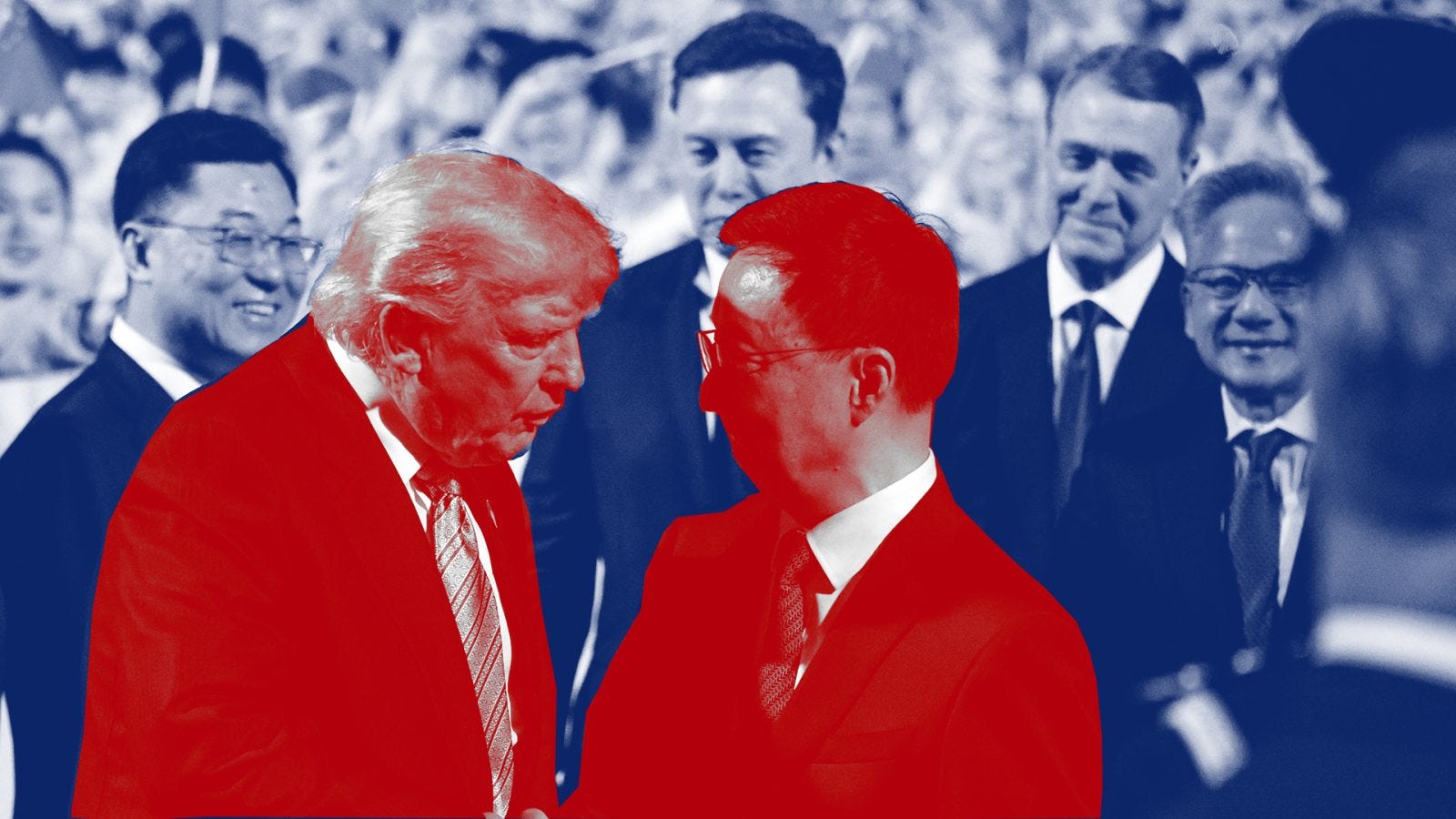
Lex Zhao argues that Silicon Valley’s China conversation has drifted too far from the way its most important companies actually operate. The public story is decoupling and confrontation. The operating story is Apple manufacturing at scale, Tesla selling and building in China, Nvidia trying to keep Chinese AI on an American stack, Meta earning billions from Chinese advertisers, and U.S. companies still depending on Chinese talent, customers, and suppliers.
The killer detail is the physical AI stack. Zhao points to China’s control over rare-earth refining, lithium batteries, permanent magnets, electric motors, and the manufacturing base behind drones, robotics, EVs, and embodied AI. If the next AI wave is hardware-heavy, pretending China is outside the equation becomes less like prudence and more like self-deception.
The useful distinction is not engagement versus naivete. It is optionality versus binary thinking. Apple, Tesla, and Nvidia have diversified without disengaging. That is the more realistic model for founders and investors: reduce single-country dependency, but do not confuse geopolitical theater with a supply-chain, talent, and market strategy.
AI is Enabling Atoms, not just Bits
Scott Hartley | Ideas | May 21, 2026 | Tags: AI, Robotics, Space, Manufacturing, Venture, Physical AI
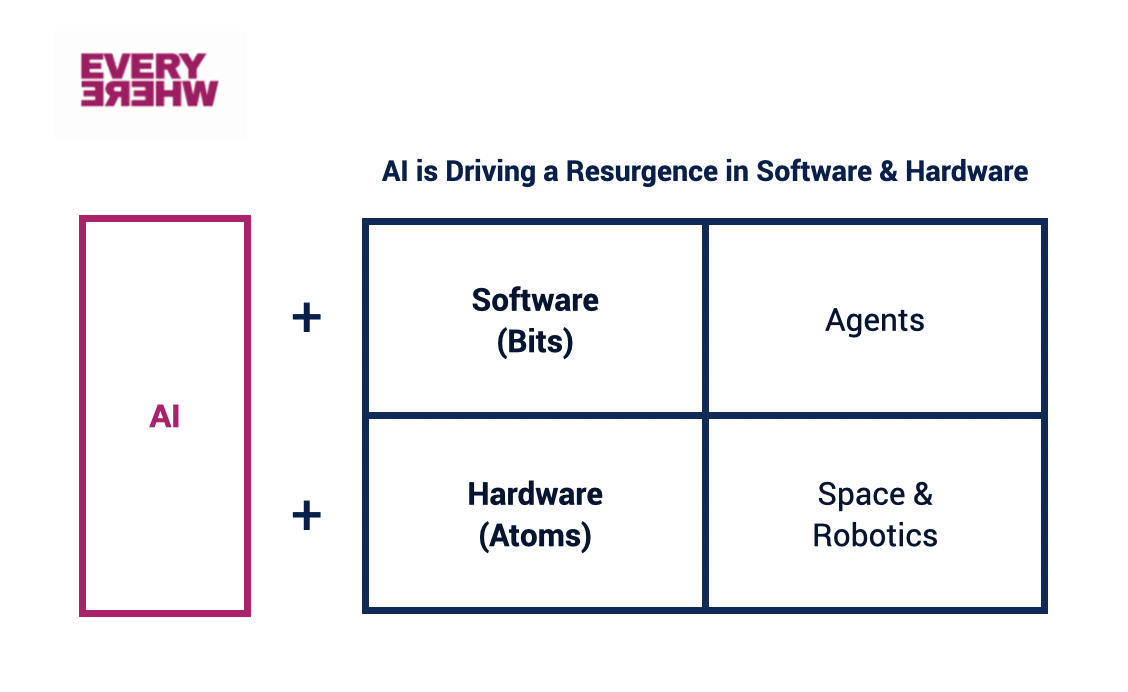
Scott Hartley argues that the AI story is too narrowly framed around software. If a robot is hardware enabled by intelligence, and space is a remote robotic system, then the next value-creation wave is as much about atoms as bits: aerospace, defense, energy, robotics, manufacturing, and industrial automation.
The useful move is connecting AI to the 2026 hardware resurgence. Hartley points to talent spinning out of Tesla, SpaceX, and similar companies, the perceived defensibility of physical products, and AI-driven gains in prototyping and complex component manufacturing. In his telling, AI does not only make SaaS easier to copy. It also makes hard-tech companies faster to build.
That belongs in this week’s venture frame because it explains why robotics, defense, space, and bio keep showing up beside AI. The model layer is the accelerant. The market opportunity is increasingly physical.
AI
The American Rebellion Against AI Is Gaining Steam
The Wall Street Journal | AI Backlash | May 18, 2026
The Wall Street Journal catches the political turn in the AI cycle: public resistance is hardening just as the industry keeps promising that adoption will rise once people see the benefits. The opening scene is useful because it is simple. Eric Schmidt told University of Arizona graduates that AI’s transformation would be larger, faster, and more consequential than previous technology waves, and the line was met with boos.
The article pulls together several sources of anger that are now converging: data centers worsening electricity-price pressure, workers fearing job losses, parents worried about education and child mental health, and polls showing broad concern about AI. That makes the backlash less like a single Luddite mood and more like a multi-constituency politics of cost, labor, children, and local infrastructure.
The TWTW relevance is that AI deployment is entering the consent phase. Technical progress and capital spending are no longer the only limiting variables. If AI becomes associated with higher power bills, threatened jobs, school disruption, and emotional harm to kids, then regulation, local opposition, elections, and corporate adoption risk all start to matter as much as benchmarks.
OpenAI Is Preparing to File for an IPO Very Soon
The Wall Street Journal | AI Capital Markets | May 20, 2026 | Tags: AI, OpenAI, IPO, Capital Markets, Microsoft
The Wall Street Journal reports that OpenAI is preparing to confidentially file for an IPO in the coming days or weeks, possibly as early as Friday, May 22. Reuters, which said it could not independently verify the Journal’s report, separately reported that OpenAI is working with Goldman Sachs and Morgan Stanley on a draft prospectus and is aiming to go public as early as September.
The timing matters because it follows the Musk verdict almost immediately. One legal attack on OpenAI’s for-profit restructuring failed, and the company now appears to be moving toward the public-market process that would expose more of its economics, governance, Microsoft relationship, infrastructure commitments, and cash needs.
The TWTW relevance is institutional. OpenAI is no longer only a frontier lab, a consumer product company, or a strategic Microsoft partner. It is becoming a capital-markets object at enormous scale. That makes the agency story sharper: the company whose systems increasingly mediate work, search, coding, commerce, and creativity may soon have public shareholders, quarterly expectations, and a prospectus that has to describe what the AI boom actually costs.
Microsoft’s AI reboot is creating a new inner circle around Satya Nadella
Ashley Stewart | Business Insider | May 22, 2026
Microsoft’s AI strategy is no longer just a product and capex story. It is becoming an operating-model reset inside one of the world’s most complex software companies. Business Insider reports that Satya Nadella has dismantled the traditional senior leadership structure and replaced it with smaller, flatter groups intended to move faster and pull technical decision-making closer to the CEO.
The strongest detail is organizational, not rhetorical. Nadella now runs an engineering leadership group of roughly 35 engineering and product leaders, reviews AI metrics weekly, and has set up a separate Copilot leadership team around Charles Lamanna, Jacob Andreou, and Ryan Roslansky. BI also reports that Nadella meets with Azure cloud infrastructure leadership every two weeks and has been studying startup operating models because Microsoft’s size has become a disadvantage in the AI race.
The TWTW relevance is direct. If AI is forcing Microsoft to rebuild the way power flows through the company, then the platform shift is not confined to model labs or consumer apps. It is changing how incumbents allocate authority, measure progress, and decide which leaders are close enough to the work.
The Rocket That Runs on Broadband
Om Malik | On my Om | May 21, 2026 | Tags: AI, SpaceX, Starlink, IPO, Broadband, Infrastructure
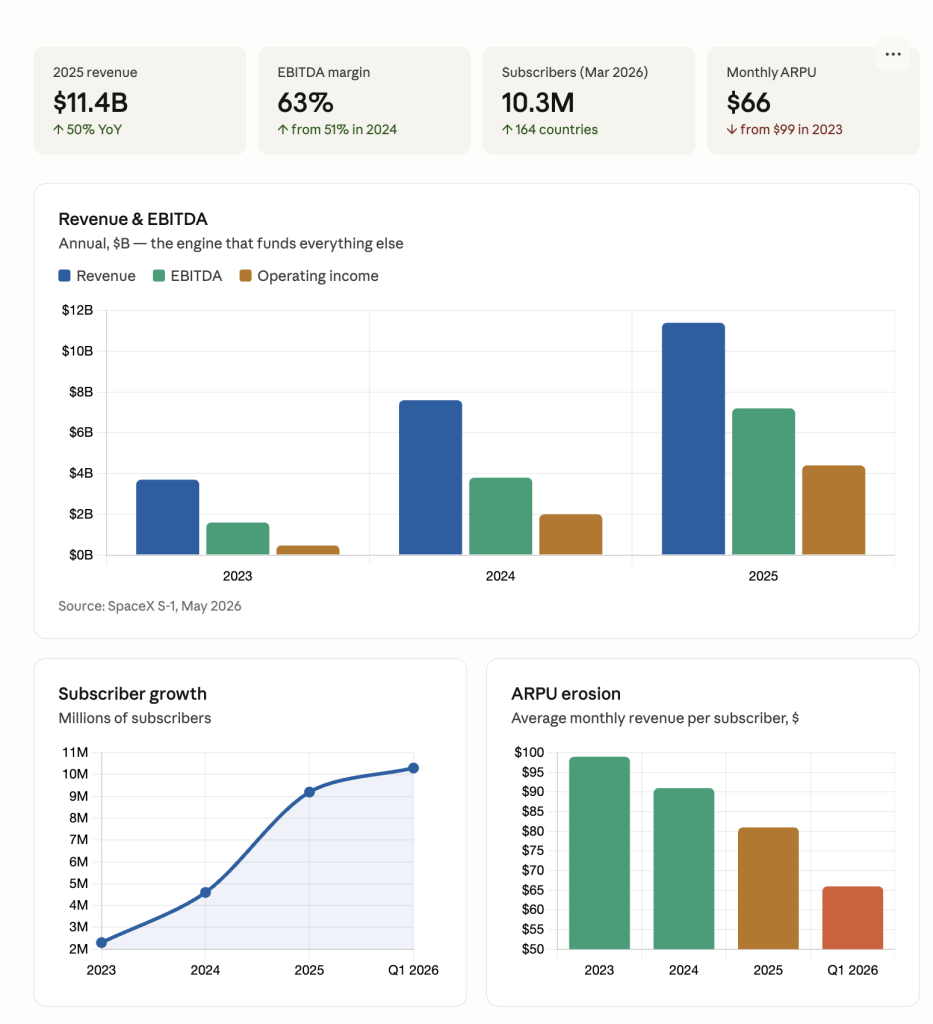
Om Malik reads the same SpaceX IPO document from the other direction. His argument is that the imaginative wrapper only works because Starlink looks like a real broadband business: $11.4 billion of 2025 revenue, $4.4 billion of operating income, $7.2 billion of adjusted EBITDA, 9.2 million subscribers at the end of 2025, and 10.3 million subscribers by March 31, 2026.
The killer detail is network utilization. Om says Starlink had more than 600 terabits per second of installed capacity by the end of 2025, roughly comparable to all global public internet traffic in 2017, while subscribers drew around 1.4 terabits per second on average. That low utilization helps explain the margin. The valuation still depends on Starship and V3 satellites lifting capacity, especially upload, without ARPU falling too far as growth shifts toward lower-paying consumer markets.
The TWTW relevance is that it grounds the SpaceX, xAI, and Starlink fantasy in network economics. If the IPO is a story about AI and orbital infrastructure, the cash engine is broadband. The governance question is whether public investors are buying a communications utility, an AI capex platform, a Mars story, or all of them inside one controlled company.
OpenAI to invest in YC startups using $2 million worth of tokens; here is what it means
ETtech | The Economic Times | May 20, 2026 | Tags: AI, OpenAI, Y Combinator, Startups, Tokens, Venture
ETtech reports that OpenAI is offering $2 million worth of model tokens to every startup in the current Y Combinator batch. Sam Altman framed the move as “tokenmaxxing”: giving startups enough OpenAI usage capacity to accelerate product development, internal workflows, and experiments that would otherwise be constrained by API cost.
The sharp detail is that this is not a grant. YC general partner Tyler Bosmeny said startups will exchange equity for the tokens, reportedly through a SAFE whose ownership stake will be set in a future funding round. The Information’s estimate, cited by ETtech, is that the package could give a startup access to nearly one trillion GPT-5 tokens, depending on model mix, caching, and usage.
The TWTW relevance is that compute access is becoming startup financing. OpenAI can use tokens as distribution, customer acquisition, ecosystem lock-in, and venture exposure at the same time. That sits beside the IPO story and Guaranteed Capacity: OpenAI is packaging AI capacity for enterprises, founders, and public markets as a financial instrument, not merely a developer utility.
The Unsustainable Subsidy
Tomasz Tunguz | Theory Ventures | May 20, 2026 | Tags: AI, Model Pricing, Unit Economics, Infrastructure, Venture
Tomasz Tunguz compares model pricing across Google, OpenAI, and Anthropic and reads the divergence as strategy. Google has increased prices but remains the low-cost player. OpenAI’s flagship pricing looks as if it was subsidized for a period before rising again. Anthropic has held some prices steady while reducing the price of its most powerful models.
The sharp detail is Tunguz’s inference about market phase. Price cuts make sense when cash is plentiful and share matters. Price increases make sense when cash is tight, margins matter, and capex keeps setting records. That makes model pricing a live signal about the economics behind the AI race, not just a developer procurement line item.
The TWTW relevance is that this completes the week’s capacity-market story. OpenAI’s IPO path, YC token financing, and Guaranteed Capacity all treat model access as something financeable, reservable, and strategically scarce. Tunguz adds the pricing layer: the subsidy era cannot last forever, and AI adoption will be shaped by who can afford reliable access when models, power, chips, and margins all have to clear the market.
Chamath Warns of Software Market Reset: AI Disrupts Enterprise
Guillermo Flor | LinkedIn | May 18, 2026 | Tags: AI, SaaS, OpenAI, Enterprise Software, Consulting
Guillermo Flor pulls a useful Chamath Palihapitiya clip into the week’s software-market story. The claim is not just that AI will pressure software multiples. It is that the low end of SaaS is structurally exposed because agents do not need another lightweight dashboard, project manager, CRM, reporting tool, or workflow app. If the user can describe the outcome and the agent can build or run the workflow, the old seat-based model loses its natural buyer.
The sharp detail is OpenAI’s Deployment Company. OpenAI announced a more than $4 billion, majority-owned deployment business with 19 partners and agreed to acquire Tomoro, bringing roughly 150 forward-deployed engineers and deployment specialists into the unit. That makes enterprise AI look less like software procurement and more like services, workflow redesign, and systems integration around a model supplier.
The TWTW relevance is the collision between SaaS and consulting. The low end gets automated. The mid-market point solution gets squeezed. At the high end, trust, data access, distribution, and deployment relationships become the moat. OpenAI’s risk to consultancies is not only that it sells the model. It can learn the workflow, install the system, own the customer relationship, and capture part of the services margin.
Forward Deployed Engineering 101
vas | X Article / Varick Agents | May 20, 2026 | Tags: AI, Forward Deployed Engineering, Enterprise AI, Agents, Evals
Vas, founder and CEO of Varick Agents, writes a practical guide to the AI forward-deployed engineer role. The core claim is that if intelligence is becoming commoditized, the advantage moves to where and how it is used. The FDE becomes the person who sits with the customer, understands the workflow, writes code against unfamiliar systems, and explains the business impact to non-technical decision makers.
The sharp detail is the three-part operating model: audit, evals, and deployment. The audit maps real workflows and decides what should be automated. The eval phase proves the agent is working by tracing the human process and measuring against strong examples. Deployment avoids ripping out existing systems, builds APIs over the current data layer, and starts with the smallest useful unit of autonomy before giving the agent more power.
The TWTW relevance is that this turns the OpenAI Deployment Company story from a corporate announcement into a labor-market and operating-model shift. Enterprise AI is not just model access. It is workflow redesign, eval design, trust-building, and controlled autonomy inside existing infrastructure. That is why FDEs are becoming valuable: they are the bridge between frontier model capability and actual institutional change.
After Automation
Dan Shipper | Every | May 21, 2026 | Tags: AI, Agents, Automation, Work, Human Judgment

Dan Shipper writes from inside Every, an agent-heavy company that uses Codex, Claude Code, and internal agents across coding, writing, design, customer service, and operations. The paradox is that the company has automated everything it can, but still has more human work to do than ever. The work has changed, but it has not disappeared.
The sharp detail is the split between two modes of agent work. Some agents act like employees, handling delegated or embedded tasks such as support, proposals, digests, and metrics. The more important mode is human-agent collaboration inside tools like Codex and Claude Code, where the human sets the frame, the agent collapses part of the task, and the human judges, redirects, and extends the result.
The TWTW relevance is that this gives the agency argument an operating model. AI commoditizes yesterday’s explicit expertise, which creates floods of cheap work and visible sameness. That raises the value of framing, taste, evals, review, workflow design, and current-context judgment. The model may climb the benchmark or complete the framed task. The human still decides what the frame is and whether the result matters.
An army of citizens building evals
Andy Hall | Free Systems | May 21, 2026 | Tags: AI, Evals, Education, Agents, Civic Infrastructure

Andy Hall argues that schools should not respond to AI by trying to ban it everywhere. Instead, students should learn to build evals, turning AI into an object of study and making model behavior something they can test against their own questions, values, and use cases.
The sharp detail is from Hall’s Stanford GSB Free Systems class. Undergrads with no required coding background used Claude Code to build model-evaluation projects in one three-hour class session. The examples included ethical framing sensitivity, Brazil election knowledge, modified logic puzzles, sensitive data leakage between agents, and uneven policy enforcement across demographic prompts.
The TWTW relevance is that this is the education version of the agency argument. If agents make cheap output abundant, the scarce skill is not merely using AI but supervising it: defining the task, building the measurement harness, reading limitations, and deciding whether the system’s behavior is acceptable. That links directly to venture’s role in funding deployment, governance, and eval infrastructure, because adoption will depend on whether institutions can create people who know how to test the tools they rely on.
Plastic User Interfaces
Tomasz Tunguz | Theory Ventures | May 22, 2026 | Tags: AI, Product, User Interfaces, MCP, Enterprise Software
Tomasz Tunguz argues that headless software does not mean the user interface disappears. Salesforce can be updated without logging into Salesforce, and MCP-style integrations let English become an interface to complex systems. But AI also makes richer, task-specific interfaces easier to create on demand.
The sharp detail is the shift from one canonical app surface to many generated ones. An email summary might become audio on the go. Marketing review might become an interactive web app. Budget planning might become a spreadsheet with charts. Some of those artifacts will be temporary, but some will become semi-permanent interfaces that businesses keep and evolve.
The TWTW relevance is that this adds a product layer to the agency argument. If agents create interfaces dynamically, then value moves to the harness that controls whether the interface is correct, the knowledge system that remembers useful artifacts, and the judgment that decides which generated tools deserve to persist. AI does not make UI vanish. It makes UI plastic.
An OpenAI model has disproved a central conjecture in discrete geometry
OpenAI | Research Milestone | May 20, 2026 | Tags: AI, Mathematics, Research, Reasoning, Science
OpenAI reports that an internal general-purpose reasoning model has disproved a long-standing conjecture in the planar unit distance problem, first posed by Paul Erdos in 1946. The problem asks how many pairs of points among n points in the plane can be exactly distance 1 apart. For decades, mathematicians believed square-grid constructions were essentially optimal.
The sharp detail is that the model found an infinite family of examples that improves on the believed bound, using unexpected tools from algebraic number theory. OpenAI says the proof was checked by external mathematicians, with Tim Gowers calling it a milestone in AI mathematics and Arul Shankar arguing that current models can now generate original ideas and carry them through.
The TWTW relevance is the science and agency tension. This is the strongest version of the pro-AI case: a model contributing a frontier mathematical discovery that survives expert scrutiny. But it also reinforces the institutional point. The value is not the model alone. It is the loop of problem selection, proof generation, external checking, companion explanation, and human interpretation that turns machine output into knowledge.
Cerebras’ $60B IPO: Slowly, then All at Once
Latent Space | May 16, 2026
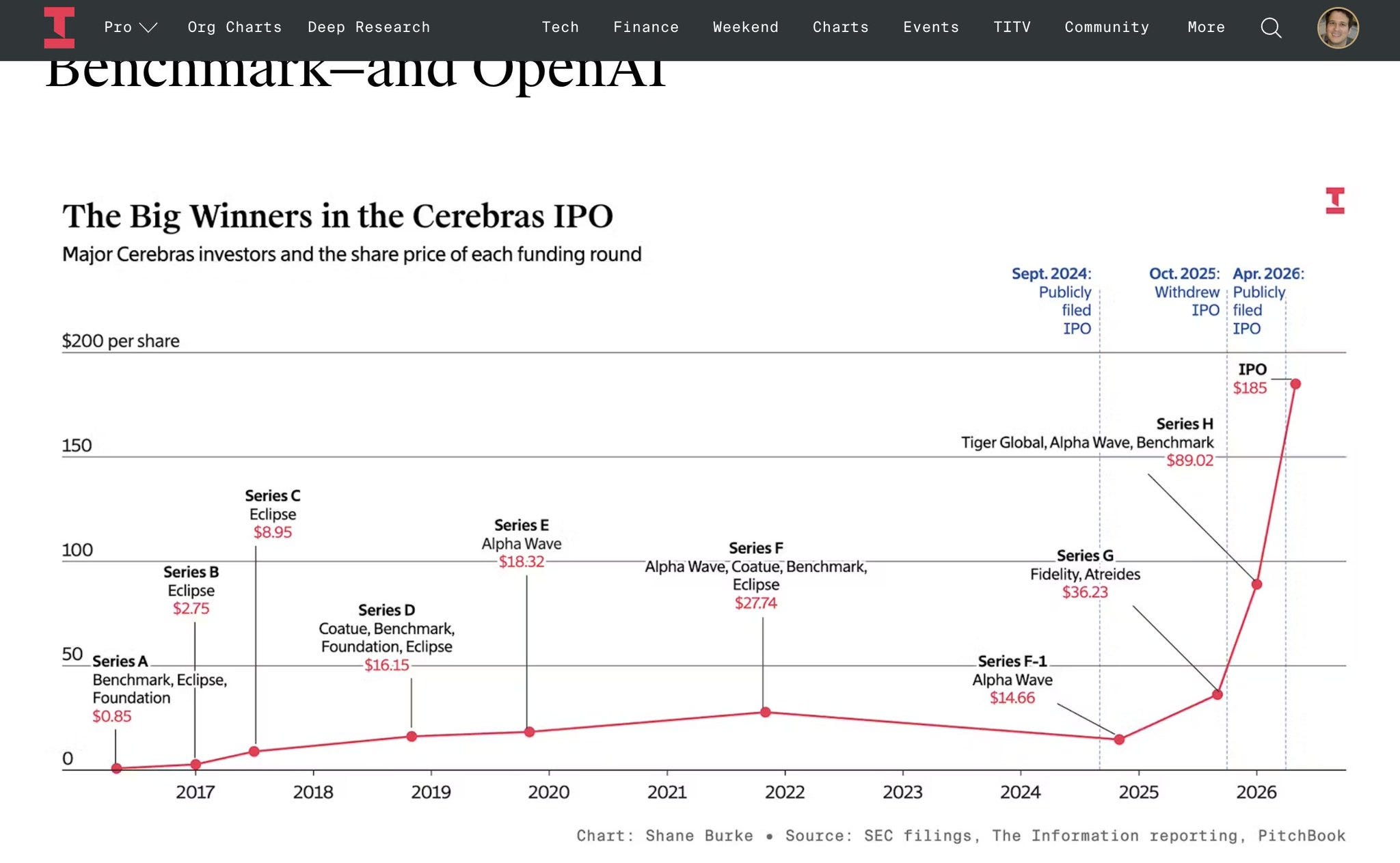
Latent Space frames Cerebras’s IPO as validation of the inference-infrastructure thesis rather than a one-off market event. As enterprise AI workloads shift from model training headlines to deployed agentic systems, latency, throughput, routing, and serving economics become product-level constraints.
The article argues that public-market appetite for this profile signals a maturing stack where infrastructure specialization now carries durable strategic value. Training scale still matters, but agents, reasoning models, and enterprise workflows make latency and throughput part of product experience. Cerebras is now public proof that investors see that shift.
Citadel CEO Ken Griffin Says AI Agents Now Automating High-Skilled Finance Jobs
VINnews | May 16, 2026
Ken Griffin’s Stanford Leadership Forum remarks make the AI jobs story harder to keep at the level of generic white-collar automation. At Citadel, he says work that once took people with master’s degrees and PhDs in finance weeks or months is now being done by AI agents in hours or days.
The killer quote is Griffin saying, “These are not mid-tier white collar jobs. These are like extraordinarily high skilled jobs being, I’m going to pick a word, automated by agentic AI.” He also said he went home one Friday “fairly depressed” after seeing man-years of work compressed into days or weeks inside Citadel’s own walls.
The pull is that agentic AI is not only replacing routine workflow at the edge of the economy. It is reaching into the analytical core of elite finance, where firms already have the data, incentives, and technical talent to operationalize it. That makes Citadel a live example of the AI jobs narrative moving from speculation to observed institutional behavior.
Are People Just “Lower-Value Human Capital”?
Author: Richard Murphy Published: May 19, 2026
Richard Murphy argues that Standard Chartered’s planned AI-driven job cuts reveal the political economy underneath white-collar automation: the central question is not whether AI can replace work, but who captures the gains when it does. The bank plans to cut more than 7,800 back-office roles by 2030, yet its chief executive framed the move to investors as replacing “lower-value human capital” with financial and investment capital.
The killer detail is that Standard Chartered is not presented as a company in distress. Murphy notes that it employs about 80,000 people globally and is targeting a return on tangible equity above 15% by 2028, rising toward 18% by 2030. In his reading, the jobs are being removed because technology and management ideology make higher shareholder returns possible.
The pull is distribution. AI’s capabilities may be built on public research, educated workforces, and shared infrastructure, but the benefits can still be privatized while workers in Bengaluru, Shenzhen, Warsaw, and elsewhere absorb the loss.
Read more: Source
SpaceX’s Limitless Ambition : An AI Conglomerate
Tomasz Tunguz | Theory Ventures | May 21, 2026 | Tags: AI, SpaceX, Starlink, xAI, IPO, Infrastructure, Capital Markets
Tomasz Tunguz reads the SpaceX S-1 as the filing of an AI-era conglomerate, not just a rocket company. The numbers split the business into three very different machines: Starlink at $11.4 billion of 2025 revenue with a 39% operating margin, Space at $4.1 billion of revenue and a Starship-driven operating loss, and AI at $3.2 billion of revenue while consuming $12.7 billion of capex.
The sharp detail is that Starlink is the cash engine. Tunguz says satellite broadband grew from 2.3 million subscribers in 2023 to 8.9 million in 2025, with operating income growing faster than revenue as the network scales. That profitable broadband layer helps fund both the launch system and the AI infrastructure bet.
The TWTW relevance is the shape of the new public-market story. SpaceX is asking investors to understand launch, broadband, xAI, data centers, and eventually orbital compute as one system. That is venture logic at public-company scale: a real cash-flowing business used to finance a much larger claim on the future.
Venture
Everything is seed
Author: Aaron Harris Published: May 18, 2026
Aaron Harris argues that venture staging has blurred because the old signals used to judge companies are losing their objectivity. Metrics once helped investors distinguish early proof from later scale, but AI-era growth can jump from zero to tens or hundreds of millions so quickly that normal and exceptional are harder to separate. Technology is also less durable as a signal when new software and even advanced AI capabilities can be copied quickly. Markets and ideas are not stable anchors either, because competitors can see the opportunity and move faster than they used to.
The killer detail is the compression of startup growth itself: Harris points to companies moving from zero to $10 million in revenue in 18 months, then zero to $100 million, and even zero to $1 billion in under two years. When that becomes the benchmark, being wrong is not only costly; it becomes publicly obvious much faster.
The pull is that investors fall back to the one stage-independent variable left: founder quality. Seed logic now applies everywhere, because every round becomes a bet that the founder can keep outrunning metrics, markets, and copyable technology. That makes later-stage investing look less like underwriting a measured company and more like extending the earliest venture wager at larger scale. The implication is uncomfortable for a market that prefers clean milestones: if every round is effectively seed, then price, conviction, and reputation may matter more than the label on the financing or the spreadsheet beneath it.
Read more: Source
The System Map
Alessandra Caggiano | Invested | May 21, 2026 | Tags: Venture, Power Law, LPs, GPs, Founders, Fund Model

Alessandra Caggiano maps venture as a chain of LPs, GPs, founders, and exits, then argues that the visible structure only makes sense once you add the invisible operating belief underneath it: venture is built around power-law outcomes. The point is not merely that a few investments return most of the money. It is that everyone in the system behaves as if missing the rare outlier is more damaging than being wrong repeatedly.
The killer detail is her distinction between the power law as an observation and the power law as a worldview. LPs tolerate illiquidity because they are buying exposure to the tail. GPs pass on good 2x or 3x companies because the fund model demands something that can return the fund. Founders who take venture money enter an implicit agreement that “interesting” is not enough; the expected outcome has to be extraordinary.
The pull for this week’s issue is that this explains the rest of the Venture section. Emerging-manager conviction, private-market liquidity pressure, geographic concentration, Series B legibility, and AI infrastructure funding are all different expressions of the same system map. Venture is not designed to be right often. It is designed to survive being wrong long enough to own a small number of companies that change the distribution.
#341: Venture Is Concentrated, But Not Dead
The Fund CFO | May 21, 2026 | Tags: Venture, Funding, Mega-Rounds, AI, Infrastructure, Liquidity
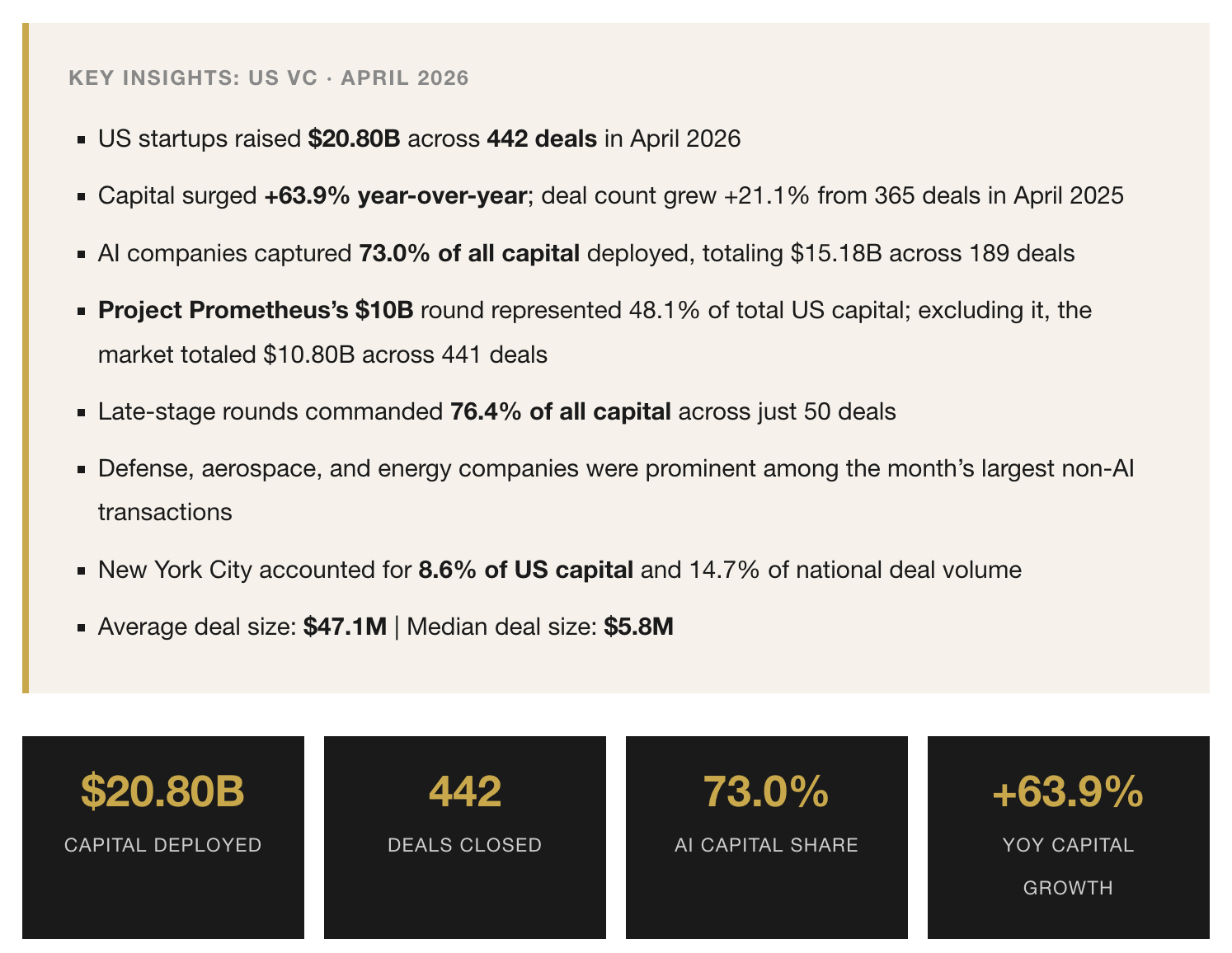
The Fund CFO uses April 2026 U.S. venture funding data to make a useful distinction: the market is still heavily concentrated, but it is not frozen. Reported April funding reached about $20.8 billion across 442 U.S. deals, up sharply year over year, but one roughly $10 billion Project Prometheus round represented nearly half of the month’s total.
The killer detail is what happens after removing the outlier. Excluding that one mega-round, April still produced about $10.8 billion of funding and roughly 441 completed deals. The headline market is being shaped by AI, infrastructure, compute, semiconductors, and defense. The underlying market is more selective, but it still functions.
The pull for this week’s issue is that venture has split into multiple markets at once. One market funds AI infrastructure and frontier-scale platforms with huge rounds. Another market still funds Seed, Series A, and more conventional company formation, but with tighter selection. For funds, the challenge is not just access to the hot categories. It is reserves, ownership retention, longer holding periods, and turning concentrated private-market value into eventual DPI.
Top Series B sectors
Rob Hodgkinson | The State of Venture | May 21, 2026 | Tags: Venture, Series B, SignalRank, AI, Defense, Robotics, FinTech
Rob Hodgkinson uses SignalRank’s 2026 Series B activity to show where top-ranked growth investors are actually concentrating. AI is the dominant theme, but the important pattern is broader: AI, defense, robotics, and FinTech account for more than 85% of SignalRank’s announced 2026 Series B investments, 13 out of 15 deals.
The killer detail is the transition from weirdness to legibility. Seed and Series A can still reward ideas that look strange before the market catches up. By Series B, the company has to become legible to later-stage and pre-IPO capital. That does not mean boring; Cowboy Space, Saronic, Skild AI, Northwood Space, Mercor, and Together AI are not boring companies. It means the category has to map to where growth investors believe public-market demand will exist.
The TWTW relevance is that the venture market is underwriting the physical and institutional version of AI. Capital is not only chasing copilots. It is moving toward defense systems, edge data centers, robotics, space infrastructure, AI-native financial workflows, and the hard assets that make autonomy deployable. The sectors backed at Series B now are likely to become the IPO candidates and public-market narratives later.
Regulation
Inside the next phase of OpenAI’s political strategy
Brendan Bordelon | Politico | May 20, 2026
Politico’s story turns AI regulation from a Washington stalemate into a state power strategy. Brendan Bordelon reports that OpenAI’s Chris Lehane is pursuing what he calls “reverse federalism”: lobbying major states to pass similar AI safety laws so that California, New York, Illinois, and eventually other states effectively create a national standard while Congress remains stuck.
The sharp detail is that the preferred laws give OpenAI regulatory stability without much new liability. Politico says the California and New York rules were shaped with substantial input from OpenAI lobbyists, while Illinois is now considering a bill OpenAI endorsed that adds mandatory third-party audits on top of transparency and reporting requirements. The politics are not only legislative. A pro-AI super PAC network funded partly by OpenAI President Greg Brockman has spent more than $1 million against the lead sponsor of New York’s AI law, while other tech PACs backed by Meta and Google have spent $10.7 million in California races.
For TWTW, this belongs beside the agency theme. The public wants AI governed, Congress is slow, and frontier labs are trying to make the regulatory harness themselves.
Governor Newsom signs first-of-its-kind executive order to prepare workers and businesses for potential AI disruption
Office of Governor Gavin Newsom | Governor of California | May 21, 2026
California is turning AI workforce disruption from a talking point into a state operating problem. Governor Gavin Newsom’s new executive order directs state agencies, labor experts, economists, universities, and industry leaders to build policies for workers, small businesses, and communities before AI displacement becomes visible only in layoffs.
The strongest detail is the policy menu. The order tells the state to explore severance standards, employment insurance and transition support, worker ownership models, universal basic capital concepts, expanded workforce training, and stronger tracking of hiring and payroll trends. It also calls for a new dashboard on AI’s sector-level workforce effects and recommendations within 180 days on updates to California’s WARN Act so the state can see disruption earlier.
For TWTW, this is the labor side of the AI capital cycle. If venture and public markets are financing companies that compress work, the political system will start asking who captures the productivity gains and who absorbs the shock. California is both the home of the AI boom and the jurisdiction most exposed to its labor-market consequences, which makes this order an early template for the next regulatory fight.
Infrastructure
Blackstone will create a new TPU cloud in a joint venture with Google
Google Cloud | AI Infrastructure | May 19, 2026 | Tags: AI, Infrastructure, Compute, TPUs, Blackstone, Google, Capital

Google and Blackstone are turning AI compute into a project-finance story. Blackstone is making an initial $5 billion equity commitment to a joint venture that is expected to bring 500MW of TPU capacity online in 2027, while Google supplies the chips, software, and services.
The important point is not just another cloud announcement. It is the shape of the capital stack. AI infrastructure is now large enough that hyperscaler hardware, private-equity balance sheets, power capacity, and cloud distribution are being bundled into purpose-built vehicles. Compute is becoming an asset class as much as a product SKU.
That fits this week’s thread on measurement, power, and physical constraints. The AI race is increasingly fought through energy contracts, specialized silicon, data-center siting, and financing structures. Models may be software, but the bottlenecks are becoming very tangible.
OpenAI Guaranteed Capacity
OpenAI | OpenAI | May 19, 2026
OpenAI’s Guaranteed Capacity offer turns access to frontier AI compute into a contracted enterprise input. Customers can make one- to three-year commitments to guarantee access for production systems, agents, customer workflows, and other AI products, with discounts increasing by annual commitment and spend that can be drawn down across OpenAI’s product portfolio.
The important detail is not the sales page language. It is the new shape of scarcity. OpenAI says customers can plan around guaranteed spend allocations across supported cloud providers and model families, with flexibility as demand changes. That is a different market from opportunistic API consumption. It makes AI capacity look more like reserved cloud infrastructure, power procurement, or long-term GPU access: something strategic buyers secure before competitors and internal roadmaps collide with supply limits.
The TWTW relevance is direct to this week’s infrastructure thread. Blackstone and Google are financing TPU capacity like an asset class, while OpenAI is packaging model access as a multi-year capacity commitment. The model economy is becoming a capacity market, and enterprise AI adoption will increasingly depend on who can reserve reliable compute at scale.
Anthropic is paying $15 billion a year for access to Elon Musk’s data centers
Andrew J. Hawkins | The Verge | May 21, 2026 | Tags: AI, Infrastructure, Compute, Anthropic, SpaceX, xAI

The Verge reports that SpaceX’s IPO filing puts hard numbers on Anthropic’s compute deal with Musk’s infrastructure stack. Anthropic agreed to pay $1.25 billion per month through May 2029 for access to SpaceX’s Colossus I and Colossus II AI training centers, or about $15 billion a year.
The killer comparison is scale. The annualized Anthropic payment is close to SpaceX’s entire reported 2025 revenue of $18.7 billion, while the filing says SpaceX spent $12.7 billion on AI capex in 2025 and another $7.7 billion in the first quarter of 2026. The AI division also lost $6.3 billion from operations in 2025 and $2.5 billion in the first quarter of 2026.
The TWTW relevance is that AI capacity is becoming a cross-company industrial system. Anthropic competes with xAI at the model layer but buys capacity from the Musk-controlled infrastructure layer. That is the new stack in miniature: rivals, suppliers, capital markets, power, data centers, and public-market filings all tied together by the sheer scarcity of compute.
From BYD to Xpeng, memory chip crunch squeezes China’s automakers
Gloria Li and Cissy Zhou | Nikkei Asia | May 22, 2026
The AI infrastructure squeeze is spilling out of data centers and into the physical industries that increasingly depend on advanced electronics. Nikkei Asia reports that the global memory crunch, driven by AI demand, is hitting Chinese automakers already caught in a brutal EV price war and operating on thin margins. The article turns the abstract “AI capex boom” into a supply-chain constraint for cars.
The sharpest detail is the allocation shift. Samsung, SK Hynix, and Micron are reallocating production toward high-bandwidth memory and DDR5 for AI servers, leaving auto buyers exposed to shortages and rising prices for legacy chips. Xpeng chair He Xiaopeng said the pricing process for the new GX SUV was “difficult” because memory costs absorbed profits from technical innovation. BYD raised the price of a mid-tier assisted-driving package by 21% last month, citing a sharp rise in global memory hardware costs.
The TWTW relevance is that AI’s bottlenecks are now ecosystem bottlenecks. The same memory supply going into model training and data-center buildouts is changing car margins, autonomous-driving package pricing, and the competitive dynamics of China’s EV market.
Clouded Judgement 5.22.26 - The Neocloud Boom
Author: Jamin Ball Published: May 22, 2026
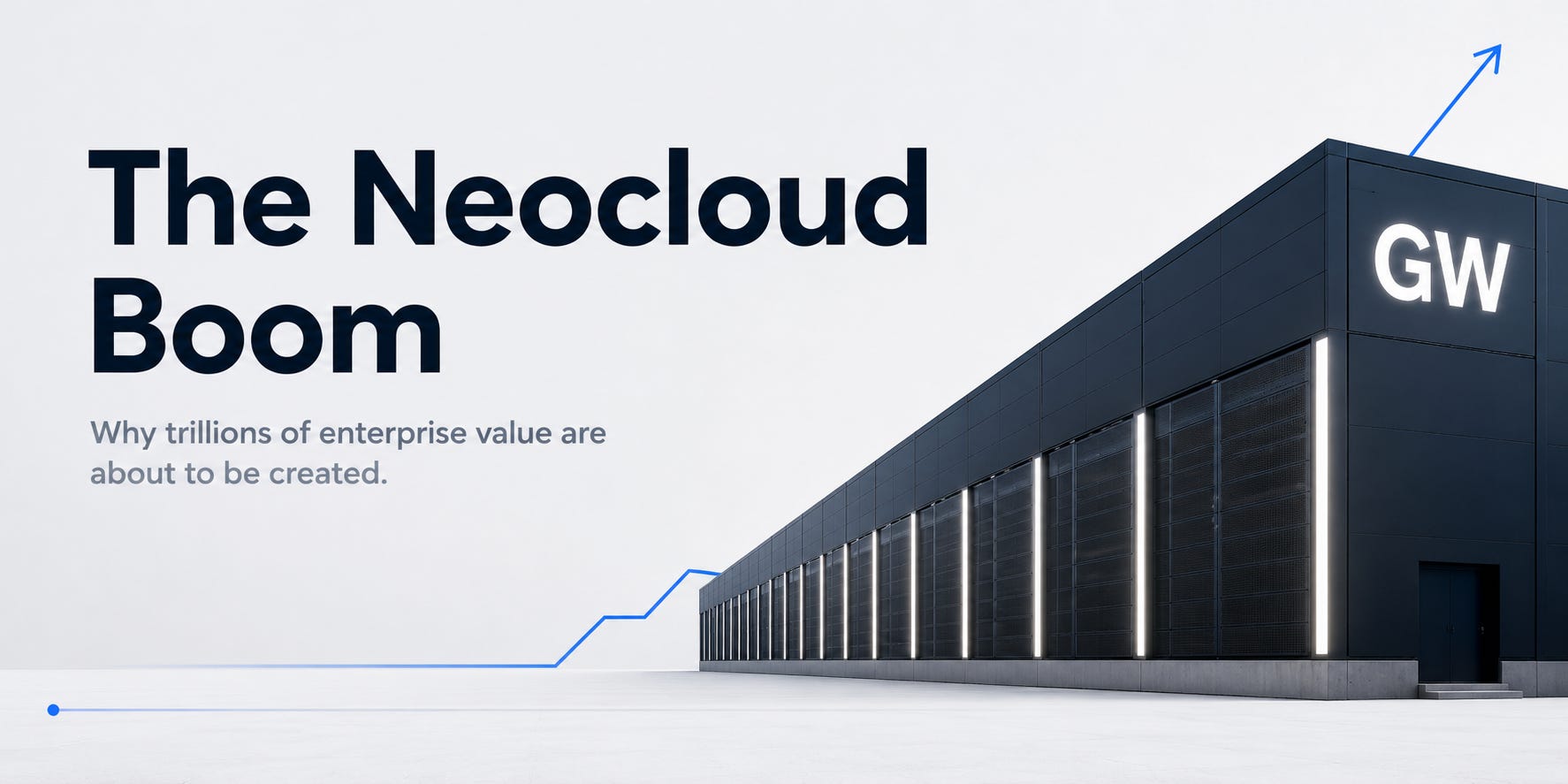
Jamin Ball argues that the AI data center buildout is creating a neocloud boom because the demand curve has become too large for the old cloud providers and financing model to absorb cleanly. He starts from reported frontier-lab capacity plans, then scales the implication: if OpenAI and Anthropic move from roughly 3 to 3.5 gigawatts of capacity at the end of 2025 toward roughly 30 gigawatts each by 2030, the broader market could require more than 150 gigawatts of new capacity over four and a half years.
The killer detail is the cost stack. Ball uses roughly $50 billion per gigawatt, with about 70% going to chips and compute, which turns 150 gigawatts into a $7.5 trillion infrastructure bill. Spread over the buildout period, that is about $1.7 trillion a year, or roughly 5% of annual U.S. GDP.
The pull is that the winners may not be only Nvidia or the frontier labs. If compute becomes the bottleneck asset, neoclouds, financiers, power providers, data center operators, and specialized infrastructure companies all become part of the AI capital markets story.
Read more: Source
Biology
What comes after AI: the $200B peptide opportunity
Guillermo Flor | AI Market Fit | May 21, 2026 | Tags: AI, Biology, Peptides, GLP-1, Drug Discovery, Startups

Guillermo Flor makes the case that peptides and GLP-1s are the cleanest near-term example of AI meeting a huge biology profit pool. Two companies sold about $90 billion of one drug class last year, and the category could reach $200 billion by 2030.
The startup angle is that the hardest remaining problems are exactly the kind of constrained search and optimization work where AI can matter: oral delivery, tolerability, manufacturing, patient matching, and discovery outside the obvious GLP-1 winners. This is not AI as a generic wrapper. It is AI pointed at chemistry, delivery, and clinical segmentation.
That fits this week’s theme because bio is where intelligence becomes infrastructure for a market that already has demand, pricing power, and measurable outcomes. If AI is moving from demos into atoms, peptides are one of the places where the commercial signal is already visible.
Interview of the Week
Don’t Retire, Rewire
Andrew Keen with Michael Clinton | Keen On America | May 18, 2026
Andrew Keen talks with Michael Clinton about longevity, retirement, and the social institutions built around a much shorter life. Clinton’s provocation is useful: retirement is a false construct created for an industrial era when far fewer people lived long enough to turn the second half of life into a mass social category.
The sharp detail is the scale shift. Clinton says the United States had about seven million people over 65 a century ago, has about 62 million today, and is heading toward roughly 80 million. That turns longevity from a personal planning issue into an institutional design problem for work, health, education, housing, media, and politics.
For this week’s issue, the interview belongs beside the AI labor discussion. If AI forces work to be reimagined every few years, longevity forces careers to be reimagined across decades. The better frame is not simply retire or be replaced. It is how people keep purpose, agency, and economic relevance when both technology and lifespan are changing the old shape of work.
Startup of the Week
Cowboy Space Corporation
Packy McCormick | Not Boring | May 16, 2026
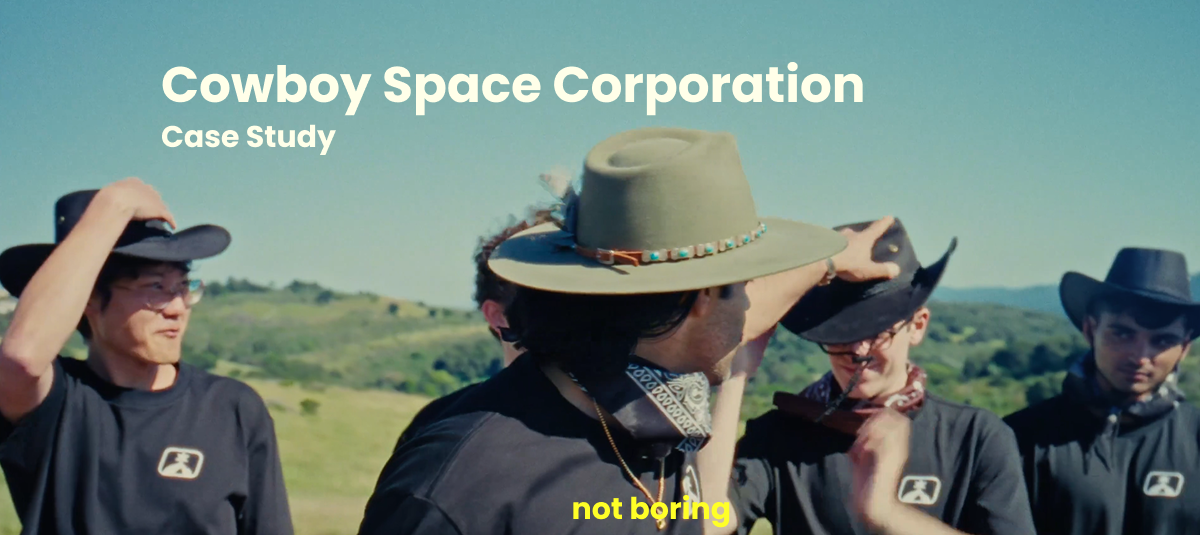
Packy McCormick uses Aetherflux’s rebrand as Cowboy Space Corporation to examine how frontier companies package ideas that would otherwise sound implausible: vertically integrated rockets, orbital data centers, space solar, optical transmission, and AI compute. The name is strange on purpose, and that is part of the differentiation.
The startup fits this issue because Baiju Bhatt’s company is chasing the physical bottleneck under AI. Cowboy Space has reportedly raised a $275 million Series B at a $2 billion valuation to build orbital infrastructure for power-hungry compute, including rockets whose upper stages can become data-center hardware in orbit.
For Startup of the Week, Cowboy Space is a venture-capital stress test. It is almost absurdly capital-intensive, technically hard, and narrative-heavy. But if AI demand keeps turning power, cooling, chips, launch, and geography into constraints, then the weird companies trying to move compute off planet are no longer pure science fiction. They are part of the same argument about where intelligence becomes infrastructure.
Post of the Week
The AI revolution today is as deep as 60y old paradigm change
peter kris quoting Andrej Karpathy | X | May 16, 2026

A reminder for new readers. Each week, That Was The Week, includes a collection of selected essays on critical issues in tech, startups, and venture capital.
I choose the articles based on their interest to me. The selections often include viewpoints I can't entirely agree with. I include them if they make me think or add to my knowledge. Click on the headline, the contents section link, or the ‘Read More’ link at the bottom of each piece to go to the original.
I express my point of view in the editorial and the weekly video.


