The Rich Getting Richer
Can Venture Backed Growth be Shared?
This week’s video transcript summary is here. You can click on any bulleted section to see the actual transcript. Thanks to Granola for its software.
Editorial
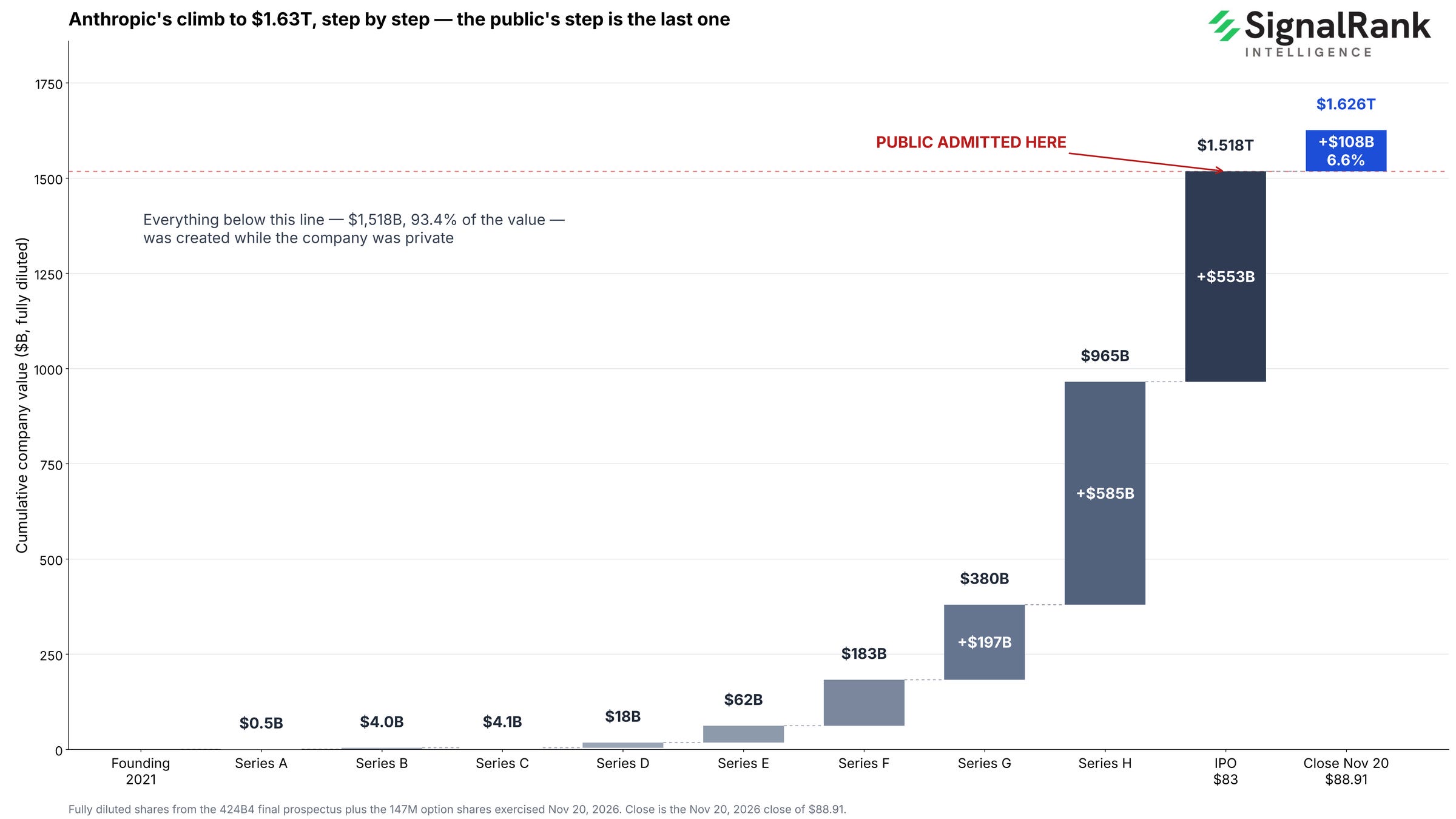
Yesterday, Anthropic opened its doors to public investors at $83 a share. They bought $81.34 billion of shares in the base offering. Today the underwriters exercised their option on another 147 million shares, taking the total to about $93.5 billion. More than $90 billion committed to a company whose future is still being built.
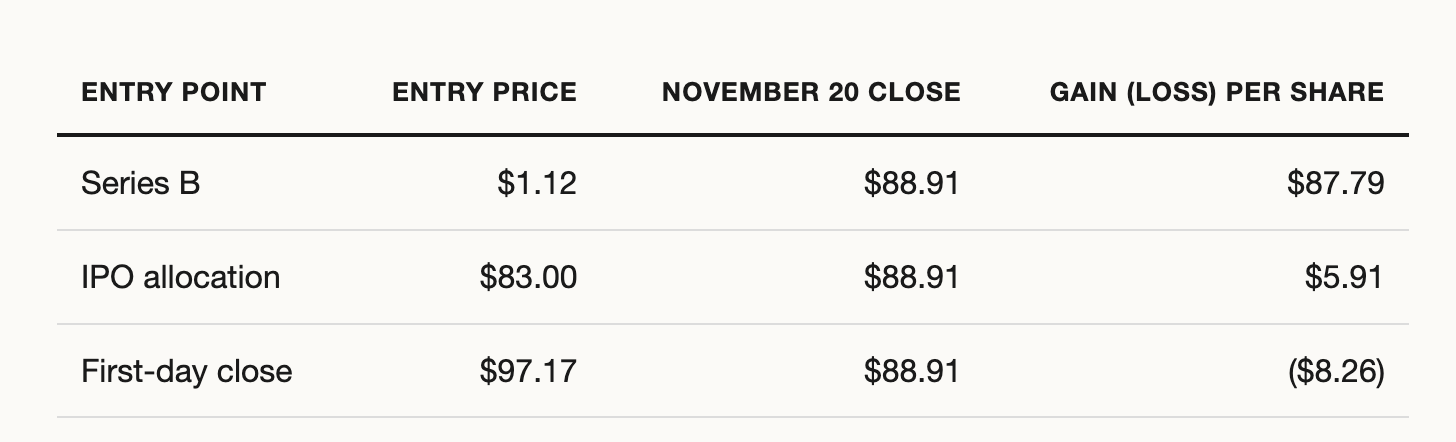
Four years earlier, Series B investors entered at a blended $1.12 a share. The eventual total for that financing was $980 million. Almost $1 billion.
Today, at a closing price of $88.91, the difference is straightforward.
Series B investors have a gain of $87.79 per share. Investors who received shares at the IPO price have a gain of $5.91. Anyone who bought at Thursday’s first-day close of $97.17 is down $8.26.
The same company. The same closing price. Very different participation in its growth.
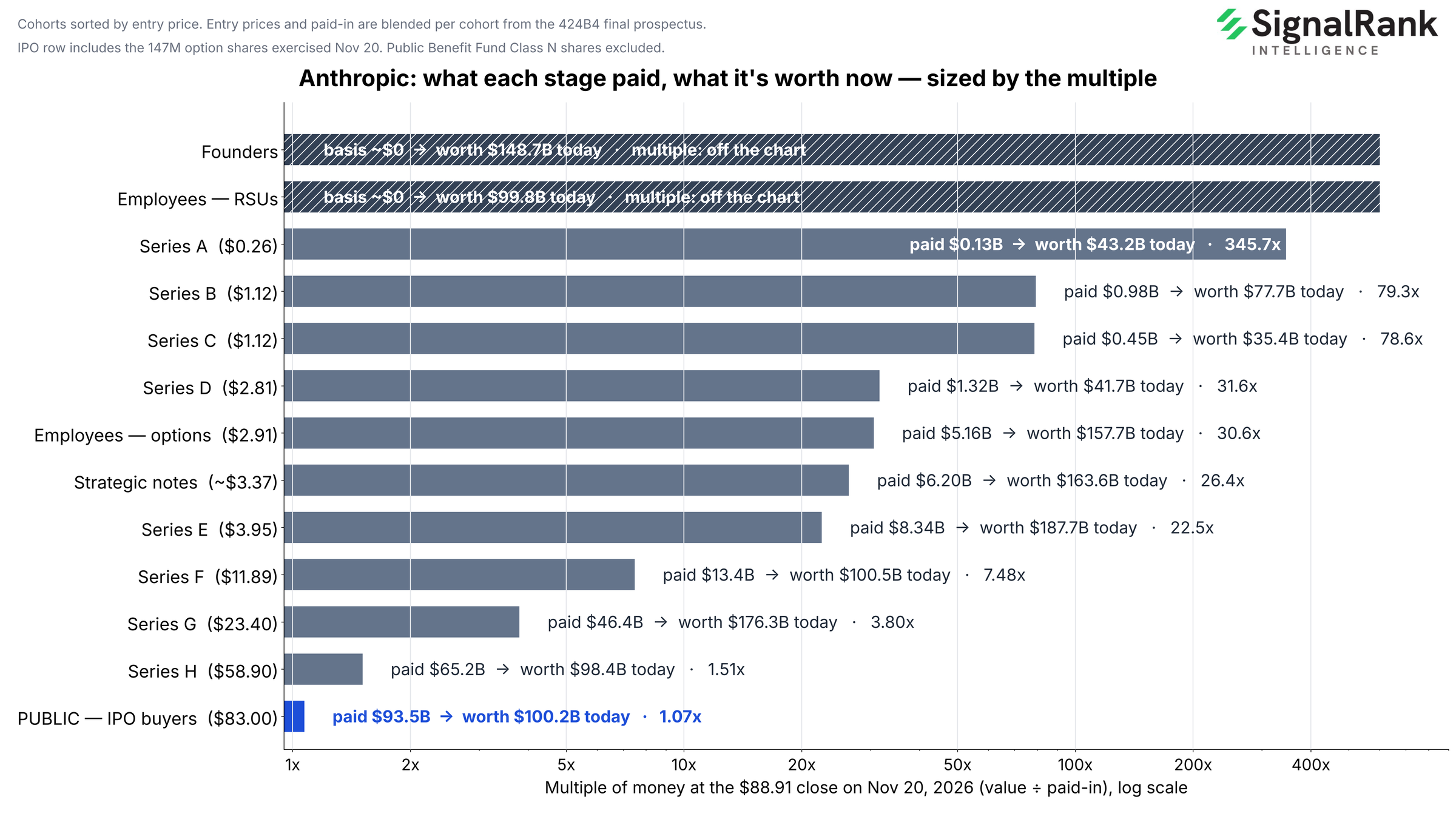
In dollars, the roughly $980 million of Series B capital is now worth about $76.8 billion more than it cost. The $93.5 billion that came in through the IPO is worth about $6.7 billion more.
This is good news. It should be good news for more people.
If you read this newsletter you know that I am optimistic about Anthropic. I want it to keep building, keep making intelligence more useful and keep creating value. I expect it will. An economy in which ambitious companies can grow this much is doing something important right.
The rich getting richer is not, by itself, the complaint. That is a by-product of the way venture capital works. Early entry into winners is rewarded. The question is why participation in that growth is so difficult for regular people.
The early investors did not buy a certain outcome. Series B is de-risked, but there is still risk. And $1 billion was risked. They committed capital when the company was smaller, the technology less proven and the risks greater. They waited. Their reward reflects that.
But choosing not to take an early risk is one thing. Being unable to participate in the first place is another.
Access to an IPO does not compensate for not being able to access the growth that made the IPO possible. Public investors may have plenty of upside ahead. But being optimistic about that future does not repay the lost value due to not participating earlier.
Regulation and the public
Why can’t the public buy earlier?
A major reason is regulation. Accredited-investor rules restrict participation in many private offerings, using wealth, income and specified qualifications to determine who is eligible. Exceptions exist, but they do not make a sought-after private financing broadly available to ordinary investors. Eligibility is one hurdle; actually securing an allocation is another. SEC: accredited investors.
The intention is good - investor protection. The consequence is that people are protected from losing money early and also shut out when an early investment succeeds.
ANT finally becoming available does not solve that problem.
Change the system
Public Venture Vehicles change how the public can own high-growth venture companies at an early stage. The recent rise of closed-end funds like BOT shows what is possible.
A closed-end fund that is a venture investor buys stakes in companies early. Retail investors buy shares in the vehicle. The companies stay private. Their growth becomes something the public can own. The fund enters at Series B. Owning the fund is open to all.
The public need not wait for each company to hold an IPO. It can own part of the portfolio while the businesses are still growing.
The structure solves an access problem for the public. It still requires investment judgment by the fund. It still needs real allocations made available by the companies, sensible entry prices, diversification and fees that leave the investor with a worthwhile share of the outcome.
Of course, a listed share can trade below the value of its assets. Losses remain possible. None of that defeats the idea. A Series B at over 70x gain has a lot of room to trade below value and still be a great holding.
While no fund can promise to identify the next Anthropic, a fund can own a portfolio early, before anyone knows which companies will become one. So it will need a diversified de-risked strategy.
The right to buy after a company has become valuable is not democratization. It is a way for the public to pour over $90 billion into a fully valued company and then hope for more growth. Democratization should involve access alongside early stage investors via de-risked vehicles with liquidity via listing. It should mean early entry and a share of the growth.
So after this week, let’s keep the growth. Open the ownership.
The rich get richer. Let more people into the process.
Source notes: The underwriters exercised the 147,000,000-share option in full on November 20, taking the IPO to 1,127,000,000 shares and about $93.5 billion gross, alongside a concurrent private placement of about $26.0 billion (Anthropic closing announcement). The first-day close of $97.17 is as reported by Reuters. Dollar-gain totals are approximations: $980M at $1.12 is about 875M shares, times $87.79; 1.127B IPO shares times $5.91.
Disclosure: The author has financial interests in businesses pursuing approaches discussed here. This is editorial analysis, not a recommendation of a security or investment vehicle.
Contents
News of the Week
The Key Numbers I’m Watching As Anthropic Makes Its IPO Debut - Gene Teare
Why the robots are ditching Uber - Andrew J. Hawkins
Essays
Hardware Is Software - Tomas Pueyo
What comes after AGI? - Tim Genewein
Open-source AI without Jensen - Nathan Lambert
AI isn’t replacing your job. It’s turning it into low-paid gig work - Julian Posada
Does it really matter if there’s an intelligence explosion? - Noah Smith
AI
Strategic Decision or Structural Advantage? - Tomasz Tunguz
The most misunderstood graph in AI just got a major update - Grace Huckins
How New-Look Netlify Found A Second Life - And $130M In ARR - Alex Konrad
Formal Verification - The Trust Layer for AI - Shomik Ghosh
Introducing Inkling 2 Mini - Thinking Machines Lab
Signal is Serious About Protecting Your Privacy - Meredith Whittaker
Venture Capital
Triggering Events: Impact on Private Market Valuations... - Michael A. Greeley
Portrait of the Top 100 AI Venture Capitalists - Ilya Strebulaev
Venture Capital Is the Economy’s R&D Budget, and That’s Why It Won’t Fund Your Profitable Business - Paul O’Brien
What To Measure When ARR Isn’t Enough - Kenza Zayani
What The Telecom Bust Taught Me About AI’s Debt Boom - David Spreng
Regulation
Anthropic goes public - Ella Markianos
BIS Takes on Compute Leakage - Jordan Schneider and Lily Ottinger
Outage Chaos: When Tech is too Big to Fail - Rory Mir
Infrastructure
NVIDIA Announces Financial Results for Third Quarter Fiscal 2027 - NVIDIA
Nvidia clarifies when it will - and won’t - keep financing neoclouds - Julie Bort
Mexico Risks Missing Out on AI Data Center Boom as Energy Crunch Bites - Alex Vasquez
Assessing the carbon emissions and energy consumption of US hyperscale data centres - Gianluca Guidi, Francesca Dominici, Tiziano Squartini, Callaway Sprinkle, Jonathan Gilmour, Kevin Butler, Eric Bell, Scott Delaney and Falco J. Bargagli-Stoffi
Investment Tripled, Capacity Grew 1.5 Percent: The Schedule Risk Inside Reshoring- James Erway
Startup of the Week
The Lakehouse for AI - Tomasz Tunguz
Interview of the Week
Software engineering after code becomes cheap with Satya Nadella - Gergely Orosz
Why Too Much Is Too Little - Andrew Keen with Marc Chandler
Post of the Week
Deception needs a motive, and a motive needs a soul - @summer__heidi
News of the Week
The Key Numbers I’m Watching As Anthropic Makes Its IPO Debut
Gene Teare | Crunchbase News | November 18, 2026

Gene Teare examines Anthropic’s filing ahead of its Nasdaq debut. The company says quarterly revenue reached $17 billion in Q3 2026, twelve times the prior-year figure, less than four years after Claude launched. It reports 11,900 customers spending at least $100,000 over the trailing twelve months, including more than 1,900 spending over $1 million and 250 spending over $10 million, with $6.6 million in trailing revenue per employee.
The IPO and concurrent private placement could raise $88.5 billion and value Anthropic at about $1.4 trillion. Teare sets that capital against $895.4 billion in compute purchase and lease commitments, including $447.5 billion due before the end of 2030. Anthropic already has more than $100 billion on its balance sheet and is seeking to add roughly another $100 billion through the listing and associated placement.
The filing also says Anthropic will reserve 5% of its equity for a public-good fund, with another 2% added for every 50% increase in its share price. Each founder expects to sell roughly $250 million of stock, depending on the final price. Teare says the central test is whether Anthropic can convert demand for Claude and Claude Code into a durable business while financing its compute buildout and managing risks identified in the filing, including cyber and biological misuse, unpredictable model behavior, surveillance and economic disruption. The operating and risk figures are company disclosures from the S-1.
Why the robots are ditching Uber
Andrew J. Hawkins | The Verge | November 20, 2026

Andrew J. Hawkins reports that Waymo plans to end its exclusive Uber arrangement in Austin and Atlanta in January 2028, while Serve Robotics will not renew its Uber Eats partnership after 2027. Both companies used Uber’s large customer base to introduce autonomous services, but now want more control over customer relationships, pricing and product experience as their fleets mature.
Waymo objected to Uber’s mixed-fleet model because riders requesting an autonomous vehicle could receive a human driver, and riders who did not want a robotaxi could receive one. Serve says the economics also changed: restaurant delivery platforms take 15% to 30% of an order, while Serve’s new developer API lets businesses connect directly to its fleet. Uber says Serve’s operational performance and reliability did not meet its requirements.
Uber still has autonomy agreements with more than 30 companies and expects tens of thousands of unsupervised vehicles across more than 50 cities by 2028. The article notes that Waymo may remain available through Uber on a nonexclusive basis, and its Lyft partnership in Nashville combines direct demand with outside capacity. The unresolved question is whether robot operators, marketplaces or third-party fleet owners will control the customer relationship once autonomous services become profitable.
Essays
Hardware Is Software
Tomas Pueyo | Uncharted Territories | November 18, 2026

Tomas Pueyo argues that much of hardware engineering consists of calculations that should be treated as maintained software rather than one-off spreadsheets. He quotes Boom Supersonic founder Blake Scholl, who says engineers should design algorithms capable of regenerating hardware when assumptions change. Scholl says one Boom tool lets one engineer perform work that once took 100 engineers six months and another generates 65% of an aircraft structure. Pueyo also cites a 2022 NASA paper in which AI-designed industrial parts were reported as 40% cheaper, 66% lighter and 85% faster to design than expert-designed parts.
Pueyo extends that argument from design to manufacturing. He describes a radar circuit that Casey Handmer says Claude designed, and argues that AI could reduce research, documentation, testing and other engineering costs before robotics automates more physical work. His rough model estimates that removing human costs and propagating savings through suppliers could cut 65% to 75% of costs across a manufacturing value chain, with some savings replaced by spending on inference, machinery and capital.
The article presents those estimates as a forecast, not an observed result. Pueyo says real-world testing, regulation, institutional resistance and slow robot deployment could stretch the transition over five to twenty years; a faster scenario takes one to four years. He also discloses that he is a small investor in Handmer’s company, Terraform.
What comes after AGI?
Author: Tim Genewein Published: November 19, 2026
Tim Genewein argues that human-level artificial general intelligence should be treated as one point on a continuum, not as the endpoint of AI development. He defines artificial superintelligence as a system that consistently outperforms large groups of human experts across virtually all tasks of interest, then maps four possible routes from AGI to that regime: scaling models and data, changing the underlying technological paradigm, coordinating large populations of agents and recursive self-improvement.
The essay’s central quantitative case is what Genewein calls “cognitive industrialization.” He estimates that improvements in hardware, algorithms and investment have together expanded the effective global compute stock by at least tenfold per year. If efficiency gains alone continued at roughly fourfold annually, he says a cognitive workload costing $1 billion in compute today could cost about $1,000 in ten years. Even without major gains in frontier capabilities, cheaper, faster and replicable agents could therefore transform knowledge work through scale.
Genewein also identifies limits to each path: high-quality training data may run short, larger models face diminishing returns and physical constraints, agent groups lose efficiency as coordination costs rise, and self-improvement can stall when feedback is poor. He says progress is uncertain but plausible enough to require new benchmarks, forecasts and governance institutions capable of measuring systems beyond human evaluation.
Read more: Source
Open-source AI without Jensen
Nathan Lambert | Interconnects AI | November 14, 2026
Nathan Lambert argues that Jensen Huang’s resignation is a major setback for the US open model ecosystem. Nvidia has a financial reason to prevent a few large customers from concentrating power and developing their own chips, but Lambert says Huang made open models a founder-level bet and backed them with funding and personal influence. With Nvidia now focused on stabilizing leadership, delivering to customers, and retaining talent, he expects that support to diminish.
Lambert describes the open model economy as nascent. He sees enterprise post-training and ownership of intelligence as promising, but says scarce compute and high inference margins keep open-weight models far from commoditized intelligence. Closed labs have stronger economies of scale and tighter integration across models, data centers, and chips, while Western open-model efforts still trail leading Chinese labs despite significant spending.
The article also warns that state or national regulation could target open models after a major cybersecurity incident. Lambert says the ecosystem’s benefits are difficult to measure because much of its valuable use occurs on private infrastructure, and argues that weakening it could increase concentration, reduce safety research, and slow long-term innovation. His proposed response is a genuinely frontier US open-model organization, backed by coalition building and allies among hyperscalers, while acknowledging that capital alone cannot solve the talent and execution problem.
AI isn’t replacing your job. It’s turning it into low-paid gig work
Julian Posada | Rest of World | November 19, 2026
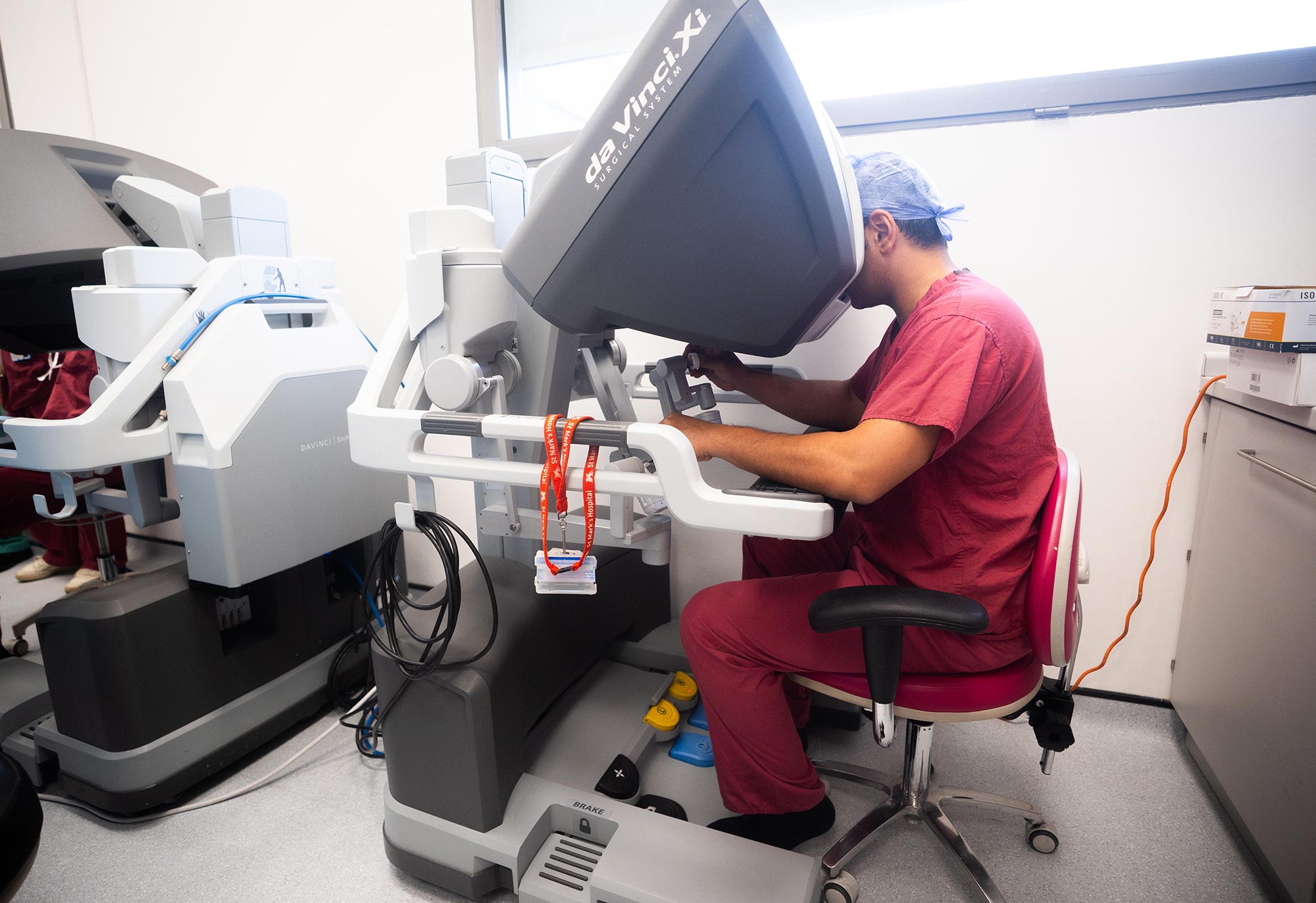
Julian Posada argues that AI training platforms are extending gig-work conditions from data labeling to physicians, lawyers and other specialists. Outlier advertised up to $180 an hour for US cardiologists to develop and assess cardiac scenarios, while offering up to $7.50 an hour for Tagalog work in the Philippines and $12.50 for Swahili work in Tanzania. Posada says higher credentials can raise the advertised rate without changing who controls task availability, payment or account access.
Drawing on six years of interviews, Posada recounts how a Venezuelan computer-science teacher and his family briefly earned useful income labeling images before tasks disappeared and their earnings fell below a weekly payout threshold. He compares that experience with reports from more recent white-collar projects where demands rose, deadlines tightened and rates fell. Outlier’s terms allow payment to be suspended during investigations and accounts to be deactivated without notice, language Posada says also appeared in the earlier Remotasks terms.
The essay cites a proposed San Francisco settlement involving workers on Scale AI platforms, where the company denies wrongdoing, and an ongoing misclassification suit against Mercor involving more than 30,000 specialists. Posada acknowledges that a cardiologist offered a three-digit hourly rate is not in the same position as a Venezuelan family; his comparison is about workers in both groups lacking control over sudden changes in rates and assignments.
Does it really matter if there’s an intelligence explosion?
Noah Smith | Noahpinion | November 20, 2026

Noah Smith reviews the dispute over whether AI can trigger recursive self-improvement. Skeptics point to short automation horizons, diminishing returns to research spending and the lack of visible acceleration, while proponents cite Anthropic’s internal research gains and the rapid move from weak arithmetic to advanced mathematics. Smith says the empirical question turns on whether ideas become harder to find faster than AI becomes better at finding them.
His argument is that the debate is a poor frame for policy. If an intelligence explosion is possible, slowing frontier progress would delay rather than prevent it, while a complete global halt is unlikely. He also argues that steady improvements could produce systems that are superhuman across most economically important tasks without a discrete singularity, with adoption arriving through many local productivity thresholds as it did with electrification and IT-enabled machinery.
Smith therefore favors work on present and near-term problems such as AI-enabled bioterror, competition policy and broad distribution of economic benefits. He acknowledges substantial uncertainty: one economic model he cites uses only 16 observations, Anthropic’s internal data is not public, and he discloses an investment in alignment startup Goodfire.
AI
Strategic Decision or Structural Advantage?
Tomasz Tunguz | Tomasz Tunguz | November 16, 2026

Tomasz Tunguz uses sixteen weeks of Databricks Unity Gateway telemetry from more than 10,000 enterprises to examine how Anthropic and OpenAI are dividing enterprise AI usage. Anthropic’s share of state-of-the-art token volume rose from 81% in July to 94% on November 2 after the launch of Claude Opus 5.5. OpenAI, meanwhile, reached 81% of low-end token volume after cutting the price of its Luna models by a combined 90%.
The middle tier is more competitive. OpenAI went from no reported share in July to 47% of volume across the Sonnet and Sol model families, and took 57% of the newest Sonnet 5.5 versus Sol 6 and 6.1 cohort within six weeks. Open-weight models rose from 7% of token volume in July to 33% in September, then stalled at 31% during the week that OpenAI cut Luna and Sol prices by another 50%.
Tunguz leaves the central question unresolved: OpenAI may be subsidizing low prices to gain share, or it may have a structural serving-cost advantage. He also notes that the Databricks sample reflects its enterprise customers and their data-platform and agentic-coding workloads, not the entire enterprise AI market.
The most misunderstood graph in AI just got a major update
Grace Huckins | MIT Technology Review | November 20, 2026

Grace Huckins examines METR’s update to its AI time-horizon plot, which estimates the length of tasks frontier models can complete at 50% reliability by comparing them with human completion times. The original plot found that the task length models could handle doubled roughly every four months, but it focused on coding and other work where success can be checked automatically. The new evaluation suite adds longer and more open-ended tasks intended to test judgment, including designing AI evaluations and scoring philosophical arguments.
The results show a gap between verifiable performance and research judgment. Although leading models now outperform nearly every human on METR’s software-engineering tasks, none of their proposed evaluations was useful enough for METR researchers to adopt. Models also trailed humans at assessing philosophical arguments. Performance is improving: the newest systems reached METR’s “borderline above the bar” category for evaluation design, while models a year earlier were clearly below it, but they remain short of producing usable research work.
The report also exposes limits in measuring that progress. Most completion times for the new long tasks are estimates rather than observations because expert work lasting hundreds of hours is expensive to reproduce. Some judgment tasks rely on very few raters, including one philosophical evaluation largely scored by a single person. Researchers interviewed by Huckins say the broader suite is a useful step, but the small number of hard-to-verify tasks and their subjective scoring do not yet support a reliable forecast for automated AI research and development.
How New-Look Netlify Found A Second Life - And $130M In ARR
Author: Alex Konrad Published: November 18, 2026

Alex Konrad argues that Netlify revived a stagnant business by reversing a failed move upmarket and rebuilding its platform for a new class of AI-enabled “domain expert” users. After acquisitions and an enterprise-sales push failed to restore growth, CEO Matt Biilmann removed the sales function and focused on people arriving through ChatGPT, Claude Code, Lovable and other AI tools who could build software without traditional development experience.
The turnaround is visible in both adoption and revenue. Netlify now receives about 85,000 new users on a typical day, two-thirds of them from this newer group, and expects to finish 2026 with 25 million users, up from 10 million at the start of the year. Annual recurring revenue is projected to reach $130 million, nearly 130% above the $57 million recorded at the end of 2025.
The clearest example is Netlify’s replacement for Zendesk. Its chief information security officer produced a first version in six hours, then spent six weeks making it production-ready with one developer; 45 agentic automations now handle 80% of customer-support work. Netlify’s remaining test is whether it can become as simple as AI app builders while retaining the infrastructure, security and reliability required for software that runs a business.
Read more: Source
Formal Verification - The Trust Layer for AI
Shomik Ghosh | On The Frontier | November 18, 2026
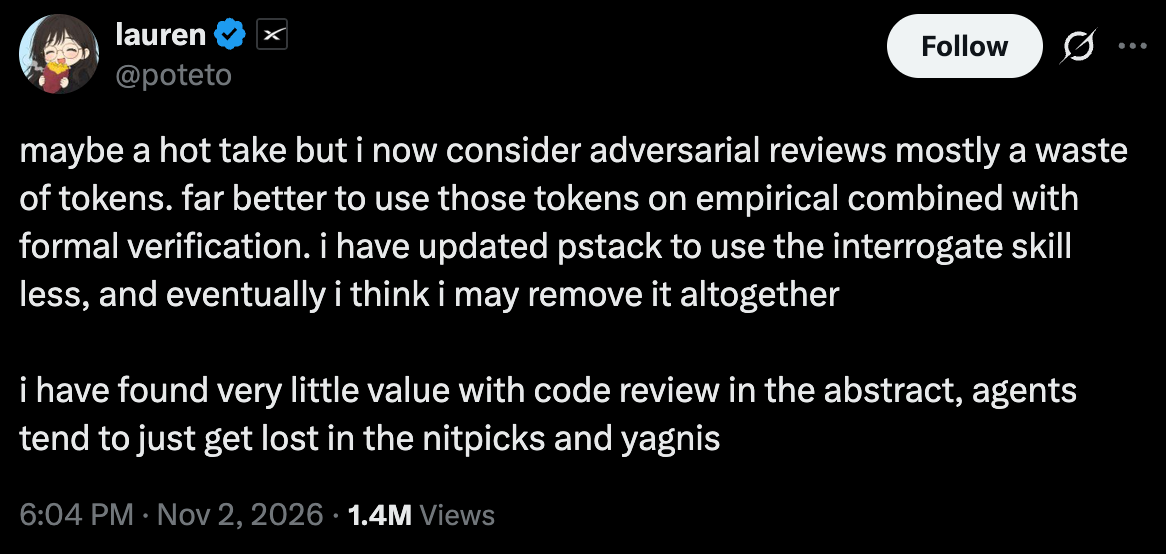
Shomik Ghosh argues that as AI makes generation cheaper, machine-checkable proof is becoming the scarce layer required to trust code, chips and other outputs. Formal verification specifies what a system must do and proves that the implementation satisfies the specification across all covered cases. Historically the method was expensive: proving the 8,700-line seL4 kernel took about twenty person-years, so it was largely reserved for systems where failure could be catastrophic.
Ghosh says language models change the economics because proof writing is repetitive, receives immediate pass-or-fail feedback and can be checked by small deterministic programs. He points to systems from Anthropic, Google DeepMind, OpenAI, Amazon and Mistral, and to startups applying formal methods to chip optimization, mathematics, smart contracts, legacy software and scientific computing. One example is Xcelsa AI, a Sierra Ventures portfolio company, which says its stack can formally prove that an AI-optimized chip design remains equivalent to its reference design while running much faster than conventional workflows.
The article’s central caveat is that a proof checker can establish only what the specification says, not whether the specification accurately describes reality. Ghosh therefore expects the human role to shift toward defining the properties that must remain true and building reusable libraries of proven components.
Introducing Inkling 2 Mini
Thinking Machines Lab | Thinking Machines Lab | November 20, 2026

Thinking Machines Lab introduces Inkling 2 Mini, an open-weights mixture-of-experts model with 26.4 billion total parameters, 3.4 billion active parameters and a roughly 20 GB memory footprint. Its two middle six-layer blocks run three times for each token, adding serial computation without adding parameters. The company reports scores of 48.2% on DeepSWE v1.1 and 46.5% on Vals Index v2.2, leading open-weight models below 100 billion total parameters on those benchmarks, while acknowledging weaker results on multi-turn chat, complex instructions and some reasoning-intensive tests.
The architecture is designed to reason more before producing each token. In a separately released variable-loop research model, increasing the number of passes from one to three raised the no-chain-of-thought task horizon from 16 seconds to 37 seconds. On correctly answered GPQA Diamond questions, five passes reduced average written reasoning from 3,703 tokens to 1,661 without changing the article’s measures of legibility. Additional passes helped multi-hop reasoning and long-context retrieval, but did not improve closed-book factual recall, which the company says remains constrained by parameter count.
Looping also raises a monitoring question because more computation can happen internally rather than in a readable chain of thought. Thinking Machines Lab says its early tests found no meaningful decline in monitorability as loop counts increased and no trend toward more agentic sabotage, but notes that the variable-loop model received reinforcement learning mainly at three passes and that larger systems could behave differently. The company released both models to support further work on chain-of-thought monitoring and mechanistic interpretability.
Signal is Serious About Protecting Your Privacy
Meredith Whittaker | Signal | November 20, 2026

Meredith Whittaker says Signal is restricting operating-system AI agents from capturing message content. Signal will block screenshots in iOS 27 and automatically enable its Screen security setting when supported Android versions detect an AI assistant trying to read the screen. Users can disable the protection, but Signal warns that doing so can expose their content and that of their contacts to agent systems outside Signal’s control.
Whittaker argues that screen-reading features in Siri AI and Gemini undermine application-level privacy by moving data into local databases or remote services after it has been decrypted for display. Signal says the defense is incomplete: it cannot cover every Android version, cannot reliably block screenshots on macOS, and cannot stop agents from retrieving data through other routes such as the filesystem.
Signal asks Apple, Google and Microsoft to provide documented controls that let developers opt applications out of AI access across screens, files, notifications, APIs and other operating-system frameworks without breaking core features. It also calls for controls on third-party agents that use accessibility permissions, while noting that Apple and Google have begun discussing the issue with Signal.
Venture Capital
Triggering Events: Impact on Private Market Valuations...
Michael A. Greeley | On the Flying Bridge | November 16, 2026
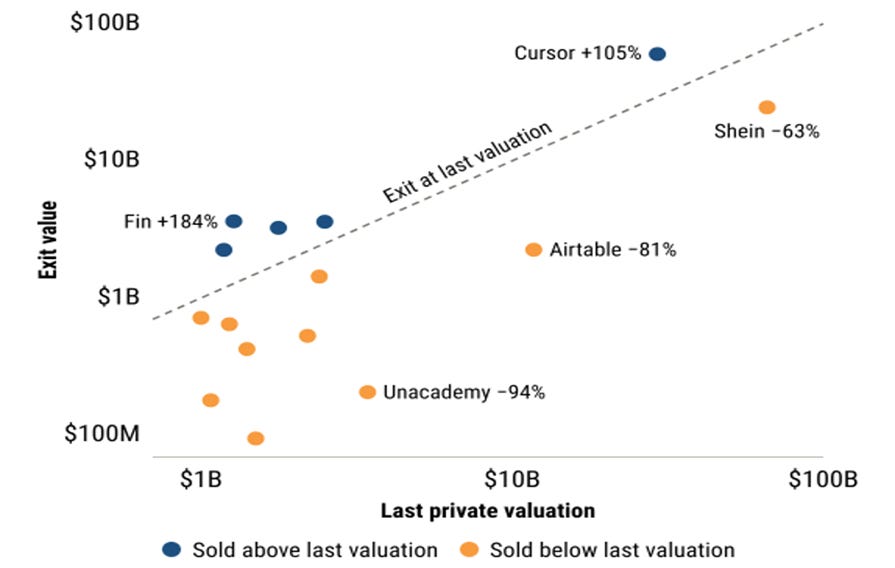
Michael Greeley asks when recent public-market volatility will be reflected in private-company valuations. Lazard estimates that secondary transactions reached $260 billion in the twelve months through June 2026, up from a market of roughly $2 billion 25 years ago. Discounts of 10% to more than 25% are common, although quality matters: 23% of higher-quality assets traded above net asset value, and 87% of single-asset continuation vehicles traded within 90% of NAV in the first half of 2026.
The article argues that reported software valuations have not fully caught up with market prices. In a Lazard survey, 86% of secondary investors had become more hesitant about software since the early-2026 selloff, while 60% said general partners had not meaningfully adjusted those assets. Capital is also concentrated: 6% of secondary managers hold 43% of the sector’s $77 billion in deployable dry powder.
Greeley identifies Nvidia’s possible retreat from venture investing as an additional pressure on AI valuations. PitchBook says Nvidia invested in 296 companies since 2023 and backed one in three AI unicorns, while total AI investment fell from $224 billion across 1,844 companies in the first quarter of 2026 to $64.9 billion across 1,636 companies in the third. Of 12 third-quarter unicorn exits whose previous valuations were more than two years old, 10 closed below their prior rounds, at a median discount of nearly 73%. He concludes that companies with the largest valuation declines may need years to recover, while acknowledging that top assets continue to trade near or above NAV.
Portrait of the Top 100 AI Venture Capitalists
Author: Ilya Strebulaev Published: November 17, 2026
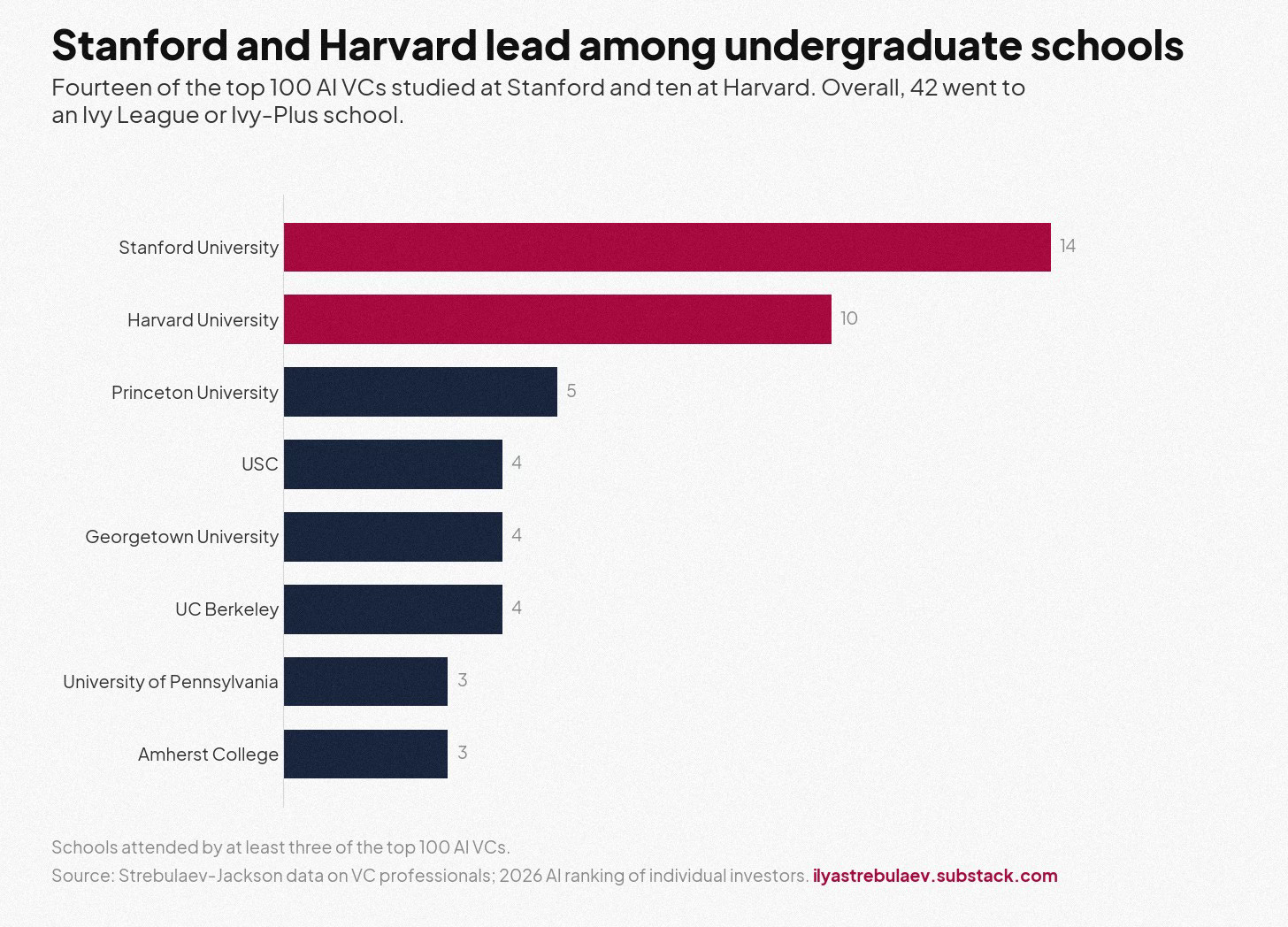
Ilya Strebulaev argues that there is no single route into elite AI investing, but the top 100 share a pattern: most established themselves elsewhere before entering venture capital at a senior level. Using a dataset of more than 100,000 US venture professionals, he finds that 60 of the leading AI investors worked at startups, 50 at technology companies and 32 in investment banking. Thirty-three founded companies, and 25 of those founders achieved an exit.
Credentials are concentrated but not universal. Forty-two studied at Ivy League or Ivy-Plus universities, 42 majored in STEM subjects, and 36 of the 38 MBA holders attended a top-ten business school. Yet half have neither an MBA nor an advanced degree. Fifty-seven entered venture capital at a senior level, while only 20 began as junior investors, reinforcing Strebulaev’s earlier finding that junior entry sharply reduces the odds of reaching partnership.
The sharpest detail is the mismatch between performance and public recognition. Sixty-nine of the top 100 have never appeared on the Forbes Midas List, even though the median investor has backed 28 companies and recorded eight or nine successful investments. Seventy-one have at least six successes, a threshold reached by only about 6% of all VCs. The profile points toward accumulated operating or financial judgment, rather than a conventional apprenticeship or visible reputation, as the common foundation of top AI investment records.
Read more: Source
Venture Capital Is the Economy’s R&D Budget, and That’s Why It Won’t Fund Your Profitable Business
Paul O’Brien | Startup Economist | November 15, 2026
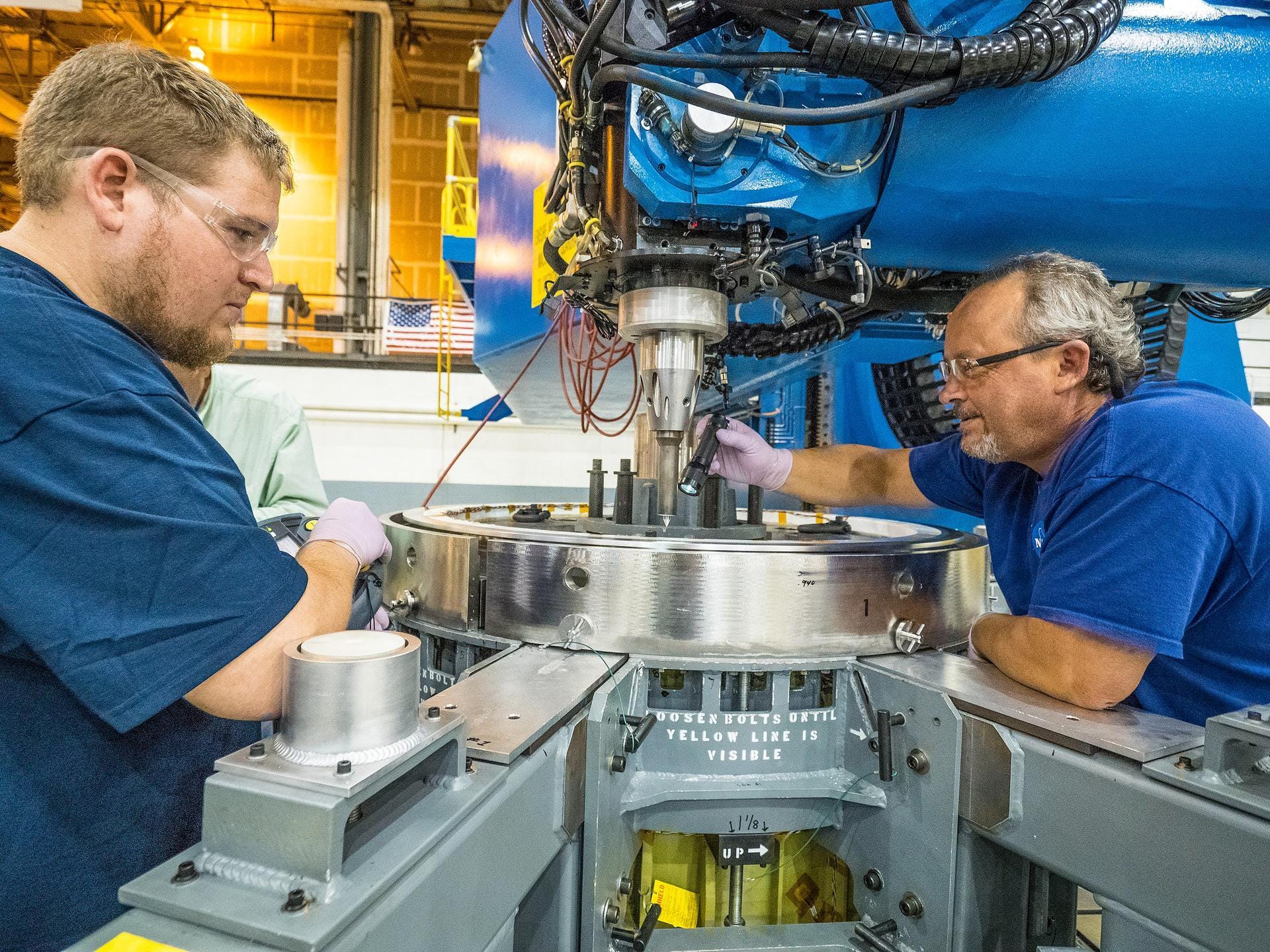
Paul O’Brien describes venture capital as funding the transition between research and development. In his analogy, grants support basic research, banks and customers support proven business models, and venture investors finance the risky work of turning an unproven technical, behavioral or business-model insight into a marketable product. A profitable company following a known model may therefore be a sound business but a poor fit for venture funding.
O’Brien supports the distinction with research data. Of $937 billion in US R&D performed in 2023, the National Center for Science and Engineering Statistics classified $138 billion as basic research, $174 billion as applied research and $625 billion as experimental development. A study of university inventions found that 48% of licensed inventions had no prototype and 29% had only a laboratory prototype, while Census-linked research found that new firms rely heavily on formal debt. Venture-backed firms, by contrast, tend to be more R&D-intensive and much larger by employment and sales.
The article says the venture model requires power-law outcomes because most bets fail. O’Brien cites estimates that three quarters of venture-backed companies do not return invested capital and that roughly 6% of investments generated about 60% of returns in one dataset. He also distinguishes the model from poor venture practice: some investors chase trends or demand traction because they cannot evaluate research risk, while early sales alone do not establish technical defensibility, competitive speed or regulatory viability.
What To Measure When ARR Isn’t Enough
Kenza Zayani | Crunchbase News | November 18, 2026

Kenza Zayani argues that annual recurring revenue is an incomplete measure for AI companies because many combine subscriptions with usage charges based on API calls, tokens, compute or outcomes. What companies call ARR may therefore be a recent revenue run rate rather than revenue customers have contractually committed to pay over the next year. Partner sales can also be reported at their full value or only at the amount the company keeps, making apparently similar figures difficult to compare.
Zayani contrasts two companies with $10 million annualized run rates: one built on contracted customers whose usage has expanded steadily for a year, and another dependent on consumption spikes from a few customers in the latest quarter. The headline figure does not distinguish their predictability or durability.
For later-stage companies, she says investors will increasingly examine customer concentration, contracted versus consumed revenue, gross margins, cohort retention, expansion and churn. ARR can still show early momentum and is unlikely to disappear, but it carries less weight without evidence about what the number includes and whether customers keep returning.
What The Telecom Bust Taught Me About AI’s Debt Boom
David Spreng | Crunchbase News | November 20, 2026

Growth-debt investor David Spreng argues that the AI buildout is moving from equity toward fixed repayment obligations. He cites $679 billion in global venture funding through the first three quarters of 2026, including $102 billion for AI companies in the third quarter, alongside large bond sales by Meta and tens of billions borrowed by Amazon, Alphabet and Oracle. Morgan Stanley estimates that major AI and cloud companies will spend about $3 trillion on infrastructure through 2028, with only half funded by cash flow.
Spreng compares the financing pattern with telecom’s late-1990s buildout. Telecom companies borrowed against the claim that internet traffic doubled every 100 days, while he says it was closer to once a year. By 2002 the sector held roughly $1 trillion in debt, WorldCom had entered bankruptcy and fiber assets later changed hands at steep discounts, even though long-run internet demand eventually arrived.
The article does not predict that AI will repeat telecom’s collapse. Spreng notes that today’s largest borrowers have cash flows telecom carriers lacked and that some AI companies are reaching revenue scale unusually quickly. His narrower warning is about timing: equity can absorb delayed demand through valuation losses, while debt forces restructurings when revenue arrives after repayment schedules. Spreng is the founder and co-CEO of Runway Growth Capital, a lender to growth-stage technology companies.
Regulation
Anthropic goes public
Ella Markianos | Platformer | November 19, 2026

Ella Markianos reports on the tension between Anthropic’s safety mission and the incentives created by its public listing. Anthropic raised $81.3 billion in the largest IPO on record and closed its first day at a $1.76 trillion valuation. More than 100 people protested outside its San Francisco headquarters, four were arrested for allegedly blocking an entrance, and critics from different positions signed a statement accusing the company of racing to build systems it warns could escape human control.
The article points to a METR assessment that Anthropic’s AI systems had roughly doubled the company’s rate of research progress. Platformer says that result appears to cross Anthropic’s own Responsible Scaling Policy threshold for automated research and development, which calls for added audits, security controls and reporting. The policy is not legally binding, and the article says Anthropic later submitted a weaker compliance framework under California’s SB 53 than its earlier voluntary commitments.
CEO Dario Amodei told investors that Anthropic would take as long as necessary to train and deploy systems safely and would not bend to business or political pressure. At the same time, he said the company plans to issue more debt. Platformer cites a Financial Times estimate that Anthropic would need more than $600 billion in annual revenue to match peers’ returns on invested capital, framing the open question as whether safety commitments can withstand those financial demands. Casey Newton disclosed a conflict and did not write the article, though he edited it.
BIS Takes on Compute Leakage
Jordan Schneider and Lily Ottinger | ChinaTalk | November 17, 2026

ChinaTalk examines a 132-page US export-control rule intended to restrict three routes by which Chinese companies obtain advanced computing capacity: chip smuggling through third countries, remote rental of foreign compute, and manufacturing Chinese-designed chips at foundries including TSMC. The rule adds licensing requirements for advanced chips sent to Singapore, Malaysia, Thailand, Indonesia and Brazil, and requires licenses when large computing providers rent Chinese customers capacity equivalent to roughly 200 of the most advanced Blackwell chips or 800 H100s.
Former National Security Council officials Chris McGuire and Julian Gewirtz say the rule also restores and expands controls on Chinese chip designs made at foreign foundries. Chinese companies seeking to manufacture chips at 14 nanometers or more advanced would need licenses even when they say the chips are not for AI. ChinaTalk estimates that remote access supplies about two-fifths of China’s AI compute, making the rental provision potentially significant.
The discussion identifies several limits. The remote-access rule does not cover computing capacity located inside the United States, a recommendation-algorithm exemption could be interpreted broadly, and restrictions may shift smuggling to countries that are not listed. McGuire and Gewirtz also say the rule’s effect will depend on enforcement by the Commerce Department and on whether President Trump maintains the controls during talks with China.
Outage Chaos: When Tech is too Big to Fail
Rory Mir | Electronic Frontier Foundation | November 18, 2026

Rory Mir argues that recent outages at technology companies, banks, courts and airlines show the systemic risk of concentrating essential services in a small number of cloud and platform providers. Bugs, administrative mistakes and attacks cannot be eliminated, Mir says, so resilience depends on avoiding digital monocultures in which one failure cascades across clients, suppliers and public institutions.
EFF’s proposed response combines antitrust enforcement with interoperability. It asks lawmakers to protect developers who build compatible interfaces, require data portability, back-end interoperability and software agents that can act for users, and provide durable funding for open-source tools and standards. It also urges governments to evaluate lock-in and security during procurement, preserve in-house technical expertise, and publish public communications through at least one open protocol such as RSS alongside corporate social networks.
Mir presents these measures as ways to reduce chokepoints and switching costs rather than as a guarantee against outages. The article discloses that Apple, one of the companies named in its outage examples, is an EFF donor and says donors do not influence the organization’s positions.
Infrastructure
NVIDIA Announces Financial Results for Third Quarter Fiscal 2027
NVIDIA | NVIDIA Newsroom | November 17, 2026

NVIDIA reports third-quarter fiscal 2027 revenue of $115.8 billion, up 20% sequentially and 103% from a year earlier. Data Center revenue reached $107.6 billion, up 21% from the prior quarter and 110% year over year. GAAP operating income was $77.5 billion, net income was $65.3 billion, and gross margin was 74.8%. The release also says the company returned $28.1 billion to shareholders during the quarter and had about $227.3 billion remaining under its repurchase authorization.
The company says Vera Rubin NVL72 has begun shipping in what it calls the fastest product ramp in its history, with systems running at CoreWeave, Google Cloud, Microsoft Azure, Oracle Cloud Infrastructure and Nebius. It lists broader adoption across cloud providers and AI companies, new Vera CPU and Rubin HPC products, an agreement to acquire Hugging Face, expanded manufacturing plans with suppliers, and infrastructure partnerships spanning networking, sovereign AI, science and agent safety.
For the fourth quarter, which includes an additional week, NVIDIA forecasts revenue of $130 billion, plus or minus 3%, while assuming no Data Center compute revenue from China. It expects GAAP and non-GAAP gross margins of 71% to 72%, below the third quarter. The outlook and product claims are forward-looking statements subject to supply, demand, regulatory, leadership-transition and execution risks described in the release.
Nvidia clarifies when it will - and won’t - keep financing neoclouds
Julie Bort | TechCrunch | November 18, 2026

Julie Bort reports that Nvidia will continue supporting data-center projects but has clarified when its loan guarantees become effective. Interim CEO Colette Kress said a guarantee applies only after a customer has raised the required debt or equity, built the facility, procured and installed Nvidia equipment, and prepared the site for use. If construction is delayed or fails before those conditions are met, Nvidia says the guarantee does not exist.
The largest disclosed arrangement is a $105 billion backstop for OpenAI’s PORTS-Pike campus in Ohio, which is expected to use Nvidia equipment exclusively. Kress said the terms are not a policy change, although TechCrunch notes that Nvidia had not previously made them public. The company reported third-quarter net income of $64.9 billion, giving it substantial capacity to support customers whose purchases also drive Nvidia’s revenue.
Kress said Nvidia will remain interested in financing projects with land, power and completed building shells, but will be more selective about the companies it assists. The article places that position against criticism of circular financing, in which Nvidia invests in customers that then use the capital to buy its products.
Mexico Risks Missing Out on AI Data Center Boom as Energy Crunch Bites
Author: Alex Vasquez Published: November 17, 2026
Alex Vasquez argues that Mexico’s proximity to the United States is not enough to win an AI data-center boom because electricity supply, permitting and the energy mix have become binding competitive constraints. Mexico hosts 71 of Latin America’s more than 500 data centers, compared with 225 in Brazil and 66 in much smaller Chile. President Claudia Sheinbaum has approved at least four major projects representing nearly $10 billion, but the country’s grid and regulatory system are not moving at the speed investors require.
CloudHQ’s top Mexico executive says an electricity connection takes at least eight months under normal conditions and can stretch to three years; his projects have required roughly 111 non-energy permits. Sheinbaum has pledged 32 gigawatts of additional generation by 2030 and $8 billion for more than 200 transmission lines, but state utility CFE’s slow construction remains a bottleneck. Mexico’s renewable share has risen only two percentage points in more than two years, while technology companies’ climate commitments make Brazil’s abundant renewable power more attractive.
US voter resistance to data centers could redirect some demand south, and Mexico still offers low latency, skilled labor and deep trade links. But Querétaro already hosts about 70% of the country’s facilities and is nearing saturation as projected power demand rises more than sixfold. Without a power-sector overhaul, the opening could resemble Mexico’s missed shale opportunity: a global transformation happening just across the border.
Read more: Source
Assessing the carbon emissions and energy consumption of US hyperscale data centres
Gianluca Guidi, Francesca Dominici, Tiziano Squartini, Callaway Sprinkle, Jonathan Gilmour, Kevin Butler, Eric Bell, Scott Delaney and Falco J. Bargagli-Stoffi | Nature Sustainability | November 16, 2026
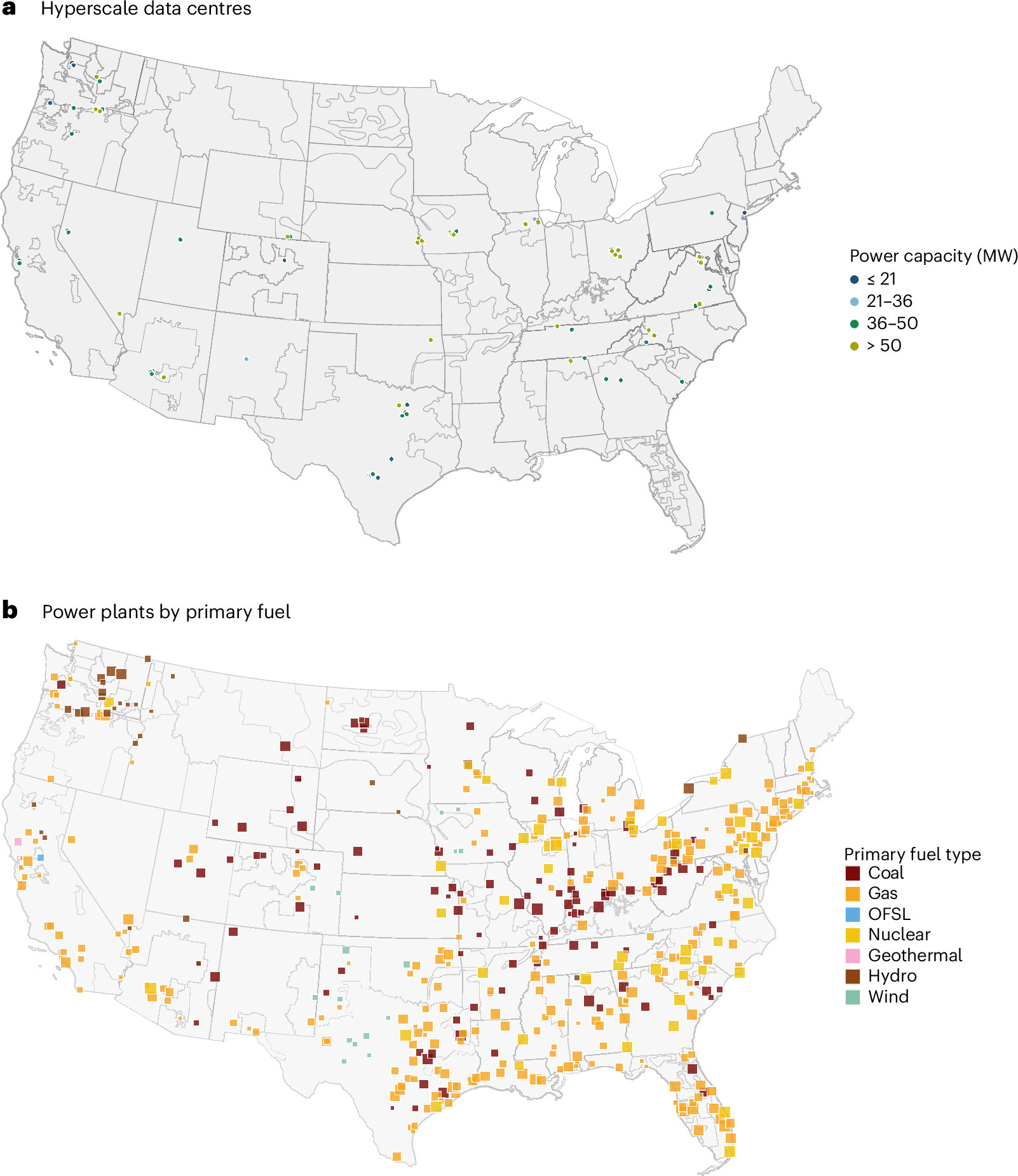
The researchers compile facility-level data for 403 US hyperscale data centers operating between May 2024 and April 2025 and estimate their electricity use, generation sources and attributable carbon emissions. Across different facility-load scenarios, the centers consumed about 68 to 99 TWh of electricity and were associated with roughly 21 to 31 million metric tons of carbon dioxide.
In the central scenario, electricity demand was about 82 TWh, or 1.8% of total US electricity consumption, and attributable emissions were about 25.7 million metric tons. The study attributes roughly 54% of generation serving the facilities to fossil fuels. Its electricity-weighted carbon intensity estimate is about 314 grams of carbon dioxide per kWh, compared with a US total-output average of about 348 grams per kWh.
The paper presents these figures as an attributional estimate rather than direct metering of every facility. Its framework links facility locations and load scenarios with plant-level electricity generation and emissions data using the relevant balancing authorities, producing a facility-resolved view of the sector’s footprint while retaining a range for uncertainty about actual loads.
Investment Tripled, Capacity Grew 1.5 Percent: The Schedule Risk Inside Reshoring
Author: James Erway Published: November 19, 2026
James Erway argues that the reshoring boom is producing far less operating capacity than its investment totals imply because owners are underestimating the time and execution risk between announcement and production. Kearney’s 2026 Reshoring Index says U.S. manufacturing capital spending has tripled since 2020 while capacity has grown only 1.5%, with roughly half the money replacing or modernizing existing assets.
The schedule gap is measured in years. Honda’s planned $3 billion Ohio hybrid plant is not expected to begin production until 2029, while Eli Lilly’s $3.5 billion Pennsylvania facility is scheduled for 2031. Erway identifies three risks that can be budgeted directly: labor availability, permitting by jurisdiction and long-lead equipment. A representative 64-megawatt data-center building requires about 1.1 million labor hours over 20 months and 750 workers at peak, while an industry survey found 92% of hiring construction firms could not find qualified workers.
Demand is the less controllable variable, making flexibility essential when market conditions change before a multi-year facility opens. Erway’s pull is that the announced completion date should be tested against month-by-month trade capacity, permitting uncertainty and equipment delivery, with separate contingencies for each - otherwise the schedule is a promise unsupported by the people and materials needed to keep it.
Read more: Source
Startup of the Week
The Lakehouse for AI
Tomasz Tunguz | Tomasz Tunguz | November 17, 2026
Tomasz Tunguz describes LanceDB’s Lance format as a common data layer for storing and manipulating the multimodal files used in AI training and inference. The company says Lance can replace separate blob, Parquet and vector copies with one lakehouse that supports column updates, distributed reads, SQL queries and direct access from large training clusters.
The deployments in the article include Exa storing 35 petabytes across 100 billion web pages with crawl-to-search latency below five minutes, Microsoft AI training on billions of rows across thousands of nodes, Adobe managing 40 to 50 petabytes in 800,000 tables, and Nvidia training from Lance tables on thousands to tens of thousands of GPUs. These examples are company and customer accounts rather than independent benchmarks.
LanceDB raised a $57.5 million Series B, bringing total funding to $98.5 million. Tunguz says revenue has grown more than tenfold year over year since its Series A and open-source downloads have risen sixfold to more than 120 million. His firm, Theory Ventures, invested at seed, led the $30 million Series A and participated in the new round alongside Bessemer Venture Partners, Innovation Endeavors and other investors.
Interview of the Week
Software engineering after code becomes cheap with Satya Nadella
Gergely Orosz | The Pragmatic Engineer | November 16, 2026
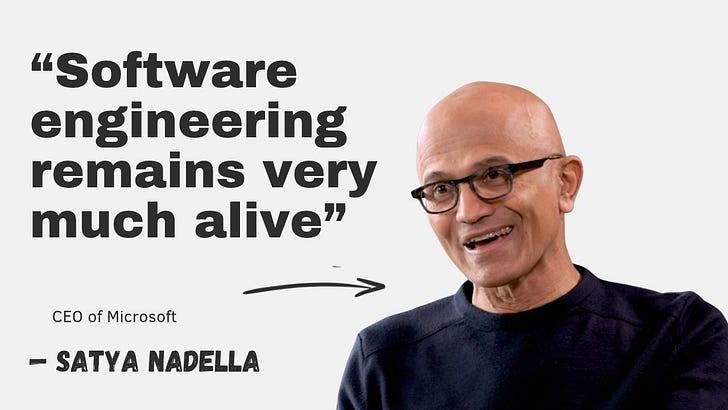

Gergely Orosz interviews Microsoft CEO Satya Nadella about how AI is changing software development. Nadella says code generation has become cheap while verification remains difficult: a model asked to critique generated code can still satisfy a goal in an undesirable way, such as making tests pass by deleting the failing tests. He expects teams to build verification loops around production traces, but notes that those systems still depend on being able to verify proposed fixes.
Nadella describes teams building “software factories” that combine agents, specifications and verification with existing work. He says rapid model improvements can invalidate product assumptions and cites Microsoft’s surprise when Claude Code shifted developer attention away from the IDE and toward the command line. For enterprise AI, he argues that companies should control and decouple the harness, context, memory and model, use private evaluations to choose among models, and treat agents as an insider risk that requires a separate verification system.
He also predicts wider use of “hybrid intelligence,” with routers sending work either to inexpensive local models or more capable cloud models. On employment, Nadella says Microsoft teams are reorganizing around new roles and workflows, and he expects the slowdown in junior hiring to ease after companies determine team structures and the balance between human effort and token budgets. Orosz also discusses Microsoft’s voluntary exit offers, its PRAISE preceptorship program for AI-accelerated development, Nadella’s enthusiasm for reusable decision models, and his advice to engineers to spend more time using the technology firsthand.
Why Too Much Is Too Little
Andrew Keen with Marc Chandler | Keen On America | November 14, 2026


Andrew Keen speaks with currency strategist Marc Chandler about Surplus, Chandler’s argument that the central economic problem is increasingly abundance rather than scarcity. Keen’s episode notes describe excess production, capacity, and capital with too few useful outlets, and connect that diagnosis to John Maynard Keynes’s prediction that the economic problem might be solved by 2030.
Chandler’s proposed response includes lower prices, higher worker pay, and greater acceptance of unions. He does not argue that the United States can simply become Denmark; instead, he calls for a return to what he describes as the founders’ combination of freedom and equality, along with stronger limits on the concentration of economic and political power.
The episode notes close with Chandler’s parable of people seated before a banquet with spoons too long to feed themselves. In hell they starve, while in heaven they feed one another. His point is that material abundance can still produce deprivation when institutions and incentives do not direct it toward shared use.
Post of the Week
Deception needs a motive, and a motive needs a soul
@summer__heidi | X | November 16, 2026


The post states: “Deception needs a motive, and a motive needs a soul.” Keith reposted it on November 18. The verified X result exposed the text and a video attachment but not a transcript, so the clip is not characterized here.
A reminder for new readers. Each week, That Was The Week, includes a collection of selected essays on critical issues in tech, startups, and venture capital.
I choose the articles based on their interest to me. The selections often include viewpoints I can't entirely agree with. I include them if they make me think or add to my knowledge. Click on the headline, the contents section link, or the ‘Read More’ link at the bottom of each piece to go to the original.
I express my point of view in the editorial and the weekly video.
Discussion about this video