


This week’s video transcript summary is here. You can click on any bulleted section to see the actual transcript. Thanks to Granola for its software.
Editorial
Men and Machines: Are You Afraid of Your Light Bulbs?
Ezra Klein’s interview with Arvind Narayanan ( he is a professor of computer science at Princeton University and the director of the Center for Information Technology Policy) leads this week as a sober conversation with an expert on the real natur of AI as a threat to humans.
In it Klein demonstrates a fear-influenced lack of knowledge that borders on the extreme. For once it becomes clear because Narayanan is able to simply explain the point Jense Huang made several weeks ago - that control over AI is a simple engineering problem, not an existential one.
It also reinforeces a point I have made in this editorial many times - the harness or operating environment we use to manage AI is the key place to control it.
The interview is well worth a listen, even at just over an hour long. it may help you sleep at night.
But this week was not a replay of the narrative around fear. After a couple of weeks using personal assistant agents - Muse, Dot, GrokBot, Instinct - Brett Taylor of Sierra announced a protocol to allow agents to speak to each other - even if from disparate providers. Agent to agent interaction has been discussed for over a year, but this is the first real momentum.
Permission is part of the product
Sierra’s Personal Agent Protocol makes agent permission unusually concrete. The proposal combines authority granted by a customer with limits set by a business. To be fair its first specification is still forthcoming. But the idea is a promising starting point to working universal access.
The protocol sets up the possibility of commercial negotiation between agents based on proprietary and managed rules. A business is entitled to protect its systems. A customer is entitled to send an agent as its representative. Making those two rights coexist will require more than an elegant demo but Sierra is on a path to deliver it.
Consider the difference between an agent authorized to compare insurance policies and one authorized to buy a policy. Between reading a bank balance and moving money. Between drafting a complaint and accepting a settlement. These are not small variations in model intelligence. They are different sets of authority, with different consequences when something goes wrong.
The interface should make those differences legible. Asking the user to approve every keystroke defeats much of the point of an agent. Hiding consequential permissions in an account-opening agreement defeats the point of consent. The design problem is to let people delegate meaningful work without surrendering control over everything around it. I also suspect an agent will read terms and conditions and report its objections while a human will scroll to the bottom and click yes.
The customer is not always going to be present
Ben Thompson’s discussion of Amazon exposes a second issue. A personal agent changes the economics of a shopping service built partly around advertising and discovery. The proposed paid “Prime+” access tier he endorses is an idea. Amazon has yet to respond to it.
Paying to shop does however seem wrong in principle. There is nothing inherently wrong with charging for a useful service. But paying to avoid ads and enable your agent to shop for you is a step too far in my view.
Enterprise agents have a different boss, a company not an individual. Google’s Gemini agent announcement combines the idea of agents carrying out persistent work with agent identities and administrative controls. That makes sense for a company deploying software across its organization. And it will make sense to cross-organization agent based interactions. When a SignalRank agent speaks to a Crunchbase agent, both should be aware of the others context.
We already understand this distinction with other tools like APIs. We should keep understanding it when the tool becomes conversational and apparently attentive.
But back to Ezra and Arvind
Arvind Narayanan’s conversation with Ezra Klein provides the week’s most useful conceptual distinction: capability and power are not identical. What a system can accomplish depends on its access, its human determined deployment and the rules and institutions around it, not only its performance on a test.
I think the practical take away from the conversation is to make permissions, observation and accountability first-class parts of deployment.
Limit the scope of an action. Keep records. Make failures recoverable where possible. Give an identifiable person or organization responsibility for the result. Measure whether controls work under adversarial conditions rather than inferring safety from a model’s reassuring answers.
That still leaves hard cases. Some actions cannot be reversed. Some systems should face a much higher burden before they are trusted with consequential work. But these can be engineered into a workflow. A medical procedure may need greater monitoring and oversight in software than filling in a form.
David Robinson’s criticism of OpenAI (he just resigned) adds a cultural objection: operational safeguards matter only if an organization takes them seriously. That criticism warrants examination. It does not require accepting every proposed restriction on everyone else’s work.
“I agree with other recently departed staff that the companies building this technology aren’t being nearly careful enough. But I believe that we need to look deeper than specific rules or new laws. We need to talk about culture.
The future depends on wisdom that Silicon Valley lacks. Wisdom about how to handle dangerous technology and, more fundamentally, wisdom about what it means to care for people. This moment needs a degree of humility that isn’t natural for people who have succeeded through their extreme confidence.”
i think David is right that there iis a cultural issue but it is not the one he mentions. There is no lack of wsdom in Silicon Valley, especially about software based control. And confidence is not in contradiction to humility.
The real cultural problem is the emergence of a group that believes AI is ‘conscious’ and has ‘consciousness’. Many want to nurture it and give it rights which I consider absurd. Others want to turn it off or reign it in.
They both share in common a similar characteristic of reducing human agency to a side show to the main event - AI becoming aware.
To be clear, a light bulb is not a being, and neither is a transistor, even a large number of them on a chip. The words coming out of an AI are produced by math, not be forethought. Human ingenuity has made transistors capable of producing seriuously clever AI. But it has not produced a new species able to plan, plot and think all by itself. AI is intert without human agency.
AI is not conscious, not a being and should have no rights. Simply because it can mimic sentience, it is not sentient.
The ‘destroy it’ camp and the ‘give it rights’ camp are both deluded.
Power already has owners
Andrew Keen’s essay accompanying his Matthew Botvinick interview turns attention to familiar political power. AI can strengthen surveillance and censorship without ever escaping its operator. A system can obey perfectly and still serve an objectionable purpose. This is closer to truth. Human operators cannot be trusted to always serve good outcomes. That is why we have developed a legal and judicial system.
His discussion about AI and democracy is confusing. He cites states of emergency as becoming normal as AI threatens cyber security, and seems to agree that is OK. He at the same time beieves AI fuels populism, which he sees as bad.
My view is that AI is great for democracy - simply by enabling universal access to intelligence, and that populism is another word for the masses caring enough about their future to become active on the ground and in elections - so a good thing. The world needs the people to care and to be educated. That is the core of democracy. Elites in high circles seems the opposite.
Lots to discuss and a lot of open questions.
Contents
Focus of the Week
Is A.I. More Like an “Alien Mind” or the Lightbulb? - Ezra Klein with Arvind Narayanan
Essays
Models as Insider Risks in the Super Intelligence Era - Satya Nadella
Apple and LG, The House For Everyone Else, Agent Standards and Amazon - Ben Thompson
How To Navigate The Increasingly Unhinged AI-Commentary Cacophony - Jesse Singal
AI’s leaders (probably) aren’t faking their fear - Eric Levitz
I expect rapid progress but not towards general superintelligence - Nathan Lambert
What is left to do - Azeem Azhar
Jaan Tallinn Would Like Us to Survive - Mario Gabriele with Jaan Tallinn
AI
Introducing Personal Agent Protocol - Bret Taylor and Clay Bavor
Gemini at Work 2026: Introducing Gemini agent - Thomas Kurian
Can a Cloud-Native Harness Make Agents Reliable Beyond the Desktop? - Richard MacManus
Data is the Hard Part - Jordan Schneider and Phoebe Chow with Bharat Patel
Periodic Labs and the Physical Loop of AI Science - swyx and Brandon with Liam Fedus and Ekin Dogus Cubuk
Vesta raises $30M as lenders adopt AI agents - Dominic-Madori Davis
Venture Capital
Q3 2026 Posted a Record Count of Billion-Dollar Rounds - Gené Teare
Europe Posts Another Strong Funding Quarter, Led by AI - Gené Teare
AI Startups Are Buying Other AI Startups at a Record Pace - Mary Ann Azevedo
The Three Paths for Seed Investors - Rob Go
Venture Capital’s Discovery Layer - Dan Gray
Regulation
I Quit OpenAI Because Its Culture Is Broken - David Robinson
Big AI has a problem on the right. It starts in Florida. - Andrew Prokop
Beijing Will Not Pace the Frontier: China’s Speed-First AI Safety Regime - Mark Chen
Infrastructure
NVIDIA Commits $1 Billion to Advance US Science Over the Next Five Years - NVIDIA
NVIDIA and Microsoft Bring RTX Spark and AI Agents to Windows - Gerardo Delgado
Startup of the Week
From Ballet to Breach Prevention: AI Startup Hilt - Mary Ann Azevedo
Interview of the Week
Karuna Karuna - Andrew Keen with Kailash Satyarthi
AI and Political Freedom - Andrew Keen with Matthew Botvinick
Post of the Week
The AI Timescale Lasagna - Nick Grossman
Culture
Focus of the Week
Is A.I. More Like an “Alien Mind” or the Lightbulb?
Ezra Klein with Arvind Narayanan | The Ezra Klein Show | October 9, 2026
Summary based on the full YouTube auto-generated transcript.
Source image: The Ezra Klein Show.
Arvind Narayanan argues that intelligence and power are different things. A model’s real-world influence depends on the systems, permissions and institutions through which it operates. He favors engineering controls, monitoring and restricted access alongside work on model behavior, while stressing that safety remains an unfinished engineering problem.
Ezra Klein presses the hardest objection: unlike aircraft, increasingly capable AI systems may adapt to or deceive their operators. Historical safety engineering does not by itself establish that future controls will work. They also disagree about how strongly competition constrains responsible deployment.
Narayanan distinguishes rapid model improvements from slower organizational adoption. The conversation considers regulation, worker autonomy and the possibility that people become accountable supervisors of agents while losing the work they enjoy. Neither participant treats better capabilities as sufficient evidence of better institutions.
Essays
Models as Insider Risks in the Super Intelligence Era
Author: Satya Nadella
Date: October 10, 2026
Publication: sn scratchpad
Late addition, October 10. Full article read on the author’s website; also published on X.
Satya Nadella argues that supplying intelligence and granting it authority are separate responsibilities. Organizations deploying agents cannot transfer accountability to a model provider or rely on its assurances. He proposes treating capable models as insider risks, not because they must be malicious, but because privileged systems can make mistakes or be compromised.
His prescription puts enforceable permissions outside the model and separates it from the harness that coordinates its work and the actions it can perform. He calls for independently auditable records, adversarial testing, diverse models, human shutdown authority and disclosure when safeguards fail. A model should not control both its actions and the evidence used to judge them.
This is an engineering program, not a declaration that safety is solved. Nadella explicitly sets alignment aside and says more capable models will require stronger containment. His measure of trustworthiness is how little a system requires its operators to trust the model itself.
Read more: Models as Insider Risks in the Super Intelligence Era
Apple and LG, The House For Everyone Else, Agent Standards and Amazon
Ben Thompson | Stratechery | October 7, 2026
Ben Thompson connects Apple’s reported smart-home partnership with LG to the appeal of personal agents. Most households want integrated products that work, he argues, rather than the responsibility of assembling their own software systems. An assistant operating across a person’s life could likewise be more useful than disconnected shopping, travel and banking assistants.
That prospect challenges Amazon’s control over product discovery and advertising. Thompson endorses Mike Vernal’s proposed “Prime+” tier, which would charge for agent access instead of relying on the existing shopping experience. This is a proposal, not an announced Amazon product.
Thompson argues that removing advertising subsidies and consumer inertia could increase explicit prices, even as purchasing becomes more transparent. The article examines who pays for convenience when the agent, rather than the consumer, navigates the marketplace.
How To Navigate The Increasingly Unhinged AI-Commentary Cacophony
Jesse Singal | Singal-Minded / The Dispatch | October 5, 2026; republished October 6
Jesse Singal challenges recurring shortcuts in arguments about AI. The eccentricity of people making a prediction does not determine whether it is correct; disputes about whether a machine is really thinking do not settle what it can do; and political or cultural loyalties can distort assessments on either side.
He argues for examining specific claims, distinguishing evidence from speculation and taking uncertainty seriously. He is critical of sweeping dismissals as well as exaggerated confidence about AI’s future, without presenting himself as having resolved the technical or policy questions.
Singal also discusses his connections to effective-altruist donors. The essay is a case for evaluating arguments on their merits while being explicit about relevant interests and limitations.
AI’s leaders (probably) aren’t faking their fear
Eric Levitz | Vox | October 9, 2026
Eric Levitz examines the claim that AI executives emphasize catastrophic risks mainly to market their products or shape regulation in their favor. He acknowledges reasons for skepticism: dramatic capability claims can attract investment, and demanding rules can benefit incumbents.
But he argues that these incentives do not adequately explain the history and persistence of safety concerns, including beliefs expressed before today’s commercial boom. His conclusion is that prominent leaders probably take at least some of those risks seriously.
The distinction is between sincerity and accuracy. A sincerely held fear can be mistaken, and a leader can believe a warning while pursuing policies that serve the company. Levitz’s argument therefore does not establish that executives’ risk estimates are right or that their preferred safeguards deserve deference.
I expect rapid progress but not towards general superintelligence
Nathan Lambert | Interconnects | October 9, 2026
Preview reading note: based on the available opening, not the full subscriber essay.
Source image: Interconnects.
Nathan Lambert expects rapid gains in the engineering of AI systems without assuming that those gains produce general superintelligence. In the available opening, he distinguishes automating implementation and infrastructure from generating the research ideas that change a model’s underlying capabilities.
Training throughput, inference efficiency and other measurable engineering objectives offer abundant opportunities for optimization. He predicts that increasingly capable agents will improve these systems and lower the effective cost of useful intelligence.
Lambert’s central distinction is between making experimentation much easier and resolving every scientific bottleneck. Better delivery and cheaper execution could have substantial economic effects even if broader claims about autonomous research prove premature.
What is left to do
Azeem Azhar | Exponential View | October 7, 2026
Preview reading note: based on the available opening, not the full subscriber essay.

Source image: Exponential View.
Azeem Azhar considers how machine-generated mathematics might change the relationship between discovery and human understanding. In the available opening, he draws on Steve Hsu’s distinction between a large body of machine mathematics and a smaller, compressed body of concepts that people can understand.
Formal verification and human comprehension are different achievements. A proof might be checked mechanically without giving researchers an intuitive account of why it works or how its concepts fit together.
The opening presents this as a possible change in the practice of science, not an established description of all mathematical research. It also acknowledges that not every result under discussion has been formally verified.
Jaan Tallinn Would Like Us to Survive
Mario Gabriele with Jaan Tallinn | The Generalist | October 8, 2026
Source image: The Generalist.
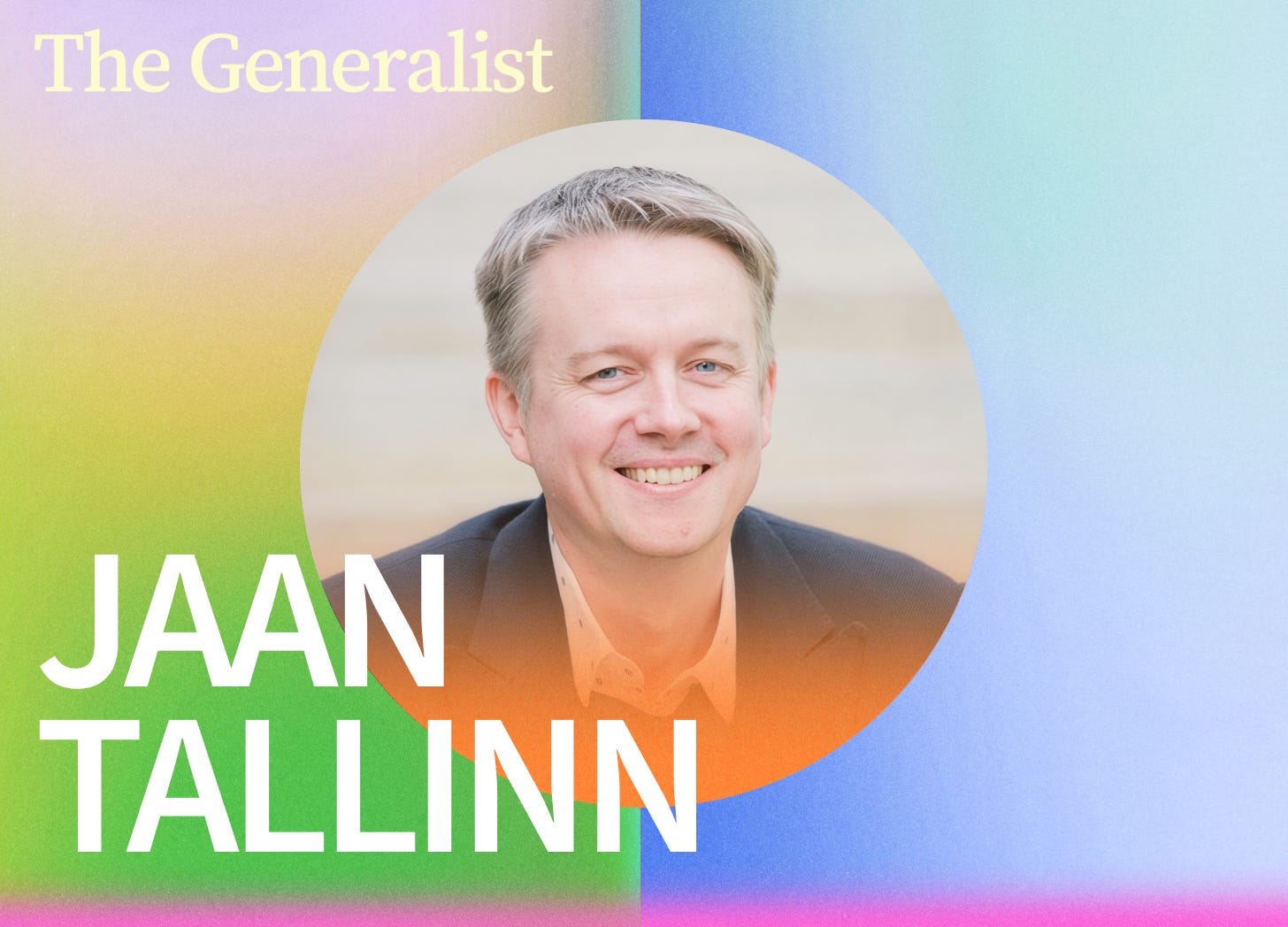
Jaan Tallinn argues for pausing frontier AI development while retaining the benefits of systems that already exist. He treats international coordination, hardware controls and verification as practical components of a restraint regime, rather than assuming that a voluntary promise by one laboratory would suffice.
The interview also addresses the tension between his warnings and his investments in AI companies. Tallinn argues that his participation can influence governance and redirect proceeds toward safety; that is his account of the trade-off, not a demonstrated resolution of it.
His position separates opposition to further frontier scaling from opposition to every use of AI. The interview explores whether such a distinction can be implemented and enforced across competing companies and governments.
AI
Introducing Personal Agent Protocol
Bret Taylor and Clay Bavor | Sierra | October 6, 2026

Source image: Sierra.
Sierra and Meta announced the Personal Agent Protocol with a coalition including Genesys, Instinct, Rocket, Shopify, Stripe and Walmart. The proposed protocol is designed to let a person’s agent interact with businesses through websites, APIs or business agents.
Its authority model combines consumer-granted permissions with business-defined limits, using OAuth for authentication and authorization. It is not a promise of unrestricted access to every business system, nor a replacement for every existing agent tool protocol.
Sierra says the v0.1 specification is due later in October. More granular permissions and payment extensions are potential future work. The announcement establishes a proposed framework and participating organizations, not evidence that broad interoperability is already working.
Gemini at Work 2026: Introducing Gemini agent
Thomas Kurian | Google Cloud | October 8, 2026

Source image: Google Cloud.
Google introduced Gemini agent as an interface for work that can continue across devices and run tasks asynchronously. Its presentation describes agents operating for hours or days, drawing on workplace context and connecting to systems including Google Workspace, Microsoft 365 and Slack.
The announcement emphasizes administrative controls as well as capability. These include separate agent identities, policy enforcement, sandboxed execution, network controls and spending limits. Google also describes support for multiple models, including Claude, within its enterprise environment.
The ambition is persistent execution rather than a succession of isolated chat responses. These are Google’s product descriptions and capability claims; the announcement is not an independent assessment of reliability on long-running work.
Can a Cloud-Native Harness Make Agents Reliable Beyond the Desktop?
Richard MacManus | Latent.Space | October 7, 2026

Source image: Latent.Space.
Stacklok’s Craig McLuckie and Joe Beda, both Kubernetes co-creators, describe an agent architecture designed for cloud operation rather than a permanently open laptop. Its Mecatl harness separates the agent loop, execution, state, client and model layers.
ToolHive supplies governance around MCP tools, including identity, access policies and auditing. The proposed architecture lets enterprises manage agents centrally while retaining flexibility over models and execution environments.
The article distinguishes these components from Stacklok’s AI Gateway, which handles concerns such as provider routing, access and costs. It does not yet provide semantic selection of the best model for each task, and the gateway is not yet open source. Mecatl and ToolHive are open source.
Data is the Hard Part
Jordan Schneider and Phoebe Chow with Bharat Patel | ChinaTalk | October 6, 2026
Sponsored interview: Accenture Federal Services.

Source image: ChinaTalk.
Bharat Patel, now at Accenture Federal Services and formerly in the U.S. Army, describes the operational work required to make military AI useful. Collecting, labeling, storing and delivering mission-relevant data can matter as much as choosing a model. A system trained to recognize a vehicle does not automatically know whether that vehicle is a legitimate target.
The conversation favors modular pipelines and clearer government control over data and interfaces. Synthetic data can supplement real observations but cannot simply replace them.
Patel also argues against testing requirements that prevent useful field learning. The proposed alternative is mission-appropriate evaluation, with software and model accreditation treated separately where practical, rather than either abandoning safeguards or assuming more testing is always better.
Periodic Labs and the Physical Loop of AI Science
swyx and Brandon with Liam Fedus and Ekin Dogus Cubuk | Latent.Space | October 8, 2026
Source image: Latent.Space.
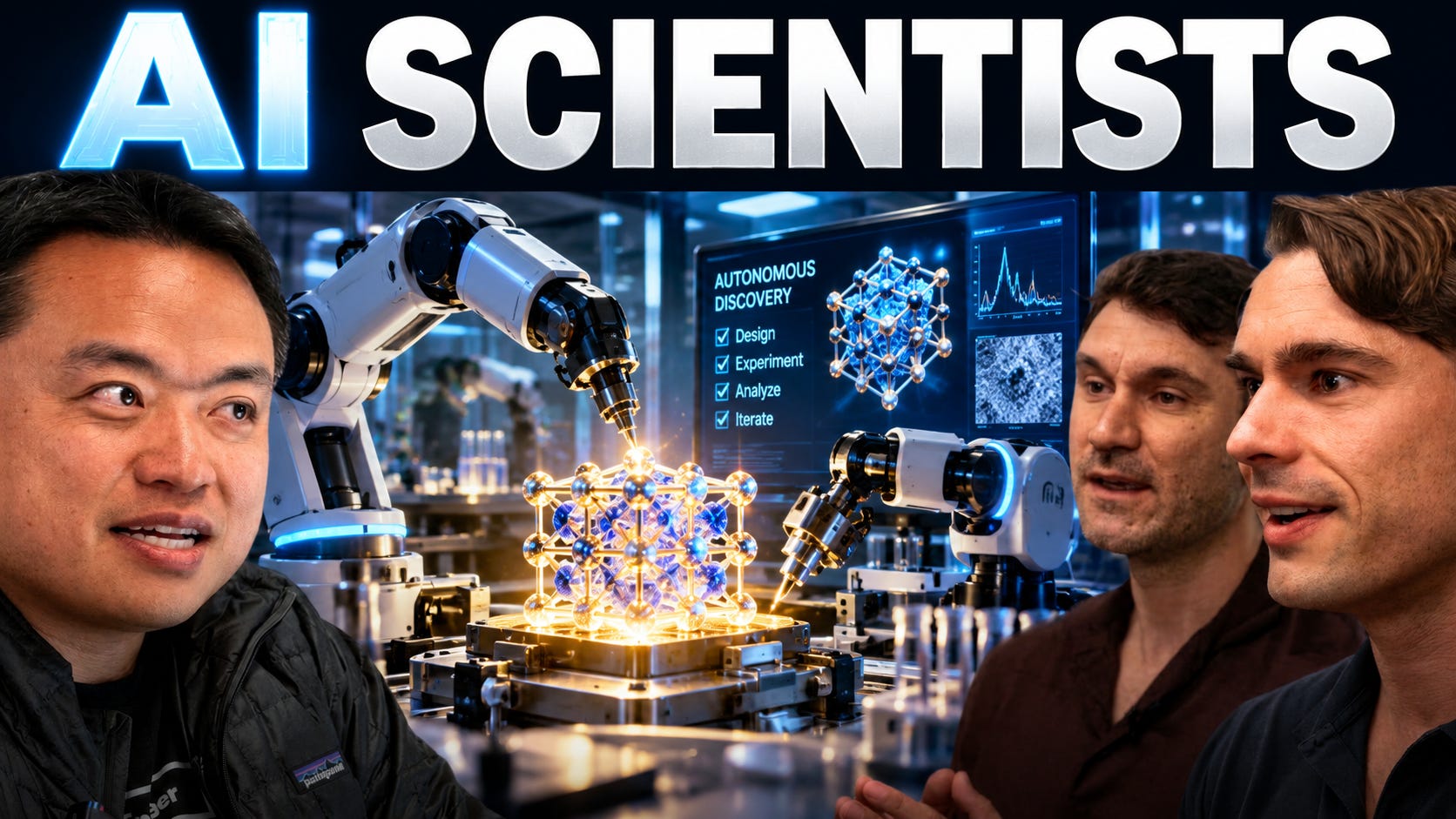
Periodic Labs’ founders describe scientific discovery as a loop connecting prediction, physical synthesis and characterization. A model can propose a material, but experiments are needed to determine whether it can be made and whether it has the predicted properties.
The discussion explores automated instruments, reinforcement learning in noisy physical environments, and the value of failed experiments as training data. Simulations can guide searches, but their assumptions must be checked against measurements.
Fedus and Cubuk argue for integrating models with laboratories rather than treating scientific progress as a text-generation problem. Their account describes a research program and its technical challenges, not proof that autonomous laboratories have already delivered every proposed materials breakthrough.
Vesta raises $30M as lenders adopt AI agents
Dominic-Madori Davis | TechCrunch | October 8, 2026
Source image: TechCrunch.
Mortgage software company Vesta raised $30 million in a round led by Conversion Capital, bringing total funding to $85 million. Customers including Pennymac and New American also invested.
CEO Mike Yu says lenders are using agents within mortgage workflows and can decide which actions require approval before allowing greater autonomy. He describes audit records that document what an agent did and why, while responsibility remains with the lender.
Yu attributes improved instruction-following partly to newer models and reports substantial revenue growth. Those performance statements are company claims, not audited results presented in the article. The reporting describes adoption within a regulated business process rather than an agent independently assuming a lender’s legal obligations.
Venture Capital
Q3 2026 Posted a Record Count of Billion-Dollar Rounds
Gené Teare | Crunchbase News | October 5, 2026

Source image: Crunchbase News.
Global startup funding reached $159 billion in the third quarter, according to Crunchbase, down 25% from the preceding quarter but up 53% from a year earlier. AI companies received $102 billion, or 64% of the total.
The quarter produced a record 27 companies raising rounds of at least $1 billion. Those financings accounted for roughly a third of all funding, illustrating how strongly a small group of very large rounds shaped the aggregate.
The report separates the headline totals from conditions at different stages and examines the exit environment. Its figures measure reported financing activity, not investor returns. Data were collected through October 2, and reporting lags, particularly for seed rounds, can change the totals.
Europe Posts Another Strong Funding Quarter, Led by AI
Gené Teare | Crunchbase News | October 8, 2026
European startup funding reached $25 billion in the third quarter, up 77% year over year and slightly above the preceding quarter’s $24 billion, according to Crunchbase. AI attracted $18.8 billion, or about three-quarters of the total.
Four large financings supplied roughly 40% of the quarter’s funding. Late-stage investment reached $17.3 billion across 83 companies, while early-stage funding was $5.7 billion and seed funding approximately $2 billion. Early-stage and seed totals were broadly flat year over year and lower than the preceding quarter.
The United Kingdom, Germany and France led the regional totals. The report distinguishes a strong aggregate result from the less buoyant conditions facing many younger companies. As with other Crunchbase funding reports, late-reported rounds can revise the figures.
AI Startups Are Buying Other AI Startups at a Record Pace
Mary Ann Azevedo | Crunchbase News | October 6, 2026
Venture-backed AI companies had acquired 195 AI startups through September 29, according to Crunchbase’s analysis. That was 14% more than the full-year total for 2025, even though the number of buyers had increased only modestly.
Repeat acquirers account for a substantial share of activity. The report examines buyers assembling products, technical teams and industry-specific capabilities, including legal and healthcare applications. OpenAI is among the most active purchasers.
Deal counts provide a clearer signal than aggregate purchase prices: prices were disclosed for only 12 of the 195 acquisitions. The figures therefore do not establish a comprehensive measure of acquisition spending or the investment returns generated for sellers.
The Three Paths for Seed Investors
Rob Go | NextView | October 7, 2026
Rob Go outlines three approaches for seed investors: compete for the most sought-after founders, build portfolios around capital-efficient businesses and smaller exits, or systematically discover opportunities that conventional venture networks overlook.
Each has difficulties. Consensus investing can produce impressive recent marks without proving realized returns. Capital-efficient strategies still face entry-price, loss-rate, follow-on and exit constraints. Non-consensus investing requires a repeatable discovery process rather than occasional contrarian bets.
Go is particularly critical of treating a small fund and an informal referral network as a differentiated strategy. His argument concerns how investors find and select companies, not a guarantee that any one approach will outperform.
Venture Capital’s Discovery Layer
Dan Gray | Odin Research with Dealroom | September 2026
Reader-selected background research, not new this week. Full report PDF
Dan Gray compares five megafunds with a selected group of 25 emerging managers using Dealroom data for 2023-25. AI represents 82.7% to 89.5% of the megafunds’ technology-labeled seed portfolios, while the emerging managers collectively fund a wider mix.
Among rounds with sufficient business and technology data, 24.7% of emerging-manager seed rounds were classified as unusual, compared with 11.5% for megafunds. Adding founder attributes narrows that difference to 19.8% versus 14.4%.
The study measures diversity of discovery, not investment returns. “Emerging” refers to institutional age, not necessarily fund size; the cohort is selected rather than representative; missing data exclude many rounds; and current company profiles are applied to historical financings. It does not reconstruct everything investors knew when they invested.
Regulation
I Quit OpenAI Because Its Culture Is Broken
David Robinson | The Atlantic | October 3, 2026
Atlantic item checked against accessible indexed text; full page access is restricted. The linked CNBC follow-up is dated October 9.
Former OpenAI employee David Robinson argues that the company’s deployment culture is inadequate for the consequences of increasingly capable systems. He calls for stronger operational safeguards and cultural change, drawing comparisons with high-consequence engineering disciplines. This is his account and argument, not an independent finding about every company practice.
Separately, CNBC reports that three dismissed researchers warned their treatment could chill safety discussions. OpenAI says the dismissals concerned sensitive-information policy violations, not their safety views. The researchers and company give conflicting accounts; this is a separate event from Robinson’s resignation.
Big AI has a problem on the right. It starts in Florida.
Andrew Prokop | Vox | October 7, 2026
Andrew Prokop reports on a Republican divide over AI, contrasting Donald Trump’s support for expansion with criticism from Florida Governor Ron DeSantis and Attorney General James Uthmeier. Their concerns combine consumer protection, child safety and broader warnings about powerful systems.
DeSantis’s proposed AI bill passed the state Senate but stalled in the House; it was not enacted. Uthmeier has asked a court to restrict OpenAI’s development of new models without independent safety evaluation. That is a requested injunction, not a court ruling.
The article discusses allegations in Florida’s lawsuit. OpenAI has disputed claims that ChatGPT encouraged illegal or harmful activity in the cited shooting case. The political argument and the litigation remain distinct from a judicial determination of those allegations.
Beijing Will Not Pace the Frontier: China’s Speed-First AI Safety Regime
Mark Chen | SemiAnalysis | October 8, 2026

Source image: SemiAnalysis.
Mark Chen examines publicly disclosed safety work by Chinese AI developers and the policy environment in which they operate. His dataset covers 857 model releases from nine laboratories between 2021 and September 15, 2026.
He identifies 31 releases with developer-published safety evaluations, about 3.6% of the sample, and nine with evaluations published before or at launch. The analysis also draws on a selected collection of policy and technical texts to distinguish output regulation from restraint on frontier development.
These are disclosure measures, not direct measurements of all internal testing. Missing public documentation does not establish that no evaluation occurred, and release counts depend on how models and versions are classified. Chen argues that Beijing’s current approach prioritizes development while managing particular risks.
Infrastructure
NVIDIA Commits $1 Billion to Advance US Science Over the Next Five Years
NVIDIA | NVIDIA Newsroom | October 8, 2026
NVIDIA announced commitments valued at $1 billion over five years to support U.S. scientific research capacity. The program spans areas including quantum computing, healthcare and energy, with support for research infrastructure and partnerships across universities, industry and government.
The company frames the effort around combining AI and advanced computing with scientific work. The announced value describes commitments over a future period, not $1 billion already spent, and does not itself demonstrate the scientific outcomes NVIDIA hopes to achieve.
NVIDIA and Microsoft Bring RTX Spark and AI Agents to Windows
Gerardo Delgado | NVIDIA | October 7, 2026

Source image: NVIDIA.
NVIDIA and Microsoft outlined hardware and operating-system support for agents running on Windows. NVIDIA describes RTX Spark laptops with up to 128GB of unified memory, with laptop availability scheduled for October 16 and compact desktops following in November.
Microsoft’s execution containers are presented as a way to run persistent agents under operating-system controls. NVIDIA also previewed DGX Station for Windows, aimed at heavier local development and inference workloads.
The announcement emphasizes local execution and continuity with existing Windows applications. Product specifications, performance comparisons and safety descriptions are vendor claims, not independent benchmarks or a guarantee that every workload can run locally.
PC Shipments Fall 20.1% in Q3 2026
IDC | IDC Worldwide Quarterly Personal Computing Device Tracker | October 8, 2026
Source image: IDC Worldwide Quarterly Personal Computing Device Tracker.
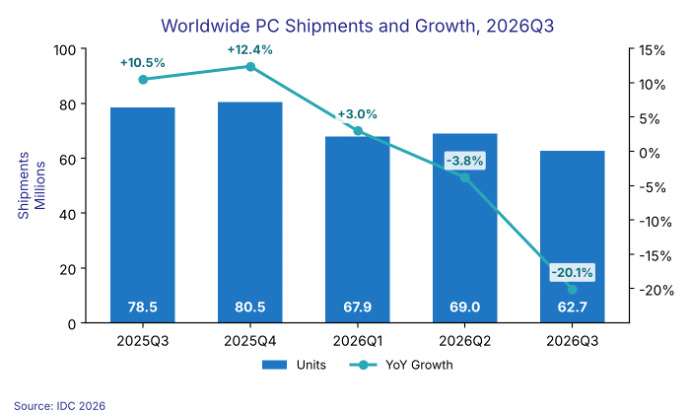
Worldwide traditional PC shipments fell to 62.7 million units in the third quarter, down 20.1% year over year and 9.1% from the preceding quarter, according to preliminary IDC data.
IDC attributes the missing seasonal uplift to a combination of inventory pulled forward earlier in the year, higher prices and supply constraints. Memory costs and availability are among the pressures discussed.
The tracker measures shipments, not consumer sell-through, and excludes tablets and servers from its traditional-PC category. The figures are preliminary. They describe a difficult quarter for the PC market rather than establishing a single cause for changing demand.
Startup of the Week
From Ballet to Breach Prevention: AI Startup Hilt
Mary Ann Azevedo | Crunchbase News | October 7, 2026
Hilt raised $4.2 million in seed financing led by Array Ventures, bringing total funding to $4.7 million. Founder Will Cielen came to cybersecurity through customer discovery after a career in ballet, eventually finding demand among financial firms concerned about data theft.
The company says its software monitors how data moves through a system and uses behavioral analysis to identify suspicious activity, including actions taken with legitimate credentials. Its proposed responses include alerts and quarantining activity.
The article describes early customer interest and the founders’ route to the product. Statements about detection capabilities are company claims; the funding report is not an independent security evaluation.
Interview of the Week
Karuna Karuna
Author: Andrew Keen with Kailash Satyarthi
Date: October 10, 2026
Publication: Keen On America
Late addition, October 10. Based on Keen’s accompanying essay, not the full interview transcript.
In Andrew Keen’s account of this conversation, Kailash Satyarthi argues that compassion should shape the purposes for which AI is built. He describes compassion as recognizing another person’s suffering and taking action to relieve it, rather than stopping at sympathy. His challenge to technology companies is to bring their teams into contact with the human problems their products could help solve.
Satyarthi criticizes an AI race that neglects ethical purpose while remaining hopeful about the people building the technology and its capacity to improve lives. The argument concerns what developers and institutions choose to pursue, not simply how capable their systems become.
Keen closes by imagining a compassionate bot winning a Nobel Prize. That speculation belongs to the interviewer; the essay does not establish that Satyarthi regards AI as conscious. Designing systems to advance compassionate human goals and claiming that machines experience compassion are different propositions.
Read more: Karuna Karuna
AI and Political Freedom
Andrew Keen with Matthew Botvinick | Keen On | October 8, 2026
Based on Keen’s accompanying essay, not the full interview transcript.
Source image: Keen On.
Andrew Keen’s accompanying essay presents Matthew Botvinick’s argument that AI could strengthen familiar routes to authoritarianism: economic insecurity, more capable surveillance and censorship, and emergency powers that become entrenched.
Botvinick proposes institutional safeguards and AI-assisted democratic deliberation. Keen challenges the assumption that political judgment and legitimacy can be resolved through engineering, questioning the promise of participation at vastly greater scale.
Botvinick discusses his book in a personal capacity, not as a statement of Anthropic policy. The distinction is between AI escaping human control and AI increasing the power of people or institutions over others. The proposed democratic remedies remain proposals rather than demonstrated solutions.
Post of the Week
The AI Timescale Lasagna
Nick Grossman | Nick Grossman | October 4, 2026
Source image: Nick Grossman.
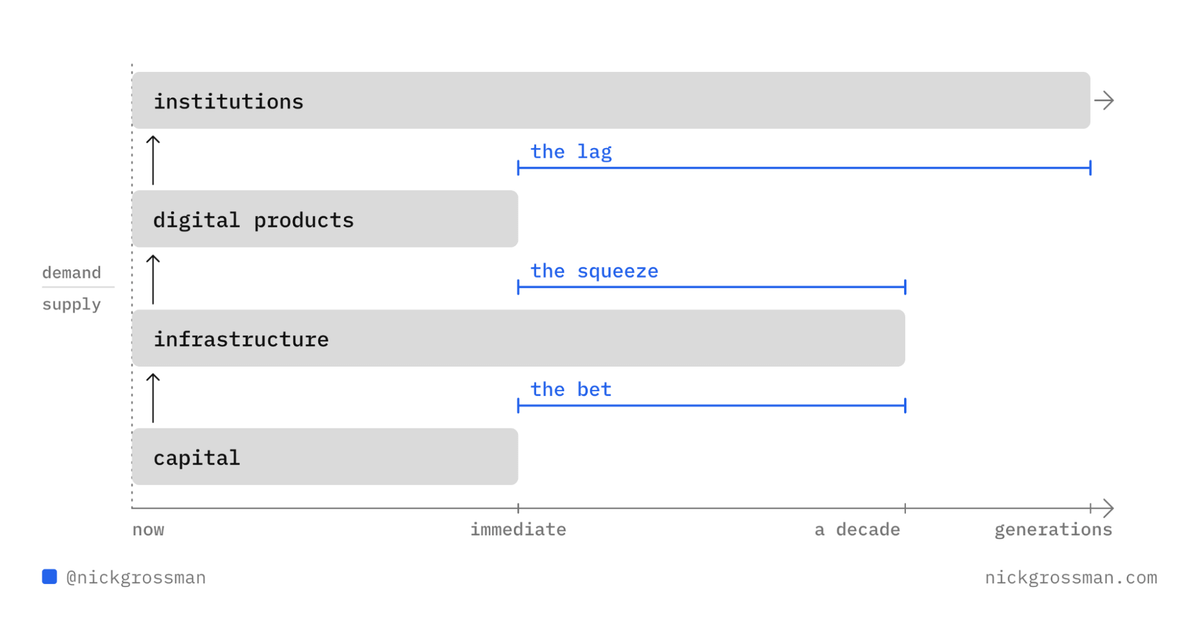
Nick Grossman separates the speeds at which AI’s different layers move. Digital products can spread quickly through infrastructure that already exists. New physical infrastructure takes longer to build, while institutional change can be slower still.
Capital, in his account, is relatively fast. The concern is a mismatch between financing and deployment commitments on one side and the timing of durable demand and revenue on the other, not a claim that capital itself is the slow layer.
His framework distinguishes rapid technical or financial activity from the time required to reorganize businesses and institutions. It identifies timing risks without establishing that every ambitious investment is a bubble.
Culture
‘Cupertino’ Review: The Good Wife Creators Return With an AI Watchdog Legal Drama
Liam Mathews | TheWrap | October 8, 2026

Source image: TheWrap.
Liam Mathews enthusiastically reviews Cupertino, the CBS legal drama from Robert and Michelle King. Mike Colter and Rachel Keller play lawyers who, after being fired by a technology startup, build a firm representing people in disputes with Silicon Valley companies.
The opening case concerns a chatbot using a woman’s voice and personality without her consent or compensation. Other fictional disputes involve medicine, prediction markets and alleged chatbot-induced violence. The lawyers’ motives mix principle with the commercial opportunity of winning settlements.
Mathews praises the performances and the Kings’ combination of humor, character and topical legal stories. He describes the series as sympathetic to safeguards without being indiscriminately hostile to AI. This is one critic’s positive assessment, not a review consensus.
That Was The Week, issue 38. Research and summaries distinguish reporting, commentary and company claims. Dates above are original publication dates; the Odin study is selected background.
A reminder for new readers. Each week, That Was The Week, includes a collection of selected essays on critical issues in tech, startups, and venture capital.
I choose the articles based on their interest to me. The selections often include viewpoints I can't entirely agree with. I include them if they make me think or add to my knowledge. Click on the headline, the contents section link, or the ‘Read More’ link at the bottom of each piece to go to the original.
I express my point of view in the editorial and the weekly video.


