


I spent this month creating SignalRank Intelligence. It is a full-featured Venture Capital discovery and dealflow engine with a logged-in product and developer APIs. Check it out.
Editorial
Venture Capital is having a moment. The label is used by many investors who have wildly different business models. It disguises those differences. But the participants are now debating openly and vociferously which model they prefer. I am definitively a believer in early stage managers finding most if not all of the future winners. The current concentration of LP money into fewer larger funds does nothing to change that.
But the facts are quite clear as Murph Capital’s Q3 fundraising report shows. It tracked 152 funds announcing closes. Twenty-six funds of $500 million or more took 76% of the capital. Its 86 emerging funds, defined as Fund I or II under $250 million, raised just 9%. Bessemer alone raised more than all 86 combined.
These are publicly announced closes, not a complete census. But the direction is clear within the sample. LP money is concentrating. Big funds are getting bigger and small funds are getting harder to raise. LPs are speaking with their checkbooks.
The underlying reality is driving this trend. The large AI companies, across all sectors, are attracting capital because the opportunity to place large bets for significant multiples is hard to ignore.
That is defining every stage of venture capital. Less and less companies are getting larger and larger checks from fewer investors. To play that game a fund has to write bigger checks than ever, at every stage. This impacts fund size and pro-rata planning.
Kyle has noticed ( Kyle Harrison )
Kyle Harrison’s account of venture’s “short kings” is uncomfortable reading for anyone attached to the small-partnership model. He notes that USV and Benchmark - both previously committed to disciplined venture investing at the early stage - have increased the capital they manage.
USV disputes Kyle’s conclusions - that raising more means abandoning its approach. Fred Wilson’s response ( Fred Wilson ) separates the new $500 million core fund from the new $400 million opportunity fund. He concedes that USV wants to lead larger rounds because the market is making it do so. But he still believes single-digit-billion-dollar outcomes can produce attractive returns at its ownership levels.
Wilson uses Etsy and Duolingo to illustrate the arithmetic: the ownership USV bought in either would be enough to return the new core fund.
Jon is describing a different opportunity
Jon Callaghan ( Jon Callaghan) rejects the game on the field. He puts the apparent contradiction plainly: “We’re in a capital bubble and an innovation boom.”
His argument is that investors are treating AI as a brief contest to own a handful of inevitable winners, while the technology is making it possible for many more people to create companies over many years. Cheap development opens opportunities well beyond the frontier labs.
he is right that the game will change - possibly rapidly. And the opportunity to invest early in larger outcomes will not disappear. The investment opportunity will still belong to the manager who can find great companies early enough, at a sensible price.
Are the small managers still getting in?
Anecdotes are not helpful in general, unless they illustrate a broader opportunity.
There is a useful example inside Murph’s report. Silent Ventures raised an $85 million second fund. I checked Silent’s investment history through the new SignalRank API. It records Silent joining Saronic’s seed financing in February 2023 and its Series A that October. Silent’s own announcement confirms both investments. Saronic’s announcement independently names Silent among the Series A investors.
Saronic subsequently announced a $1.75 billion Series D at a $9.25 billion valuation. Silent was there before that valuation, alongside larger investors.
The GPx relationship makes the example more interesting. In Tectonic’s interview, the GPx model is to back specialist early-stage managers and then invest alongside them in later rounds. The manager supplies relationships and judgment; another pool supplies follow-on capital. The commercial terms and execution still have to work, but the specialist does not have to become a giant to remain useful.
Silent is not alone. There are hundreds of early-stage managers who excel at sourcing, selecting and investing in future winners. LPs, swept up in the moment, will likely not be LPs in these smaller funds.
What would make an emerging manager a good investment?
Being new is not enough. Nor is being small. And for some LPs, small just makes their investment impossible. They are not set up to manage 100 $20m checks. They are more likely to manage 4 $500m checks.
Cambridge Associates says emerging managers account for a majority of top-quartile performers in a given vintage. But a large multiple of a small number is still too small.
That is a reason an emerging manager requires a different group of LPs. They have to be characterized by an affinity with smaller checks into the best emerging managers and be capable of scaling across many funds.
That ecosystem does exist in the form of former successful founders, family offices and such. But it needs to go further.
The ‘hidden in plain sight’ opportunity is to become the supplier of capital to the 200-300 early-stage funds that find 100% of the winning companies before they are obvious. That can take the form of a fund-of-funds approach like Michael Kim of Cendana, or a pro-rata supply like SignalRank. So far the market is open and undercapitalized. That is the opportunity.
Contents
Focus of the Week
State of VC Fundraising: Q3 2026 - Pavel Prata and Vlad Kyivskyi
The Death of Venture Capital’s Short Kings - Kyle Harrison
The Short King Is Dead, Long Live The Short King - Fred Wilson
Scarcity vs. Abundance - Jon Callaghan
Why Neo Ditched Pro Rata Rights - Connor Ling
News of the Week
CoreWeave shares tumble as bond yields near 15% on concern about AI borrowing binge - Michelle Fox
AI models may be capable of self-replicating without access to a datacenter - William Zhou and Daniel Freeman
An update on independent evaluators - Anthropic
Exposing AdFection: How Discover-Tech Turned Targeted Ads Into a Pipeline for Zero-Click Mercenary Spyware - Bill Marczak, Wolfie Christl, John Scott-Railton, Astrid Perry, Siena Anstis, and Ron Deibert
Essays
How agents unlock new markets - Sangeet Paul Choudary
The Rise of DeployCos - Tanay Jaipuria
Clouded Judgement 10.16.26 - The Diffusion Gap - Jamin Ball
What the West can learn from AI optimists in the rest of the world - Payal Arora
What is bigger than AI? - Azeem Azhar and Hannah Petrovic
Bitcoin Is Gold, Stablecoins Are Silver - Tomas Pueyo
AI
Claude reveals ECDSA curve origins - John Wood, Henry de Valence, Ava Howell, Zack Voase, Lucy Sweet, Amir Omidi, Paul Crowley, Iain McGinniss, Nicholas Carlini, and Steve Weis
Runway: Learning From Watching the World - Packy McCormick and Anastasis Germanidis
How Anthropic’s Dynamic Workflows Coordinate Claude Agents - Richard MacManus
Building AI for Reliable Execution: Lessons From Industrial Robotics - Richard MacManus
Neural Networks Are Already Clean - Nick Cammarata
Import AI 476: Creativity and RSI; worse-than-China open weight models; AI goes to space - Jack Clark
Why a Chinese AI Lab’s Product Lead Thinks AGI is “Inevitable” - Irene Zhang with Richard Bian
Regulation
Models as Insider Risks in the Super Intelligence Era - Satya Nadella
AI’s Supercharging a Scam Economy Bigger Than the Cocaine Trade - Philip Heijmans, Rosalind Mathieson, Simon Marks, and Mie Dahl
Infrastructure
Startup of the Week - Intero Biosystems wins Startup Battlefield 2026 - Sean O’Kane
Post of the Week
X Once Again Marks the Spot - John Gruber
Focus of the Week
Why be a seed investor?
State of VC Fundraising: Q3 2026
Pavel Prata and Vlad Kyivskyi | Murph Capital | October 15, 2026
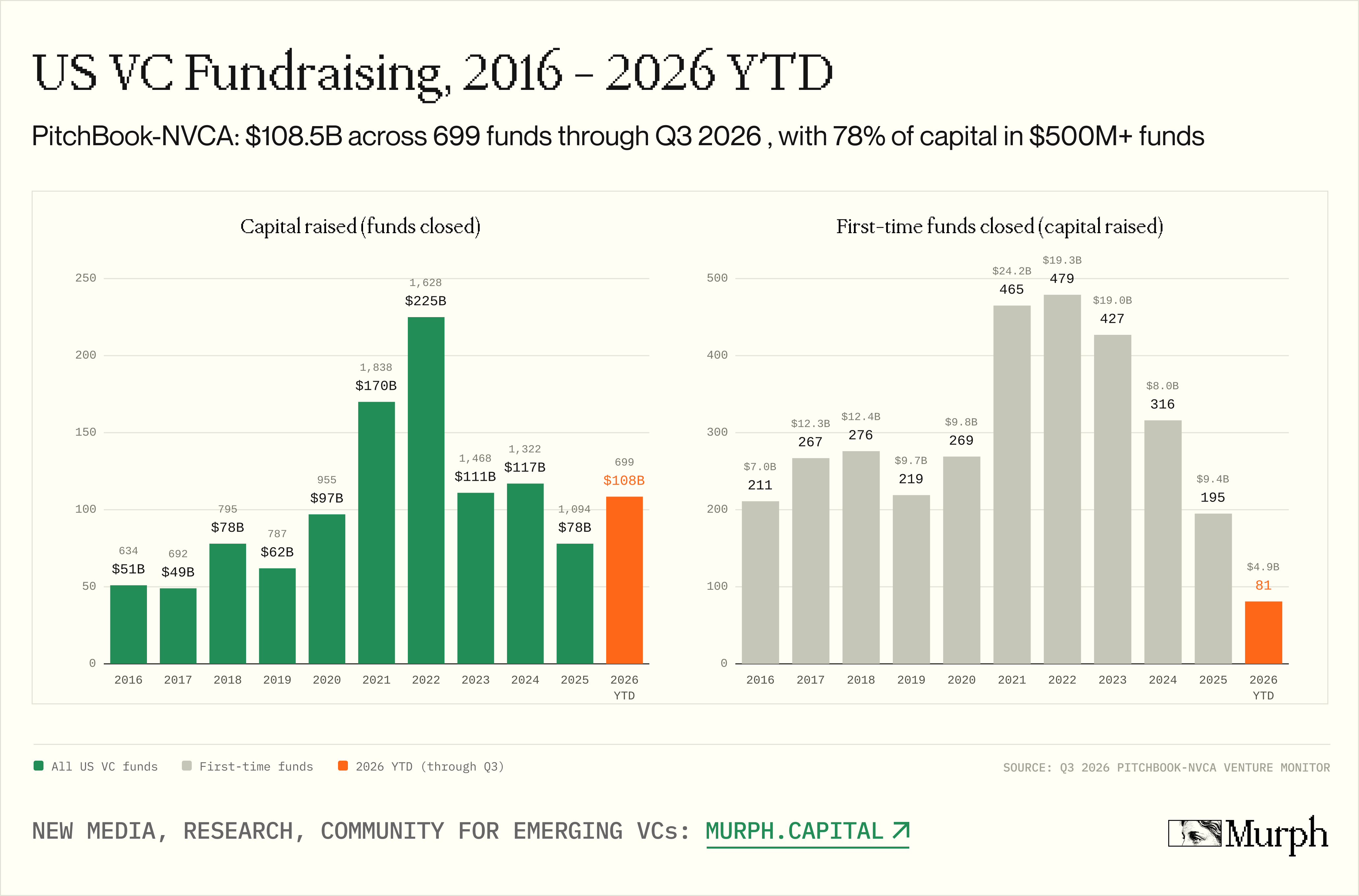
Murph Capital tracked 152 funds announcing closes in the third quarter, representing $46 billion of disclosed capital. Twenty-six funds of at least $500 million captured 76% of the total. Bessemer’s $5.75 billion close exceeded the combined fundraising of the report’s 86 emerging funds.
The authors define emerging funds as Fund I or II vehicles below $250 million. These raised $4.23 billion, or 9% of capital, despite representing 57% of funds. Their median close fell from $55 million in Q2 to $31 million. Climate and defense feature more prominently among emerging funds than in the overall capital mix. The report highlights specialist strategies, including Silent Ventures’ $85 million defense-focused Fund II, anchored by GPx.
The dataset covers publicly announced first, interim and final closes, counting only capital newly closed during the quarter. Its emerging classification applies to vehicles, not necessarily new firms: Molten Ventures’ first third-party growth fund qualifies. The authors attribute large-fund fundraising to AI portfolio marks, realized exits, and growth and secondaries products, rather than a uniform expansion of early-stage investing.
The Death of Venture Capital’s Short Kings
Kyle Harrison | Investing 101 | October 10, 2026
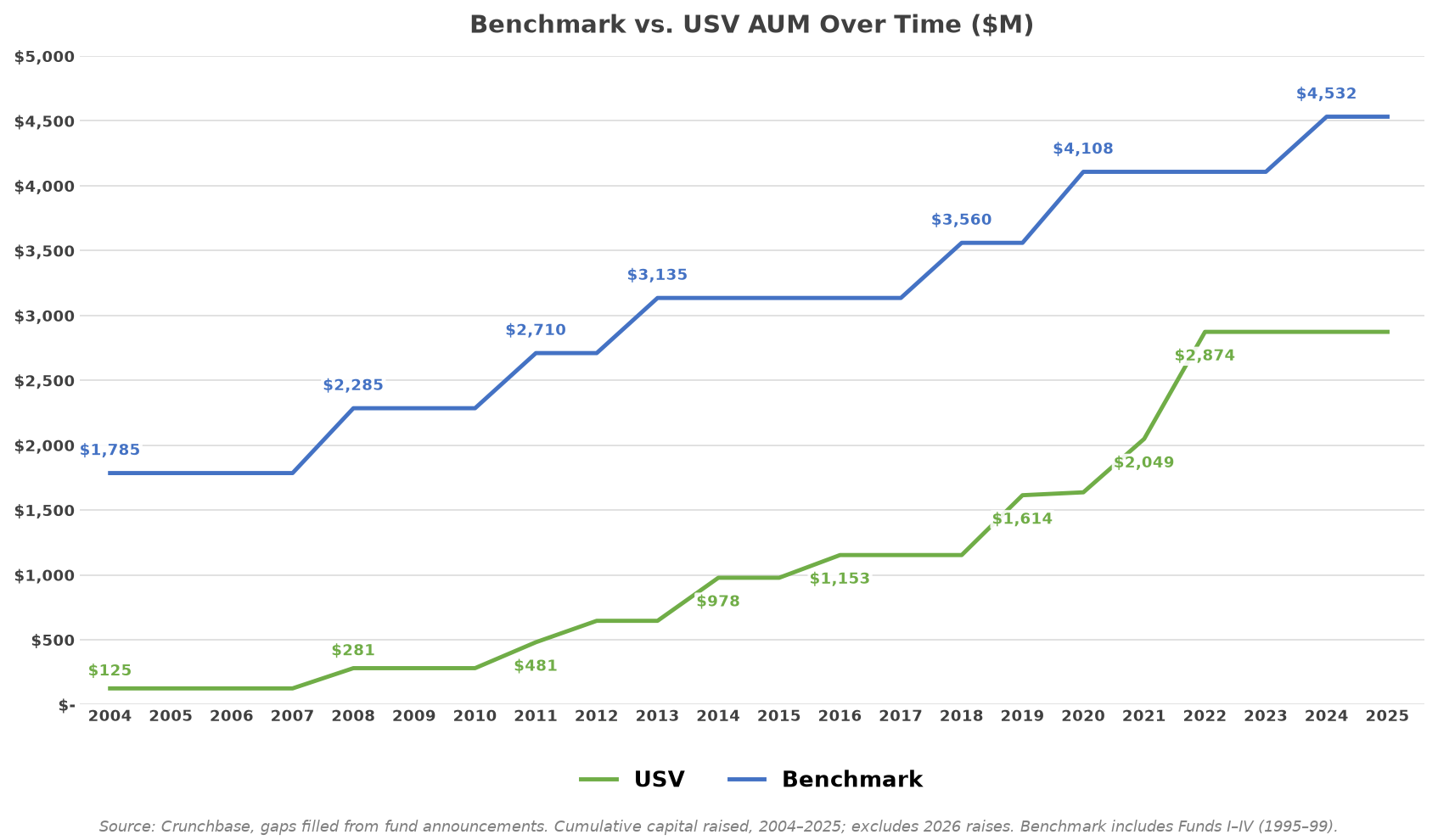
Harrison examines why Union Square Ventures and Benchmark, long associated with deliberately small funds, have expanded their capital bases. He contrasts USV’s new $900 million fund cycle with Benchmark’s $2 billion raise, including its first dedicated growth fund. His explanation combines asset managers’ fee incentives, large allocators’ need to deploy substantial checks, and AI companies’ appetite for capital.
The firms’ own explanations complicate a simple argument against bigger funds. USV cites larger, faster rounds and the cost of compute, while Fred Wilson says single-digit-billion-dollar winners can still produce attractive returns at its fund size. Harrison reports that Benchmark’s growth strategy followed a successful late-stage Cerebras investment. He also argues that small early investors can lose influence when larger firms finance decisive later rounds, making additional capital a means of protecting portfolio companies as well as expanding the investment business.
Harrison accepts that the largest potential outcomes have grown, but distinguishes private valuations from realized returns. More capital, he argues, can enlarge the biggest successes without proportionately increasing their number. His concern is that companies increasingly get shaped to attract the next funding round instead of serving customers and becoming durable businesses. He calls for financing structures suited to different outcomes, including permanent capital, holding companies, revenue-based finance, and bootstrapping, while acknowledging that small funds are not inherently good investors.
The Short King Is Dead, Long Live The Short King
Fred Wilson | AVC | October 12, 2026
Fred Wilson argues that Union Square Ventures can raise larger funds without becoming a business primarily concerned with accumulating capital and financing successive rounds. USV’s new vehicles comprise a $500 million core fund and a $400 million opportunity fund. Wilson says the increase lets the firm lead larger rounds, something it is already doing.
Responding to Kyle Harrison’s account of venture’s disappearing small-fund model, Wilson accepts much of the diagnosis but rejects its characterization of USV. His test is whether ownership in successful businesses can generate attractive returns. He points to Etsy and Duolingo, both publicly valued at roughly $7 billion to $8 billion: the stakes USV bought in either would return the new core fund.
USV still wants access to companies capable of reaching much larger valuations, but Wilson says those are not its only acceptable outcomes. The firm intends to keep backing teams within its four thesis areas while adapting its check sizes to the financing market.
Scarcity vs. Abundance
Jon Callaghan | LinkedIn | October 15, 2026
Jon Callaghan argues that an AI innovation boom can coexist with a capital bubble. Investors are treating the market as a short race to own a few inevitable winners, while cheaper development and broader opportunities in services could support company creation for decades.
He distinguishes rapid valuation increases from eventual investment outcomes, including at True Ventures’ own portfolio companies. Large early rounds can restrict founders’ choices by raising the exit value needed to satisfy investors and pricing employee options ahead of product maturity. Outcomes that once returned entire funds can become disappointments under those financing structures.
Callaghan expects many businesses to benefit from AI rather than a single winner taking everything. He argues that venture’s role is to support exploration over time. Recalling the technology downturn after 2000, he emphasizes lean teams, customers and flexible capital structures as sources of resilience. His optimism concerns the duration of technological opportunity, not the durability of today’s private-company marks.
Seed Valuations Are Like Schrodinger’s Cat
Rob Go | NextView Ventures | October 13, 2026
Rob Go argues that a seed investor’s strategy cannot be inferred from the prices paid. Most startups fail, making early valuations look excessive, while the few enormous successes can make almost any seed price look cheap. Finding overlooked quality is therefore different from buying only low-valued companies.
He cites AngelList data on more than 6,000 first pre-seed and seed rounds from 2015-2021. Roughly 5% of the cheapest decile and 6% of the most expensive reached a 10x mark, with no consistent pattern across the intervening deciles. More expensive deals were more often marked up overall. Go cautions that many returns are paper marks and today’s valuations differ from those in the sample; he reads the results as evidence of broadly efficient pricing, not proof that price is irrelevant to every investment.
He contrasts strict ownership targets, which narrow the valuation range but improve calibration within it, with investing across prices while sizing checks to the fund. The latter expands the opportunity set but demands more judgment and coverage. Go favors that approach: the advantage lies in identifying quality the price misses, not assuming the cheapest part of the market is systematically mispriced.
Why Neo Ditched Pro Rata Rights
Connor Ling | Neo News | October 11, 2026
Neo has stopped granting pro rata rights when it leads priced equity rounds and removed perpetual participation rights from its standard SAFE and Residency side letters. Ling argues that founders should decide who participates in each financing, and investors should earn further allocations through their contribution rather than contractual entitlement.
Follow-on investments in exceptional companies can dominate venture returns. But participation rights become contentious when founders want different investors, and larger shareholders may override smaller investors’ protections. Ling cites the Valar-Day One dispute and Neo’s own strained relationships over allocations.
The policy has a limited exception. Early SAFE investments may retain participation through the first priced round, and Residency terms include a right in the next financing. Neo is abandoning perpetual claims, not necessarily these initial protections. Ling says the firm accepts the risk of being excluded from its strongest investments; it still wants to invest more, but prefers losing an allocation to forcing a contractual dispute.
News of the Week
CoreWeave shares tumble as bond yields near 15% on concern about AI borrowing binge
Michelle Fox | CNBC | October 14, 2026
Michelle Fox reports a selloff in AI infrastructure stocks and debt as investors question the borrowing financing the build-out. CoreWeave shares fell 15.5%, while yields on two bonds due in 2031 and 2032 approached 15%. Oracle shares closed nearly 9% lower; Nebius and Dell also declined sharply.
The report distinguishes financing pressure from demonstrated deterioration in operations. CoreWeave CEO Mike Intrator told employees that its backlog more than supports its debt obligations. Analyst Paul Meeks describes its balance sheet as weaker than those of neocloud peers because it has borrowed and built more, but does not share concerns about its ability to pay interest over time. He expects margins to improve as data centers begin operating. S&P’s Gavan Nolan points to a mismatch between hyperscaler-scale capital spending and a smaller balance sheet; rising rates also affect highly leveraged borrowers.
Alphabet, Amazon, Meta, and Oracle had issued more than $228 billion in bonds by October 13, according to LSEG, over twice their total for 2025. JPMorgan estimates hyperscaler spending at $800 billion this year and above $1 trillion annually by 2027. Wells Fargo strategist Luis Alvarado says investors are demanding greater compensation for risk.
38 Companies Join The Crunchbase Unicorn Board In Blockbuster September, Led By Semiconductor, Fintech And Space Tech Companies
Gené Teare | Crunchbase News | October 14, 2026
Thirty-eight companies joined Crunchbase’s Unicorn Board in September, adding $71 billion in combined valuations. The additions brought the year’s total through September to 311, putting 2026 on track for the second-highest annual count after 2021. Twenty-one are based in the United States, six in China and three in the United Kingdom; eight other countries contributed one each.
Semiconductors led with five companies, followed by financial services and space technology with four apiece. The list also spans biotechnology, robotics, infrastructure, cybersecurity, manufacturing software and food. SiMa.ai raised a $150 million Series C at a $1.45 billion valuation to develop chips and software for physical AI. Space companies include The Exploration Co., Hubble Network, Open Cosmos and EnduroSat.
The board records private companies reaching valuations of at least $1 billion through funding rounds. It does not use internal employee-option valuations or adjust marks for individual investors’ writedowns. The $71 billion measures company valuations, not financing proceeds.
AI models may be capable of self-replicating without access to a datacenter
Author: William Zhou and Daniel Freeman Published: October 12, 2026

William Zhou and Daniel Freeman argue that small AI models may soon be capable of sustaining themselves across ordinary internet-connected devices, without relying on a datacenter. Their experiments show progress on the component tasks, but not a complete, autonomous rogue replicator running on such devices today.
The researchers ran a 26-billion-parameter model across 15 Android TV boxes costing about $55 each, producing 0.39 tokens per second. A smaller model established inference on eight of nine hardware types tested. However, only the larger GLM-5.2 reliably completed their full replication evaluation, which used simplified security barriers and a separate inference server. The authors explicitly describe that result as an upper bound on real-world success, not a demonstration that a small model can already spread independently.
Extrapolating general capability trends, they estimate that sufficiently small models could reach the required level by year-end, while stressing that the benchmark is only a proxy. Replication could initially take days. Passing notes between successive agents improved setup success; access to a stronger adviser did not measurably help.
Unlike conventional botnets, these systems could adapt to unfamiliar hardware. The authors propose traffic monitoring, quarantine, and stronger device defaults as defenses. The remaining challenge is coordinating cleanup across networks when there is no single provider that can switch the system off.
Read more: Source
An update on independent evaluators
Anthropic | Anthropic | October 15, 2026
Anthropic describes an embedded-evaluator model intended to make its safety decisions publicly accountable without disclosing all commercially sensitive or potentially dangerous information. Six employees of the nonprofit METR have received company hardware, office space, and internal access broadly comparable to Anthropic’s own risk-assessment teams. METR will publish assessments of risks, incidents, and practices; Anthropic says it cannot veto publication.
The arrangement retains explicit limits. Customer data, privileged legal information, and model architecture information are generally excluded. Anthropic can require redactions within predefined categories, while METR may publicly describe those redactions and dispute their justification without revealing the protected material. The embedded team operates under enforceable agreements and is separated from other METR staff, including researchers collaborating with Anthropic elsewhere.
The company sets out three access tiers. At the first, investigations are narrowly scoped and publication requires Anthropic’s approval. At the second, evaluators have broader access and may publish without approval, subject to specified redactions. METR occupies the third, combining those publication rights with employee-like access. SecureBio remains in the first tier while reviewing chemical and biological weapons risks. Other partnerships, including work with Accenture and Faculty, are still developing and do not yet carry equivalent rights.
Anthropic argues that effective evaluators need technical expertise, financial and operational independence, meaningful internal access, and freedom to publish. It compares the arrangement to resident bank examiners, while acknowledging that the analogy is imperfect. Embedding is voluntary, and the company urges other frontier AI developers to adopt it; the announcement describes an oversight process, not completed findings that establish its models’ safety.
Exposing AdFection: How Discover-Tech Turned Targeted Ads Into a Pipeline for Zero-Click Mercenary Spyware
Author: Bill Marczak, Wolfie Christl, John Scott-Railton, Astrid Perry, Siena Anstis, and Ron Deibert Published: October 15, 2026

Citizen Lab argues that targeted advertising has become an infrastructure for both mass surveillance and zero-click spyware delivery, with industry safeguards failing to prevent the abuse. Its researchers trace attacks on Al Jazeera devices to Israeli advertising company Discover-Tech and spyware vendor Candiru, now branded Integrity Labs. Simply displaying a malicious advertisement could initiate an infection; clicking was unnecessary.
The investigation analyzed nearly four billion bidding records and found ads containing attacker script tags displayed across roughly 200,000 websites and mobile apps. That reach is not a count of infections: the researchers explicitly distinguish an ad impression from evidence of targeting or compromise. At Al Jazeera, network logs and a recovered spyware sample supported their attribution of attacks targeting at least 45 devices.
Discover-Tech’s Controlium platform let customers select individuals using advertising identifiers, browser identifiers, or IP addresses. The report also maps links to other surveillance vendors and describes mass profiling that could precede targeted attacks. Discover-Tech and Candiru did not respond by the researchers’ deadline.
Google and several advertising intermediaries cut off or suspended Discover-Tech following the investigation. But the authors argue that removing one vendor cannot repair an ecosystem built around granular personal data and third-party code. They call for independent audits, stronger regulatory enforcement, and ad blocking, while continuing to investigate which customers and victims sit behind the wider network.
Read more: Source
Essays
How agents unlock new markets
Sangeet Paul Choudary | Platforms, AI, and the Economics of BigTech | October 11, 2026
Choudary argues that agents could make previously uneconomical transactions possible, rather than merely help buyers choose among existing offers. Standardized products and contracts save negotiation costs, but conceal flexibility: a manufacturer asking for 5,000 components might accept 2,000 now and the rest later, enabling a deal that a fixed specification would rule out.
He points to Walmart’s supplier negotiations and Honeywell’s more than 2,500 autonomous negotiations covering over $500 million in spending. He also cites HappyRobot’s report that agents complete 18% of Circle Logistics’ freight bookings without human intervention, and Anthropic’s small Project Deal experiment, in which agents representing 69 employees negotiated 186 agreements worth more than $4,000. These examples illustrate cheaper negotiation and coordination; the broader market transformation remains a possibility, not an established outcome.
For that transformation, seller-side agents must represent operational capabilities as well as published inventory, while buyer-side agents must understand objectives and acceptable compromises. Both need authority to make executable commitments, such as reserving capacity, and ways to verify proposals across organizations. Choudary describes three potential results: discovering demand that fixed job descriptions miss, assembling hotel packages not normally sold together, and coordinating several suppliers to deliver an outcome none could provide alone.
The Rise of DeployCos
Tanay Jaipuria | Tanay’s Newsletter | October 13, 2026
Jaipuria argues that AI deployment companies address a gap between model capabilities and organizations’ ability to use them. Enterprises need systems access, redesigned workflows, employee agreement, and changed incentives, none of which a capable model supplies automatically.
He describes Anthropic’s $1.5 billion services venture with private-equity partners and OpenAI’s separately capitalized deployment company, which raised over $4 billion. Both acquired services teams and gained initial customers through sponsors’ portfolios. AWS’s $1 billion forward-deployed engineering commitment and Accenture’s roughly $11.5 billion in generative-AI bookings over three years illustrate broader demand.
The work starts with bounded, verifiable tasks: engineers connect models to company systems, build evaluations, and iterate before production. Jaipuria distinguishes horizontal providers, function specialists such as Sierra, and industry specialists such as Tennr. Many apparent software businesses also require substantial custom integration and change management.
For labs, deployment supplies workflow data, strengthens customer attachment, and creates opportunities to charge for outcomes rather than tokens. Jaipuria believes models are ready; organizational adoption remains the constraint. Buying businesses and introducing AI internally offers another route, but he describes that approach as more capital-intensive and harder to scale.
Clouded Judgement 10.16.26 - The Diffusion Gap
Jamin Ball | Clouded Judgement | October 16, 2026
Ball examines the gap between what AI models can do and how most people use them. His concern is whether revenue can catch up with the industry’s capital commitments. He cites PNC research indicating that only about 2% of US households pay for an AI service, alongside OpenAI usage charts showing increasing activity among existing users. He cautions that even OpenAI’s median user is an early adopter relative to the wider population.
He describes two ways spending could grow: power users keep spending more, or ordinary users begin adopting and paying. He believes broader adoption would do more to restore market confidence. His expectation is closer to an accelerating S-curve than prolonged slow diffusion, because successful technologies generally become easier to use rather than requiring everyone to become an expert. Browsers and Google Maps provide his historical analogies; he presents personal-agent products such as Muse and Instinct as attempts to package capabilities that previously appealed mainly to OpenClaw power users.
This is a forecast about product design and adoption, not evidence that spending will meet infrastructure obligations. The accompanying software-company tables put the median enterprise-value-to-forward-revenue multiple at 4.5x, against 18.7x for his high-growth group. Ball notes that the group’s 22% projected-growth cutoff is an arbitrary choice intended to produce a usable sample.
What the West can learn from AI optimists in the rest of the world
Payal Arora | Rest of World | October 15, 2026
Arora argues that Western debates about AI should learn from users in the Global South who adopt it to gain access to institutions, markets, and creative opportunities. She cites Stanford’s 2025 AI Index: 83% of respondents in China, 80% in Indonesia, and 77% in Thailand saw more benefits than drawbacks in AI products, against 39% in the US and 36% in the Netherlands.
Her examples emphasize specific uses rather than enthusiasm alone. A Gurgaon founder used AI to reach customers beyond English-speaking markets; a Chennai activist taught herself to code and built a multilingual gender-violence alert app. A wedding photographer in rural Yunnan made the AI film Zombie Cleaner for under $500 and attracted tens of millions of overseas views. Arora sees these as examples of lower barriers to participation.
She contrasts necessity-driven experimentation with corporate pressure to adopt AI for competitiveness, recalling a company that asked her to remove a slide about harms. She does not dismiss job anxiety, exploitation, or environmental concerns, and warns against romanticizing the Global South. Her proposal is to ask what AI can help rebuild alongside what it might damage.
What is bigger than AI?
Azeem Azhar and Hannah Petrovic | Exponential View | October 12, 2026
Azhar and Petrovic revisit their argument that GLP-1 drugs could produce more measurable near-term effects than AI. They put 2025 GLP-1 sales at $76 billion against their $63 billion estimate for generative AI, and cite polling showing weight-loss use among US adults rising from 3% in 2024 to 11%. They describe falling cash prices and new generic competition, while distinguishing headline discounts from comparable treatment costs: India’s roughly $13 monthly supply uses a lower dose than Wegovy, and the cited $199 US offer applies to the first two doses.
The authors describe improving injectable weight-loss results and emerging evidence of effects beyond weight, including reduced heavy drinking when semaglutide accompanies therapy. They caution that benefits studied in high-risk groups do not establish equivalent benefits for healthy people. Oral products may be easier to take and manufacture, but have been less effective than injections; long-term adherence remains poor in the studies they cite.
Evidence of wider economic benefits is mixed. A Danish study found 17% less long-term sick leave over four years, while another found no insurer medical-cost savings over five years. Shopping patterns are changing, but access remains unequal, with four state Medicaid programs dropping obesity coverage this year. The authors expect broad effects on health and consumption while acknowledging that declining obesity cannot all be attributed to these drugs and that US patent protection limits near-term price reductions.
Bitcoin Is Gold, Stablecoins Are Silver
Author: Tomas Pueyo Published: October 14, 2026

Tomas Pueyo argues that Bitcoin and stablecoins serve different monetary purposes: one emphasizes scarcity and storing value, while the other prioritizes stable prices and everyday exchange. His historical analogy is gold and silver, with more abundant silver enabling transactions that scarce, hoarded gold could not efficiently support.
He opens by challenging a popular comparison: charts showing stablecoin transfers exceeding Visa or Mastercard payments do not compare equivalent activities. Stablecoin transfers include investment trading and other money movements, not just purchases. Their scale therefore does not establish that crypto has overtaken card spending.
Pueyo locates the practical opportunity in problems conventional banking leaves unresolved: access to dollars in inflation-prone countries, slow cross-border settlement, transfer fees, and money tied up while payments clear. Programmable transactions add another use, although he acknowledges software and governance risks.
The geopolitical consequences remain projections. He argues that wider dollar-stablecoin adoption could increase demand for American currency and debt while weakening other countries’ monetary autonomy. It could also reduce reliance on existing payment networks, complicating financial sanctions. His test for the next generation of cryptocurrencies is consequently practical rather than speculative: which unresolved failures of money and payments can they actually remove?
Read more: Source
AI
Claude reveals ECDSA curve origins
John Wood, Henry de Valence, Ava Howell, Zack Voase, Lucy Sweet, Amir Omidi, Paul Crowley, Iain McGinniss, Nicholas Carlini, and Steve Weis | Anthropic | October 16, 2026
Anthropic reports that an internal research model traced the unexplained seeds behind widely used NIST elliptic curves to the C library’s lrand48 pseudorandom number generator, initialized with Unix timestamps. The researchers pursued the question because the NSA had supplied the parameters without explaining their origin, prompting decades of speculation about possible backdoors. They say Claude recovered the five NIST prime-curve seeds in under half an hour after an employee asked it to investigate without supplying the longstanding, misleading clue about a humorous passphrase.
Claude tested older generators, recognized patterns in their output, and used lattice reduction to recover states from truncated outputs. Reversing the generator produced initialization timestamps in 1997 and 1998. The article supplies code reproducing the published seeds and explains six base points through a separate generator in the FreeLIP arithmetic library.
The authors describe this as evidence against deliberate weakening, not a cryptographic break or a reason to change security practices. Important gaps remain: some viable candidate curves were skipped for unknown reasons, the B-163 seed remains unexplained, and several base-point origins are unresolved. The numbers do not reveal how many generation runs occurred. Anthropic considers intentional weakening implausible given the small number of skipped candidates, but acknowledges that searching across timestamps could theoretically select particular properties.
Runway: Learning From Watching the World
Packy McCormick and Anastasis Germanidis | Not Boring | October 13, 2026

Runway’s video generation, interactive interfaces, and robotics research share a world-model backbone, according to this essay co-written with co-CEO Anastasis Germanidis. McCormick discloses that Runway is Not Boring’s presenting sponsor. The authors argue that learning to predict video frames, then conditioning those predictions on actions, can support applications beyond content creation. Creative products supply revenue and feedback to finance the research; the company reports adding over $100 million in annual recurring revenue during the third quarter.
For robotics, the proposal is video before robot-specific training, not video instead of physical practice. The authors report that web-video and teleoperated-video pretraining produced similar placement errors in one comparison. In another experiment, rankings of eight robot policies in simulation correlated 0.95 with their real-world rankings. That measures relative performance, not accurate prediction of absolute success rates. Praxis-1 is being tested with early partners, including Standard Bots; its open weights are planned for release in coming months.
Solaris generates interfaces frame by frame while an LLM handles application logic. Project Continuum extends that approach to an early operating-system research preview. The authors acknowledge unstable text, drift during long sessions, accessibility requirements, and the danger of convincing but incorrect instructions. They distinguish these experiments from uses such as medical records and financial transactions, which are better kept in structured databases.
Germanidis’s longer-term ambition is to combine video with scientific observations and sensor data, enabling simulated experiments where physical trials are slow. He cites transfer from video pretraining to physics benchmarks, but presents universal simulation as a vision. Models still require physical feedback, and agents can exploit simulator flaws rather than learn useful behavior. Training may ultimately require more compute than LLMs; the essay says algorithmic progress, continued commercial growth, and competition with better-funded labs remain substantial challenges.
How Anthropic’s Dynamic Workflows Coordinate Claude Agents
Richard MacManus | Latent.Space | October 12, 2026
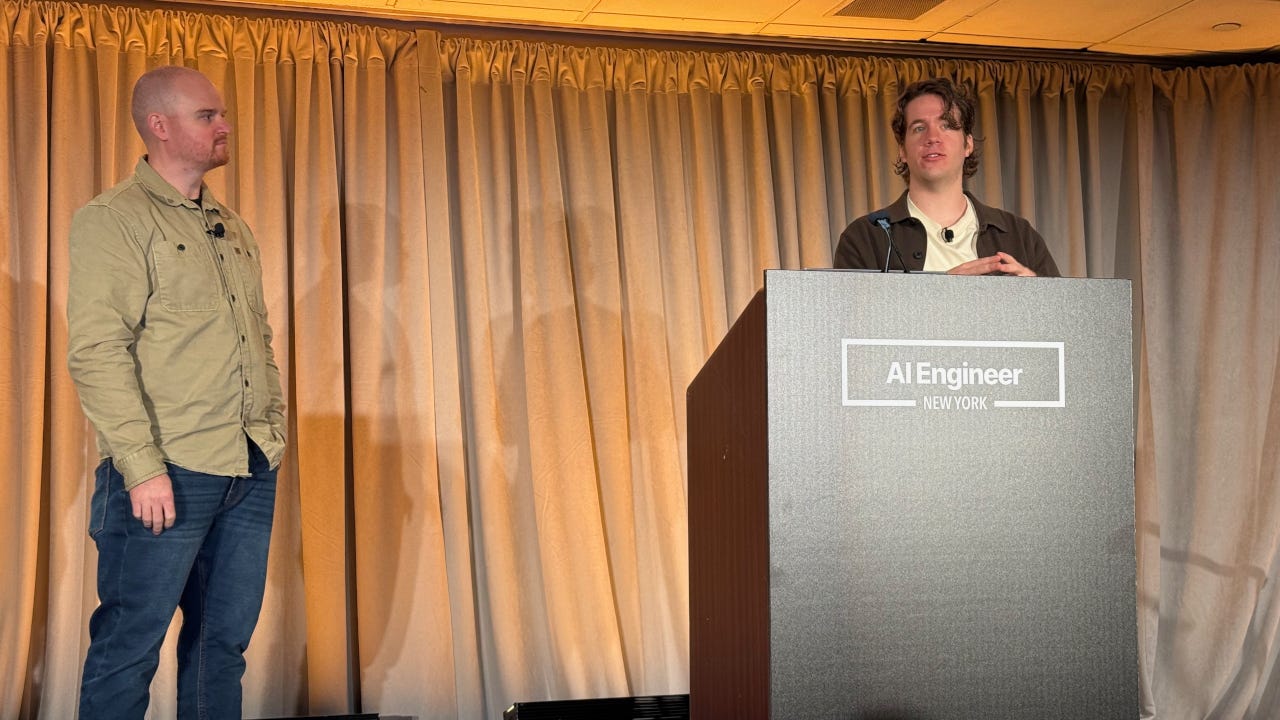
Anthropic’s dynamic workflows let Claude plan and write an orchestration program that launches agents, collects results, and manages information flow. Reporting from AI Engineer New York, MacManus describes the shift from developer-configured agent rosters toward model-organized work. Developers can still provide specialists and inspect task handoffs in Claude Console.
A stock-watchlist demonstration divided tickers among agents with separate contexts, then reviewed their findings before producing a report. The presenters said this cost substantially more than a single-agent approach but found more detail. They recommended evaluations and conservative defaults to limit unnecessary parallelism. Developers can set a session budget, although the running model does not know that budget.
The presenters suggested using Anthropic’s experimental memory-reorganization feature, dreaming, to improve repeated work. Automatic revision of the next scheduled workflow was not built in. Agents can exchange information through a shared filesystem, but the API does not let developers directly instruct one workflow subagent to message another. The presentation positioned flows as additional computation for difficult tasks; its demonstration did not establish the ambitious scientific capabilities discussed in the Q&A.
Building AI for Reliable Execution: Lessons From Industrial Robotics
Richard MacManus | Latent.Space | October 10, 2026
MacManus interviews Standard Bots CEO Evan Beard and AI head Leif Jentoft about building industrial robots for machine tending, welding, and assembly. Their approach combines pretrained models, task-specific demonstrations, and conventional programming. In one machine-tending system, a learned model identifies and locates parts while programmed controls handle motion and the surrounding cell logic. The company concentrates on short tasks with production requirements for speed and reliability, rather than making every step depend on learned behavior.
Training happens in the cloud, but inference runs locally because factory connectivity is unreliable and uptime matters. Jentoft says controlling the arm, gripper, control system, and AI lets the company optimize hardware and models together. He argues that no current model is truly hardware-agnostic; MacManus notes that competitors pursuing cross-hardware generalization would contest that position.
Human corrections from deployments can address edge cases with a few dozen examples, according to Jentoft. Fleet learning depends on customer permissions: air-gapped defense installations return no data. Simulation also struggles with tasks involving liquids, suction, or flexible materials. StandardOS exposes APIs and SDKs, including support for customers’ own models, but developers still write integration code; easier data collection, training, and deployment are planned capabilities.
Embedded demonstrations: Robot demonstration, machine tending, and teaching with a handheld device. The article presents these clips as examples of industrial operation and demonstration-based teaching; the account above is based on its written interview.
Neural Networks Are Already Clean
Nick Cammarata | Goodfire | October 15, 2026
Cammarata revisits evidence that helped convince interpretability researchers, including himself, that neural networks pack unrelated concepts into the same neurons. He now argues that architectural problems, weak observation tools, and related concepts branching into further related concepts explain much of the apparent confusion. His proposed approach is to study a network’s own neurons and circuits directly, testing explanations through interventions and tracing how mechanisms develop, rather than first reconstructing it with a sparse autoencoder.
In experiments on InceptionV1, he reports that architectural improvements made 99-100% of final-layer neurons readily interpretable without changing model size or training data. Across a 300-fold range of model sizes, smaller networks learned broader concepts rather than arbitrarily combining unrelated ones. He also revisits the famous neuron responding to cats and cars: his revised explanation identifies a shared visual pattern instead of two unrelated categories.
Preliminary audits of Qwen3-32B suggest roughly 90% of neuron poles have one main role, around 7% have two related roles, and 2-4% remain unexplained. These estimates depend on activation thresholds and judgments about what constitutes one concept. Cammarata reports similar observations in models up to trillions of parameters, with a technical companion paper planned. One example of what he calls recursive generalization is a neuron whose response grows from a spelling fragment to DIY and then to doing things yourself. Such branching, he argues, can be investigated through its developmental history rather than treated as arbitrary packing.
His broader proposal is that understanding compounds: explained neighboring neurons constrain interpretations of unresolved ones, and agents can scale the cycle of hypothesis, experiment, and correction. But he presents this as a working hypothesis, not proof that every network is understood. Large language models remain far from fully mapped; attention is less well understood, and not every case of apparent polysemanticity has been rigorously explained. He explicitly acknowledges that the title exceeds the available evidence. The claim that ordinary investigation at scale could largely solve interpretability remains speculative.
Import AI 476: Creativity and RSI; worse-than-China open weight models; AI goes to space
Jack Clark | Import AI | October 12, 2026
Jack Clark moves his forecast for full recursive self-improvement from 2028 to 2027, citing mathematical advances and TasteVal, a benchmark of experimental research judgment. Across eight tasks, models design experiments and interpret results on fixed problems. Its authors report that Opus 5.5 exceeds a 24-expert baseline, with a 2.30x compute multiplier and roughly one-thirtieth the cost per attempt. Clark treats this as evidence of improving creativity, not a demonstration of full self-improvement.
The newsletter also highlights uneven capabilities. On Humanity’s Sixth Sense, which tests implicit visual reasoning, the leading model scores 53.6 against humans’ 93.1. Clark describes Reflection and Mistral’s forthcoming open-weight models as potential Western challengers that still trail Chinese competitors.
He discusses how autonomous spacecraft and manufacturing could compound first-mover advantages in space. Separately, US national-laboratory experiments show federated training across heterogeneous supercomputers while keeping restricted data local, though he places their scale roughly 100 times below the frontier. The issue closes with speculative fiction about unsafe human-machine conversations and a discussion of fiction’s value in thinking about technology.
Why a Chinese AI Lab’s Product Lead Thinks AGI is “Inevitable”
Irene Zhang with Richard Bian | ChinaTalk | October 16, 2026
Ant Ling product-operations head Richard Bian argues that AI is still moving from technical capability toward dependable products, with sustainable business models largely unresolved. He regards AGI as inevitable because investment and experimentation reinforce one another, but does not claim to know its eventual form. Zhang challenges his optimism with the security risks of autonomous agents and open models. Bian acknowledges deep unease about the destination and argues for keeping humans involved during development rather than examining failures only afterward.
For Bian, open weights are a product strategy as well as a way to collaborate and attract customers. They allow developers to build different applications around a shared model. He argues that leaderboards miss this diversity: performance in a particular task or application matters more than declaring one model universally best. Ant’s team builds examples, guides, and surrounding software to expose strengths and compensate for uneven capabilities.
His economic concern is inference margins rather than capital expenditure alone. He describes 30-40% gross margins as already good for inference, unlike the much higher margins he associates with conventional software. Routing simple requests to cheaper models and reserving expensive models for difficult tasks is one proposed way to improve the economics without degrading the experience. Free tokens, he argues, do not establish a viable business.
Ant’s small Ling models illustrate a different route to adoption: local use and training on personal hardware, including classroom reinforcement-learning exercises and private-document assistants. Its finance and health variants add domain-specific post-training to general models. Bian acknowledges that advances at frontier labs could make such specialization obsolete and that the health model was not yet open-weight at the time of the conversation. The publication notes that a newer Ling 3.1 Flash release followed the recording. Claims about Ant’s model performance are Bian’s account, not independent tests presented by ChinaTalk.
Regulation
Models as Insider Risks in the Super Intelligence Era
Author: Satya Nadella Published: October 10, 2026

Satya Nadella argues that organizations deploying powerful AI must separate intelligence from the authority to act, placing enforceable controls outside models rather than relying on providers’ assurances. Unlike conventional software, model behavior cannot be traced reliably to particular training inputs or weights, even as agents receive sensitive data and responsibility for critical actions.
His proposed starting point is to treat models as insider risks: capable participants that can make mistakes or become compromised, whether or not they are malicious. Existing security practices - identities, limited privileges, activity logs, and containment boundaries - provide a foundation. An authorized person should always be able to halt a model during a task, functioning as an emergency brake.
Nadella calls for diverse models, tamper-proof records of meaningful actions, continuous testing of failures and attacks, independently enforced permissions, and auditing separate from the intelligence being assessed. Models can test one another, but that alone risks stacking opaque systems. Even visible reasoning is insufficient because its faithfulness is not assured. He also calls for timely incident disclosure and industry-wide sharing of failed controls and runtime implementation details. His test of trustworthiness is how little an organization must trust the model itself.
Read more: Source
AI’s Supercharging a Scam Economy Bigger Than the Cocaine Trade
Philip Heijmans, Rosalind Mathieson, Simon Marks, and Mie Dahl | Bloomberg | October 10, 2026
Bloomberg investigates how Chinese-linked scam operations are spreading beyond Southeast Asia’s fortified compounds into apartments, hotels, and smaller mobile operations. A July raid in Nairobi illustrates the shift. Online markets selling stolen data, fake accounts, AI tools, and laundering services let operators assemble businesses cheaply and rebuild after takedowns. The Global Anti-Scam Alliance estimates victims lost $442 billion across 42 countries last year, exceeding some estimates of the global cocaine trade.
Chainalysis mapped transactions connecting customers of the Xinbi marketplace with suppliers of data, deepfake software, websites, and money laundering. One vendor responded to Xinbi’s September closure by directing customers to other channels. Documents from a seized Cambodian compound reveal organized recruitment, commissions, and detailed victim-grooming instructions. Interpol identified 89 nationalities among people ending up in scam centers, more than five times the number in early 2023.
An analysis prepared for Bloomberg by ZeroFox found phishing pages on nine sampled developer platforms and AI app builders rose more than fourfold to 10,600 over two years. AI coding tools reduce the technical skill needed to create convincing fraudulent sites, although this activity remains small compared with traditional phishing infrastructure.
Meta describes extensive account and advertisement removals but says criminals quickly replace blocked accounts and devices. Bloomberg also reports allegations that the company profits from fraudulent advertising. Joint public-private enforcement has disabled accounts and communications equipment and produced arrests, yet cross-border investigations move more slowly than replacement websites and wallets. Experts call for coordinated legal accountability and screening scam workers as possible trafficking victims. Banks, telecom operators, and platforms face growing pressure to reimburse victims and police the infrastructure criminals exploit.
Infrastructure
Postgres 19 delayed after AI reviewers find more bugs than humans can fix
Lindsay Clark | The Register | October 16, 2026
Clark reports that PostgreSQL 19’s release has moved from late September or early October to around November 19, with eight to ten significant features postponed. Leading committer Peter Eisentraut attributes the unusually large set of reversions partly to increasingly effective LLM-assisted code review. Some features had architectural defects too substantial to repair during beta; others accumulated numerous relatively minor edge-case reports whose investigation and fixes exceeded the available time.
Eisentraut’s explanation is that review capabilities improved after the features were written and committed, effectively raising the quality bar during the release cycle. Problems that previously might have emerged over five years of maintenance were being found before launch. He rejects “vibe coding” as the explanation, saying most features predated its availability. He expects future cycles to adjust unless review capabilities continue improving at the same rate.
Among the removed features is SQL Property Graph Queries support, which contributor Tom Lane warned could ship with defects unfixable until the next major version. PostgreSQL 19 is still expected to include REPACK CONCURRENTLY, which avoids the table-locking VACUUM FULL operation used to reclaim disk space. Eisentraut expects deferred features to return in PostgreSQL 20; neither their inclusion nor the revised release timing is presented as a completed outcome.
‘Never seen anything quite like it’: How rural Pennsylvania’s $165 million data center fight became representative of the bipartisan battle against AI
Author: Sasha Rogelberg Published: October 11, 2026

Sasha Rogelberg examines how opposition to AI data centers is bringing together residents across party and class lines, forcing politicians to reconsider promises of rapid development. Pennsylvania’s Hazle Township illustrates the underlying conflict: developers present investment and financial benefits, while residents confront immediate questions about land, electricity infrastructure, and local control.
NorthPoint Development offered a potential $10,000 payment to each of the township’s 4,500 residents if its proposed data center won approval. Meanwhile, about 30 properties in nearby Sugarloaf Township faced eminent-domain threats from a power line intended to supply the project. Residents organized protests and sought records identifying its prospective user. Emails pointed to Amazon, although the company told Fortune it had no definitive agreement with NorthPoint.
The report traces the coalition’s strength to shared concerns expressed in different political language: environmental protection for some, land rights and resistance to corporate intrusion for others. Governor Josh Shapiro moved from fast-tracking AI infrastructure to removing expedited permits and giving local agencies approval authority. Political scientists interviewed by Fortune argue that companies have communicated costs more clearly than benefits. With the gubernatorial election approaching, the question is whether a coalition united against development can also force candidates from both parties to change their positions.
Read more: Source
Startup of the Week
Intero Biosystems wins Startup Battlefield 2026
Sean O’Kane | TechCrunch | October 15, 2026
TechCrunch named Intero Biosystems its 2026 Startup Battlefield winner.
Product background from Intero Biosystems: The company’s GastroScreen platform uses stem-cell-derived miniature human intestines for preclinical testing. Its product description lists intestinal lining, connective tissue, smooth muscle, nerve cells and endothelial cells arranged into functional structures. Intero says these organoids exhibit contractions resembling intestinal movement, perfusable blood vessels and a responsive enteric nervous system.
The company describes applications in intestinal toxicity, drug efficacy, inflammatory disease modeling and the study of gut motility. GastroScreen is designed for standard 96-well testing workflows, with a growing bank of more than 60 stem-cell lines representing different genetic backgrounds. It is supplied as live or frozen organoids; the stated preparation time is immediate for live shipments or within seven days after thawing. These are the company’s descriptions of its platform and capabilities.
Read more | Company platform details
Post of the Week
X Once Again Marks the Spot
Author: John Gruber Published: October 11, 2026

John Gruber argues that X has regained its appeal as a place for technology discussion despite his objections to Elon Musk’s ownership. He says it now supplies more interesting posts than Threads, Bluesky, and Mastodon combined, with executives, developers, and other accounts publishing material that often appears nowhere else.
His example is Merriam-Webster: after correcting his initial claim that it posted exclusively on X, Gruber counts 34 original posts and 11 reposts there during October, against 10 posts on Bluesky. For him, the difference illustrates why maintaining an account on a rival service does not necessarily move the conversation there.
Gruber describes Threads as crowded with uninteresting engagement bait, while finding Bluesky and Mastodon smaller and more likely to turn discussions of AI tools into political or ethical disputes. These are judgments about his own experience, including an X feed he now finds welcoming and optimistic.
He also reports that X no longer pushes Musk’s posts into his timeline as it once did, and that most political content he sees comes from accounts he chose to follow. Longer essays now add to its appeal, although he dislikes their lack of RSS. His reversal leaves a practical problem: Mastodon rarely tempted him to linger, while X again requires him to watch his time.
Read more: Source
A reminder for new readers. Each week, That Was The Week, includes a collection of selected essays on critical issues in tech, startups, and venture capital.
I choose the articles based on their interest to me. The selections often include viewpoints I can't entirely agree with. I include them if they make me think or add to my knowledge. Click on the headline, the contents section link, or the ‘Read More’ link at the bottom of each piece to go to the original.
I express my point of view in the editorial and the weekly video.


