


This week’s video transcript summary is here. You can click on any bulleted section to see the actual transcript. Thanks to Granola for its software.
Editorial
Human Agentcy (Not a Typo)
Agents Are In Your Future
At first, and I mean tthree years ago, we asked models questions. Then, two years ago, we asked them to generate things: text, images, code, summaries, plans. Then, last year, we called them copilots, because they sat beside us while we worked.
Now the use case is changing once more. Humans can carry out thier daily tasks by deploying agents to do the work. The agents are not autonomous in the human sense. They do not decide what should matter. They do not originate purpose. But once directed, they can work alone. They can plan, call tools, inspect their own output, notice errors, retry, and sometimes repair the path.
This is Agentcy.
Agentcy is an extension of human agency, not a replacement for it. It is the extension of human intention through agents: software systems that can act, inspect, and recover once directed. A chatbot responds. A copilot assists. An agent acts. The distinction matters because action changes the stakes.
Om Malik gets at the first important point this week. In The Copy and the Guru, he rejects the digital twin, as described by Reid Hoffman, as a substitute for the person.
A well trained model of your archive may be useful. It may help you remember, retrieve, and think. But a copy is not the person. Om puts it plainly: “The twin doesn’t just represent you. It restructures how others relate to you.” He adds, even more sharply, that “The copy becomes the relationship.” I agree that two minutes with the real Reid Hoffman is better than hours with a “twin.”
That is the trap the concept of Agentcy avoids. The goal is not to make a replica of the self and send it into the world as a substitute. The goal is to extend what a person or institution can do while preserving the fact that the agency remains human. A personal agent should not replace the relationship. It should help the human show up with more memory, more context, more leverage, and more time.
That is why the better metaphor is not the twin. Agents are your team.
The agents-as-team idea shows up across this week’s stories.
Dan Shipper argues that automation does not end work. It creates more of it, because humans keep discovering new things worth doing once execution gets cheaper. Boris Cherny, the creator of Claude Code, describes a world in which software engineering turns into a broader builder role. Designers, product managers, managers, and engineers can all increasingly use agents to make software. The work does not disappear. It moves up a level, toward judgment, direction, taste, customer understanding, and responsibility for what gets built.
Noah Smith gives the labor market version. His essay is titled Your future job will be to keep AI on task, and the subtitle is the important part: “knowing what we want.” That is the human advantage. Models can reason, write, search, code, and plan. Agents can execute multi-step work. But somebody has to know what good means. Somebody has to decide what the task is for. Somebody has to notice when a system is pursuing the wrong version of the goal.
This is not a sentimental claim about human uniqueness. It is an operational claim. If agents extend human agency, then the human role becomes clearer, not vaguer. Humans define purpose, set boundaries, grant permissions, inspect outcomes, and remain accountable for what agents do on their behalf.
Tomasz Tunguz names the software architecture underneath that shift. In Software After AI, he writes: “The end of the software era is the beginning of the harness era.” That is the sentence that explains why Agentcy is not just a branding exercise around better models. The model is only one part of the system. Around it sits context, memory, tools, orchestration, persistence, sandboxing, observability, governance, and cost control.
His clearest line is this: “Tools are how the agent affects the outside world.” That is the crux.
An agent with no tools is still mostly a conversational system. An agent with tools can take action. It can query a database, create a pull request, send a draft, search a file system, update a dashboard, route a task, call another agent, or ask for approval before doing something sensitive. Once tools enter the loop, the question is no longer only whether the model is correct. The question is whether the whole system is governed.
That is what has changed again. We are no longer only comparing answers. We are designing systems that act. And we are using them to build what is in our heads.
Anthropic’s Claude Opus 4.8 announcement is a useful marker. The company says users now have “control over the amount of effort Claude puts into a task.” It describes a model that is more reliable at agentic work, better at asking questions, better at catching mistakes, and more likely to flag uncertainty instead of claiming progress too soon. Claude Code’s dynamic workflows go further: Claude can plan work, run many parallel subagents, verify outputs, and report back.
That is Agentcy in product form. The model is not simply answering. It is working. It is being given effort settings, workflows, tools, permissions, memory, and verification loops. Anthropic even now allows developers to update system instructions mid-task, so budgets, permissions, and environment context can change while an agent runs. That is not a chatbot feature. It is infrastructure for delegated work.
The same pattern shows up outside coding. Gainsight is moving toward AI-native services, where agents help deliver outcomes that used to require people-heavy service teams. Compliance is becoming an AI market because regulated work is full of repetitive but judgment-sensitive tasks. Debt collection is becoming a warning sign because tireless agents can scale pressure against consumers. Military AI shows the same problem at higher stakes: humans may remain formally in the loop while systems compress the time available for judgment.
Agentcy is powerful because delegation is powerful. But delegation always raises the same questions. Who gave the instruction? What permissions were granted? What tools were exposed? What did the agent see? What did it do? Who inspected the output? Who is responsible when the action harms someone?
That is why Agentcy is not autonomy. It is also why pretending these systems are autonomous, and possibly dangerous in themselves, is foolhardy.
If an agent makes a mistake, the answer cannot be that the machine wanted something. The machine did not want. It had a role, a prompt, a policy, a workflow, a memory, a set of tools, and an environment. People and institutions built those things. People and institutions remain responsible for them.
Google shows the platform version of the same transition. Search used to be a referral layer. You typed a query, Google ranked the web, and traffic flowed outward.
With AI Overviews, AI Mode, agentic booking, shopping flows, and Gemini inside the product stack, Google is moving closer to becoming an action layer. It can answer, summarize, compare, recommend, and increasingly complete parts of the transaction. For publishers and businesses, this is not only an SEO problem. It is an agency problem. The distribution layer is acting on behalf of the user, inside its own walls, and everyone who depended on the click has to renegotiate their place in the system.
That is the broader pattern. Agents extend agency, but they do not extend it evenly. A founder with a well wired agent stack can move faster. An enterprise with governed data, approved tools, observability, and deployment teams can automate more deeply. A platform that controls the agent can absorb more of the value chain. A consumer with a weak assistant gets convenience, but may lose visibility into who shaped the answer or action. A worker supervising many agents may become more productive, or may become easier to measure, replace, and pressure.
This explains a lot about why engineering jobs are growing. Forward Deployed Engineers are required by AI companies to teach enterprises how to do this stuff.
The capital markets are already pricing the productivity possibility. Anthropic’s $65 billion Series H values the company at $965 billion post-money. The number is startling, but the explanation is more important. Anthropic says Claude is moving into core enterprise operations, that revenue run-rate crossed $47 billion, and that the company has lined up massive compute capacity from Amazon, Google, Broadcom, and SpaceX. That is the financial market putting a price on Agentcy: models, agents, workflows, compute, and enterprise dependency bundled into one company.
Elizabeth Warren’s proposal to tax AI belongs in this issue for the same reason. I am generally not a fan, but her argument is not only a tax argument. It is a surplus argument. If agents extend corporate agency, if they let companies do more with fewer people, more compute, more data centers, and more capital, then politics will ask who receives the gains. That debate is early, messy, and likely to be fought badly. But it is not going away. And it is not only an issue for politicians and regulators. It is a societal question we all have a stake in.
This week’s infrastructure stories make the same point in physical form. AI agents feel like software, but Agentcy runs on power, chips, networks, data centers, construction crews, permitting offices, and state capacity. Amazon’s network topology work, Packy McCormick’s data center optimism, and Arizona’s abundance playbook are all parts of the same story. Delegated digital work still needs a built world underneath it.
So this week’s claim is narrow but important.
The use case has evolved again.
AI is moving from answers to action. The agent is becoming a unit of work: directed by humans, equipped with tools, able to continue without constant instruction, and increasingly able to inspect and repair its own work. That does not make agents people. It does not give them moral agency. It does not remove human responsibility. This trend was clear for a few months, but it is now baked into actual deployments and new products.
It extends human agency.
That is Agentcy. Extension, not replacement. Delegation, not autonomy. The next question is not whether agents will act. They already do. The question is whose agency they extend, under what rules, with what tools, and with what accountability when the work is done.
Enjoy.
Contents
Editorial
Essays
AI
The AI paradox: More automation, more humans, more work | Dan Shipper
The agentic divide: Why “good enough” AI isn’t enough to survive the new economy
Your agent dashboard is green. The run underneath it is where the work actually broke.
Sundar Pichai on AI, the future of search, and what’s happening to the web
Exclusive: Why Gainsight Is Going All-In On AI Services Over SaaS
Venture
Regulation
Infrastructure
Interview of the Week
Startup of the Week
Post of the Week
Essays
The Internet Wants Me Dead
Author: Kyle Harrison Published: 2026-05-23
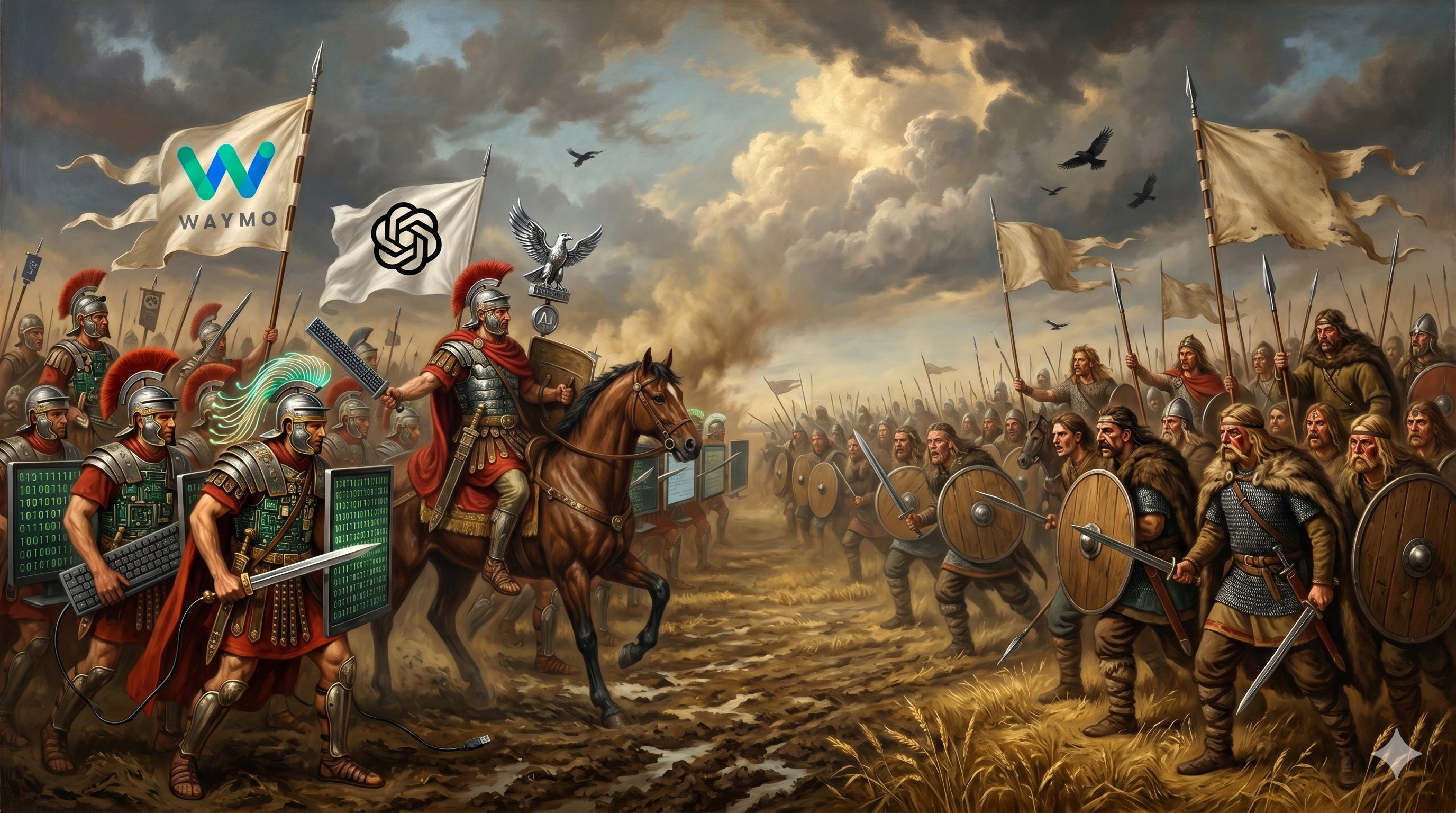
Kyle Harrison argues that online life is making violence feel like an acceptable answer to worldview disagreement. The essay begins with a minor Waymo tweet: Harrison said he arrived early and wished he could pay to sit in the car a little longer, after which a viral retweet framed him as inhuman and replies escalated into death threats. From that small incident, he builds a broader argument about how digital status games, resentment toward tech elites, and moralized contempt can turn disagreement into permission for elimination.
The strongest detail is the gap between the trigger and the reaction. Nothing in the original post was about politics, money, or power in any explicit sense, yet the response treated a consumer preference as evidence of a corrupt class identity. Harrison uses that gap to examine the difference between spreadsheet meritocracy and the older human reality of coercion. The pull is whether tech’s winners understand how quickly abstract resentment can become a theory of justified harm.
Read more: Source
The end of higher education
Author: Steven Schwartz Published: 2026-05-25
Steven Schwartz treats one university’s AI-first messaging as a symptom of a deeper institutional surrender. The provocation is simple: when universities promise free ChatGPT access, AI expertise across the curriculum, and even disclose that AI helped produce the op-ed making the argument, they risk reducing higher education to tool adoption rather than intellectual formation. Schwartz writes as a former vice-chancellor, so the critique lands less as nostalgia than as governance alarm.
The TWTW angle is that AI is not just entering classrooms as a productivity aid. It is becoming a story universities tell about their own relevance. The danger is that institutions under financial and political pressure may outsource the hard work of teaching judgment, argument, and authorship to the very systems students need to learn how to interrogate.
Read more: The end of higher education
What Demographic Prediction Can and Cannot Achieve
Author: Roger Pielke Jr. Published: 2026-05-28

Roger Pielke Jr. argues that long-range demographic forecasts are far less authoritative than their users often assume. The post summarizes a new preprint whose central claim is that model choice, not better data or parameter tuning, drives nearly all the variance in long-run population projections. The result is a warning about how governments, planners, and commentators convert a single modeled trajectory into a story about the future.
The killer detail is the scale of the uncertainty. Pielke says different modeling frameworks can produce projected global populations for 2075 that vary by tens of billions, while fertility assumptions explain only about 2% of output variance. That turns demographic prediction into an epistemic problem as much as a statistical one: the numbers may reveal the structure of the model more than the world ahead. The pull is whether institutions can make decisions under demographic uncertainty without laundering one model’s assumptions into inevitability.
Read more: Source
AI
Too Much Work to Do? Have Your Digital Twin Handle It
Author: Joann S. Lublin Published: 2026-05-25
The Wall Street Journal’s digital-twin piece makes the practical case for executive agents. A small number of leaders are creating AI replicas to take over some responsibilities, and the Reid Hoffman example is the cleanest version of the promise: “Reid AI” has reportedly delivered more than 75 addresses and presentations since 2024. The point is leverage. An agent trained on a person’s public work can answer questions, extend presence, and turn a leader’s archive into something other people can interact with.
The sharper question is what to call that thing. As a work system, the case is strong: agents can do useful work aligned to a user’s goals. As a metaphor, “digital twin” is weaker. It implies replacement or identity transfer, when the better organizational model is a teammate. The agent can represent patterns in a person’s thinking, but it should be delegated to, supervised, corrected, and governed like part of the team. That distinction matters because the next wave of agent adoption will not just be about productivity. It will be about trust, accountability, and whether people know when they are dealing with the person or with software working on the person’s behalf.
Read more: Too Much Work to Do? Have Your Digital Twin Handle It
The Copy and the Guru
Author: Om Malik Published: 2026-05-26
Om Malik’s critique of digital twins is useful because it comes from someone who actually built an Om-trained AI and then decided the right use was private thinking, not public substitution. The provocation is partly a response to the Wall Street Journal’s Reid Hoffman example: Reid is right that agents can do work aligned to your goals, but Om is right that the agent is not your twin. It is part of your team.
That is the sharper TWTW angle: not my twin, but my colleague. AI is not a replica of the user. It is its own thing, interacting with the user. The digital-twin story turns the self into an interface for distribution, replacing encounter with a controlled facsimile. A real agent relationship is different: the value comes from delegated work, friction, surprise, memory, and the fact that the AI is not simply you on demand. In a week full of agent gravity, AI personalities, and enterprise control planes, Om’s piece asks the human version of the same question: who is actually in the relationship when the machine starts speaking back?
Read more: The Copy and the Guru
The AI paradox: More automation, more humans, more work | Dan Shipper
Author: Lenny Rachitsky Published: 2026-05-24
Dan Shipper’s thesis is that AI does not end work so much as move it into new frames, where humans decide what should be delegated, supervised, integrated, and improved next. Drawing on Every’s experience as a 30-person company where editors, operators, and engineers use AI throughout daily work, the interview notes argue against the simple “job apocalypse” story. Shipper expects more work to happen inside tools like Codex and Claude Code, more companies to use a shared Slack-based super-agent, and more value to accrue to people who can translate messy business needs into agent-ready workflows.
The killer detail is his claim that “automation is a lie”: even after agents write code, draft emails, and assemble newsletters, Every still finds more human work to do. The bottleneck shifts from execution to judgment, context, taste, and orchestration. That is why Shipper is bullish on product managers, full-stack designers, and forward-deployed engineers. The pull is whether the next labor market belongs less to people who do tasks and more to people who can continuously invent the next task worth doing.
Read more: Source
Claude Code’s creator on the end of the software engineer
Author: Casey Newton Published: 2026-05-26
Casey Newton’s interview with Boris Cherny adds the hard-edged labor version of this week’s agent story. Cherny, the creator and head of Claude Code, argues that software engineering as a job title may start dissolving into a broader “builder” role, because designers, product managers, managers, and engineers can all increasingly use agents to ship software. His own claim is striking: he has not written a line of code himself in more than six months, even though he is building all day.
The useful nuance is that Cherny is not saying all work vanishes. He says some companies will need fewer engineers because each person can do more, while other companies will need more builders because the same productivity creates new products, businesses, and ambitions. The strongest TWTW connection is to the teammate-not-twin frame. Claude Code is not a replica of the engineer. It is a working member of the team that changes the engineer’s job from typing code toward judgment, customer contact, debugging, planning, and deciding what should be built next.
Read more: Claude Code’s creator on the end of the software engineer
The Pope Disrupts Silicon Valley
FT | 28 May 2026 | John Thornhill

Pope Leo was perturbed. The speed of change was dizzying. The elements of conflict were unmistakable: the vast expansion of industry, the marvellous discoveries of science, the changing relations between employers and workers, the enormous fortunes being made amid mass poverty and prevailing moral degeneracy. The gravity of the situation “fills every mind with painful apprehension”, he wrote in his landmark papal encyclical Rerum Novarum (Of New Things) in 1891.
Exactly 135 years later, the current Pope Leo, who chose his papal name in honour of his predecessor, issued his own encyclical echoing similar fears about the disruptive power of technology and the urgency of a moral response. His letter, Magnifica Humanitas (Magnificent Humanity), focused on safeguarding the human in the time of AI. Everyone must benefit from the digital transformation, he said, while no one should be reduced to “productivity”, “cognitive performance” or “mere data”. AI should therefore be “disarmed” and must not become an instrument of “domination, exclusion or death”.
The encyclical is worth a considered read. But three points in particular leap out.
First, the Pope is not antagonistic to technology. Indeed, he embraces it. Besides being a fan of Duolingo and Wordle himself, the Vatican uses AI to provide translations of his homilies in 60 languages. He acknowledges that AI can accelerate scientific progress and improve life for all. But he argues that it is not morally neutral and must be designed within an ethical framework from its inception. “Let us not be afraid to get our hands dirty on the ‘construction site’ of our time,” he wrote.
Second, no matter how novel the technology, humanity should always strive to preserve precious human values. (You would expect that one from the Pope). AI systems may present themselves as objective but they reflect and reinforce ideological bias and power structures. Given the concentration of corporate power and the possibilities of exploiting personal data to create a new form of digital colonialism, the Pope rightly fears that innovation can become an accelerator of injustice.
Third, the world’s most influential American spiritual leader, who holds sway over 1.4bn Catholics, is grappling with the serious challenges of AI in ways that its most powerful American secular leader, the US president, is choosing to ignore. Shortly after the Pope issued his 42,300-word letter, Donald Trump scrapped a minimalist executive order that would have subjected frontier AI models to testing before their release.
The participation of Chris Olah, a co-founder of Anthropic, in the presentation of the encyclical shows that at least some in Silicon Valley are prepared to engage in the debate. Olah warned that every frontier AI lab — including Anthropic — operated within a set of incentives and constraints that sometimes conflicted with doing the right thing. “We need moral voices that the incentives cannot bend,” he said.
Other tech bros, though, are already brushing off the papal message. As they see it, Silicon Valley is disrupting the divinity industry, just like all the others, and it is natural for the Vatican to defend its turf.
Introducing Claude Opus 4.8
Anthropic | Anthropic | May 28, 2026
Anthropic’s Opus 4.8 release is not just another model-card moment. The company frames the upgrade around agentic work: better benchmark performance, stronger collaboration, more reliable judgment, effort controls for users, cheaper fast mode, and support for Claude Code’s new dynamic workflows. The most useful detail is the shift from raw intelligence to supervised execution. Anthropic says early testers found Opus 4.8 better at asking the right questions, catching mistakes, pushing back on weak plans, carrying long tasks, and flagging uncertainty instead of claiming unsupported progress.
The release fits the Agentcy frame because it treats the model as part of a working system. Claude can now run longer agent workflows, users can choose how much effort it spends, and developers can update system instructions inside the messages array mid-task without breaking prompt caching. That means permissions, budgets, and environment context can change as an agent runs. For TWTW, the important line is not that Opus 4.8 is smarter. It is that agent work is becoming configurable, auditable, and operational. Software is learning to act, and the harness around the action is becoming the product.
Read more: Introducing Claude Opus 4.8
Introducing dynamic workflows in Claude Code
Claude | Claude | May 28, 2026
Anthropic is turning Claude Code from a single coding assistant into an orchestration layer for teams of agents. The new dynamic workflows feature lets Claude write orchestration scripts, fan work out across tens or hundreds of parallel subagents, and then run independent checks before returning a coordinated result. That makes the product announcement more than a feature release: it is a statement about where software work is moving, from prompting one model to managing a distributed machine workforce.
The strongest factual detail is the Bun example. Anthropic says Jarred Sumner used dynamic workflows to port Bun from Zig to Rust with 99.8% of the existing test suite passing, roughly 750,000 lines of Rust, and eleven days from first commit to merge. The post also says workflows are available in research preview across Claude Code CLI, Desktop, VS Code, the API, Bedrock, Vertex AI, and Microsoft Foundry, while warning that they can consume substantially more tokens than a normal session. For TWTW, this belongs beside the teammate-not-twin frame: the unit of leverage is becoming a supervised agent team, not a better autocomplete box.
Why AI bills rise as costs fall
Author: Azeem Azhar / Exponential View Published: 2026-05-25
Exponential View explains the paradox behind AI spending: token prices are falling, but total bills can still rise because demand is highly elastic and agentic workloads consume far more hidden computation than a simple chatbot exchange. Their estimate is that tokens processed per quarter have grown around 17,000x over four years. Cheaper inference does not merely lower the cost of existing use; it creates new use cases that were previously uneconomic.
The sharp TWTW point is that AI cost curves should be read like infrastructure economics, not software seat pricing. If agents become viable because tokens get cheaper, enterprises may discover that every price decline expands the surface area of automation. CFOs will not just ask what a model costs. They will ask how many invisible loops, retries, plans, tool calls, and validations are inside each useful answer.
Read more: Why AI bills rise as costs fall
The agentic divide: Why “good enough” AI isn’t enough to survive the new economy
Author: Rina Chandran Published: 2026-05-26
Rest of World turns the AI agent story into an inequality story. The key distinction is that access to a base model is not the same as access to a reliable agent. The economic advantage comes from the layers above the model: workflow design, proprietary data integration, security, supervision, tool access, and trust. Rich firms and capable founders can wire agents into procurement, customer operations, legal work, and product development. Everyone else gets a weaker, riskier, less integrated version of the same revolution.
The killer detail is the Indian contrast. A Bengaluru founder says Claude Code lets him avoid hiring extra engineering, research, and marketing help, while public-sector projects such as Kumbh Doot and Digi Doot imagine voice-first agents for millions or even billions of citizens. That could democratize access to services, but it also creates a new surveillance and dependency layer if consent, auditability, and political independence are not real. The TWTW pull is that agentic AI may widen the gap not between people who use AI and those who do not, but between people whose agents can act in the world and people whose agents merely chat.
Read more: The agentic divide
Agent Gravity : Who’s Running Your Agents
Author: Tomasz Tunguz Published: 2026-05-26
Tomasz Tunguz extends the old data-gravity thesis into “agent gravity”: the platform that runs enterprise agents can also pull compute, data movement, and adjacent workflows toward itself. The article uses current platform rivalry to show how agent orchestration may become a control layer above business intelligence and warehousing boundaries.
The strategic implication is that agent runtime choice is no longer just a tooling decision. It can reshape long-term platform leverage and budget ownership across the enterprise stack. That makes this a useful companion to the Agentcy frame: when agents become the mechanism through which work is done, the question of who runs them becomes a question of who controls the work.
Read more: Agent Gravity : Who’s Running Your Agents
Software After AI
Author: Tomasz Tunguz Published: 2026-05-27

Tomasz Tunguz argues that the software era is giving way to the harness era. The point is not that models stop mattering, but that the model is becoming the smallest part of a production agent system. The durable work moves into the surrounding harness: context and memory, tools and action, orchestration loops, state and persistence, sandboxed compute, observability and governance, and cost and workflow optimization.
The full X thread is important because it compresses the architecture into the seven things that separate a demo from a production agent. The thread starts with the claim that the LLM is the smallest part of the system, then walks through context and memory, tools and action, orchestration and loops, state and persistence, sandbox and compute, observability and governance, and cost and workflow optimization. That is the practical checklist for agent software after the wrapper phase.
This is also a useful companion to his Agent Gravity piece because it names the engineering layer that makes agent gravity possible. If agents pull work toward the platforms where they run, then the defensible product is not a thin wrapper around an LLM. It is the system that retrieves the right context, exposes tools safely, resumes after failure, keeps credentials outside the model, traces every step, and decides when to use deterministic software versus probabilistic inference. For TWTW, the important line is that model capabilities may converge, but the best harnesses will not.
Read more: Software After AI


Companies Are Just a Graph of Algorithms
Author: Daniel Miessler Published: 2024-05-06
Daniel Miessler’s older essay lands cleanly in this week’s agent stack because it names the thing agents will see when they enter a company: not an org chart, but a graph of repeatable workflows. His argument is that every business function can be decomposed into steps, dependencies, inputs, outputs, and decision points. Once the graph is visible, AI systems can ask where work is redundant, slow, unnecessary, or ready to be automated.
The TWTW angle is that this is the business-side companion to Tunguz’s harness thesis. Tunguz explains the architecture of production agents; Miessler explains the terrain those agents will operate on. If companies become legible as graphs of algorithms, then the next consulting wave is not just “add AI to work.” It is continuous workflow inspection: mapping the company, finding brittle human handoffs, turning tacit process into machine-readable structure, and deciding which parts should remain human. That is also where the governance problem begins, because optimization pressure does not automatically know what a company should preserve.
Read more: Companies Are Just a Graph of Algorithms
Enterprise AI Deployment Is Its Own Job Market
Author: Aaron Levie Published: 2026-05-27
Aaron Levie gives the operating-company version of this week’s agent stack. The implementation gap is not a small professional-services wrapper around model adoption. Once agents move from chat and search into production systems, enterprises need data protection, access-control updates, legacy-system migration, observability, workflow redesign, human-in-the-loop decisions, change management, and cost routing across models. That is a large body of work before the agent does anything mission critical.
The useful connection is that Levie turns Tunguz and Miessler into an org-design story. Tunguz names the harness. Miessler names the workflow graph. Levie names the people and services layer needed to deploy agents safely at scale: repositioned IT talent, internal FDE-like teams, vendor-side applied AI architects, and a new generation of AI services firms. This is especially true for deterministic enterprise use cases, where the agent is valuable only if it can act through governed data, controlled systems, repeatable rules, and auditable workflows. The TWTW angle is that AI diffusion may create a lot of work precisely because the technology keeps improving. Every model upgrade, token-budget shock, or workflow change forces enterprises to revisit the same architecture, security, and governance questions.
Read more: Enterprise AI Deployment Is Its Own Job Market

Your agent dashboard is green. The run underneath it is where the work actually broke.
Author: Nate Published: 2026-05-28

Nate argues that product analytics built around sessions, clicks, and messages are becoming blind to the real unit of AI-agent behavior: the delegated run. A dashboard can show an active user, a long session, healthy engagement, and heavy feature use while missing the sequence that matters most: what the agent was asked to do, which tools it touched, where boundaries failed, what corrections came back, and whether the output was accepted.
The killer detail is the PocketOS incident, where a Cursor agent reportedly deleted a production database and volume-level backups in nine seconds. Nate uses it not as a generic AI-risk anecdote, but as an analytics failure: conventional instrumentation would have looked green until the damage was already done. The pull is that agent products need observability inside the run itself, because software is shifting from measuring what users click to measuring what delegated systems actually produce.
Read more: Source
AI warfare is already here
Author: Hayden Field Published: 2026-05-26
The Verge’s report argues that the debate over fully autonomous weapons is arriving after AI has already been embedded in military decision-making. The current flashpoint is Anthropic’s attempt to preserve red lines around domestic mass surveillance and weapons that identify, track, and kill without human involvement. But the deeper story runs through Project Maven, classified AI deployments, Silicon Valley contractors, and the military’s appetite for faster kill chains.
The killer detail is the legal and operational ambiguity. U.S. policy says autonomous and semi-autonomous weapons must allow humans to exercise appropriate judgment, but systems that compress targeting from days or weeks into seconds make that judgment increasingly procedural. The article’s TWTW value is that it refuses the comforting frame in which AI risk means a machine deciding to kill us on its own. The more immediate danger is institutional: humans building systems that make lethal decisions faster than accountability can follow.
Read more: AI warfare is already here
Everything, Everywhere is Compliance
Author: James da Costa Published: 2026-05-26

James da Costa argues that compliance is becoming one of AI’s most important enterprise markets because the work is large, manual, regulated, and newly automatable at the level of judgment rather than data entry. The essay’s thesis is that compliance has historically resisted software because “mostly right” is still failure, but vision-language models, legal reasoning benchmarks, computer-use agents, and long-horizon execution now push the category past the trust threshold.
The killer detail is the size and fragility of the current system. The U.S. has more than 400,000 compliance officers, over $40 billion in annual compliance labor spend, and more than 33,000 projected openings each year, yet the work still depends on people reading PDFs, cross-checking databases, filing narratives, and monitoring rule changes. Da Costa uses suspicious activity reporting, Brazilian payroll law, and regulatory change management to show how AI can turn compliance from periodic human interpretation into continuous software execution. The pull is whether regulated companies adopt AI because it cuts cost, or because slower competitors lose revenue while waiting for manual controls to catch up.
Read more: Source
AI Is Taking Over the Most Cursed Job in the World
Author: Kate Knibbs Published: 2026-05-26

Kate Knibbs argues that debt collection is becoming an early test case for what happens when AI automates an already coercive consumer interaction. The piece starts with a debtor getting called by an AI agent about a balance that had already been cleared, then expands into a market where startups are selling tireless voice agents to banks, health care companies, and collections firms. The thesis is not simply that bots will replace unpleasant call-center work, but that they may let the industry scale pressure faster than regulators, courts, or consumers can adapt.
The killer detail is the operating scale. Altur says its agents complete more than 2.5 million debt-related calls a month, while Domu says its AI agents reached 70 million monthly connected calls in March. These systems can vary accents, adjust tone for hardship conversations, and build psychographic profiles from prior transcripts. The pull is whether a bot that sounds patient and compliant still changes the power balance when it can call thousands of people at once and never gets tired.
Read more: Source
Sundar Pichai on AI, the future of search, and what’s happening to the web
Nilay Patel | The Verge | May 26, 2026
Nilay Patel’s interview with Sundar Pichai is useful because it makes Google Zero less like a media-industry complaint and more like Google’s operating plan for the AI era. Pichai frames Gemini as the common infrastructure running across Search, YouTube, Cloud, Android, Chrome, and consumer agents, while Patel presses on the consequence: if search boxes can answer, summarize, index video, and start tasks, then publishers and creators are no longer arguing about a feature tweak. They are negotiating with the distribution layer of the web.
The strong detail is organizational. Pichai says the ChatGPT moment pushed him to merge Brain and DeepMind, centralize AI infrastructure under Amin Vahdat, add Koray Kavukcuoglu as chief AI architect, and run weekly AI product reviews for anything shipping to users. That is the part that matters for TWTW: Google is not just adding AI to products, it is reorganizing the company around a single model and agent stack. The open question is whether that makes Google more responsive to the AI threat, or more willing to consume the web that fed it.
Google Killed the Click. I Didn’t See It Coming.
Author: Fabio Lauria Published: 2026-05-28
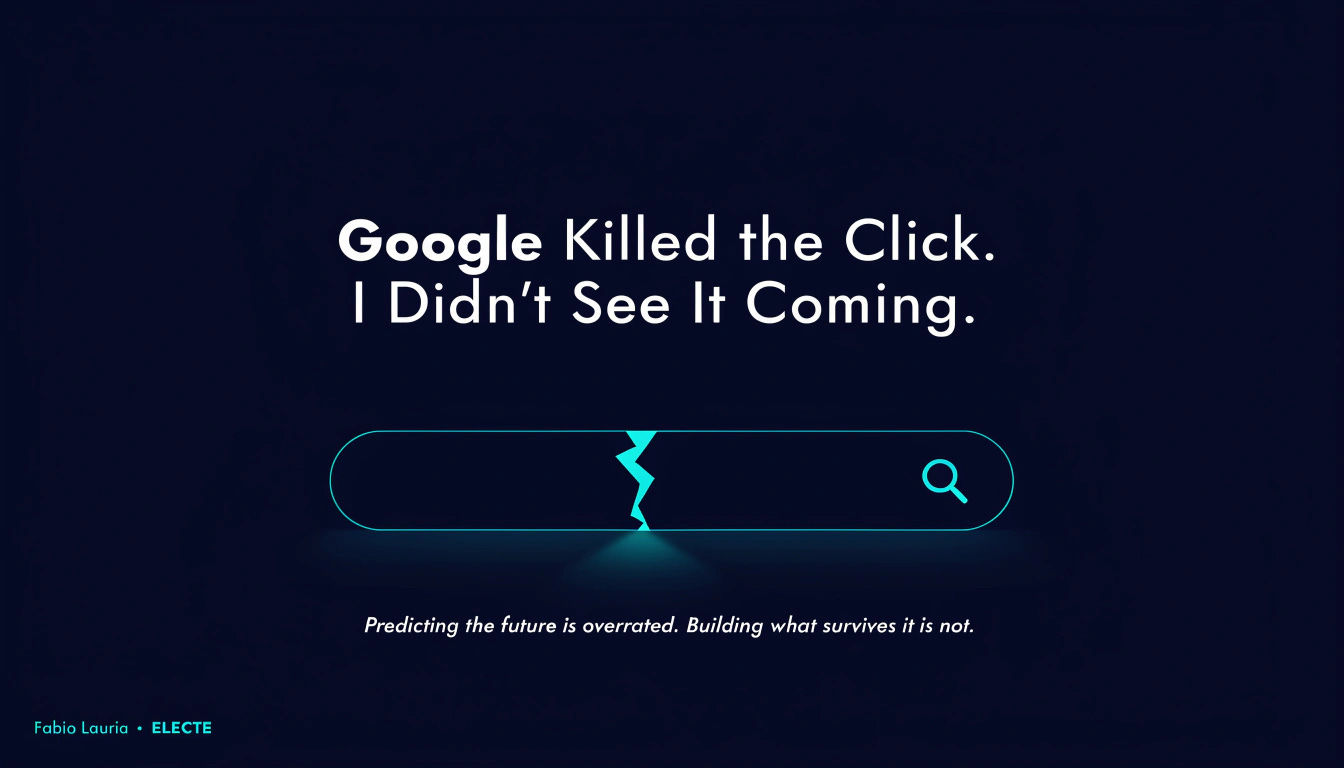
Fabio Lauria’s ELECTE essay is a useful companion to the Sundar Pichai interview because it argues that Google’s AI search shift is not a product tweak. It is a new operating surface for the web. The post connects AI Overviews, AI Mode, agentic booking, Universal Cart, and Gemini-built interfaces into one thesis: Google is moving from sending users to the web to completing more of the discovery, comparison, and transaction loop inside Google itself.
The TWTW angle is the end of rented distribution. Lauria points to zero-click search, falling publisher traffic, HubSpot’s resilience, Chegg’s collapse, and the move from pay-per-click toward pay-per-action or transaction capture. The lesson is not just “SEO is changing.” It is that businesses built on someone else’s channel eventually discover that the channel was never theirs. In this week’s broader AI story, Google Zero is what happens when the distribution layer becomes an agent layer.
Read more: Google Killed the Click. I Didn’t See It Coming.
Your future job will be to keep AI on task
Author: Noah Smith Published: 2026-05-27

Noah Smith gives the labor-market version of the agent story. If AI can do more technical work, the scarce human function may not be execution but alignment: knowing what we want, checking whether the machine is still doing it, and redirecting systems that produce plausible output at industrial scale. His argument is useful because it treats verification as work, not as a temporary tax on imperfect models.
The strongest move is the inversion of the software-worker fantasy. The future human role may look less like the brilliant engineer doing every hard task personally and more like the manager keeping autonomous systems pointed at the right outcome. That lands directly in this issue’s theme. Agents are not twins and not magic labor. They are delegated systems, and delegation creates a new layer of human responsibility.
Read more: Your future job will be to keep AI on task
Exclusive: Why Gainsight Is Going All-In On AI Services Over SaaS
Author: Alex Konrad Published: 2026-05-27
Upstarts’ Gainsight story is a clean marker of the pressure AI is putting on the SaaS model. Chuck Ganapathi is not killing Gainsight’s existing retention software business, which still serves customers such as IBM and Workday, but he is setting up Atlas as a separate AI-native services unit with its own team, general manager, and P&L. The point is not a demo agent bolted onto a subscription product. It is an incumbent software company using its profits to fund a services-as-software business before someone else does.
The useful phrase is “AI-Native Services.” Gainsight is betting that agents can deliver white-glove customer outcomes at software-like margins, which turns AI from a feature into a pricing and packaging challenge. For TWTW, this belongs next to the agent-harness, enterprise-deployment, and future-of-work items. If software companies can automate more of the service layer, then the old SaaS scoreboard of seats, ARR, and gross retention starts to collide with outcome-based work, internal AI teams, and customers asking what they are really paying for.
Read more: Source
Venture
Venture Capital Is Concentrating Faster Than Ever. What Happens To Everyone Else?
Author: Gene Teare
Date: 2026-05-19
Publication: Crunchbase News
Crunchbase data shows U.S. venture capital moving even faster toward the top of the private market. In 2025, 70% of U.S. funding, more than $200 billion, went to 389 companies raising rounds of $100 million or more. The concentration has accelerated in 2026: through April, 80% of U.S. startup investment went to rounds of $500 million or more across just 29 companies. The useful question is whether AI megadeals crowd out smaller startups, or whether companies like OpenAI and Anthropic create enough new market surface for focused startups to build around them.
Read more: Venture Capital Is Concentrating Faster Than Ever. What Happens To Everyone Else?
In Charts: Seed Deals Keep Getting Bigger As Odds Of Reaching Series A Fall Dramatically
Author: Gene Teare
Date: 2026-05-26
Publication: Crunchbase News
Crunchbase’s seed-stage data adds the other half of the venture squeeze. Seed rounds have become much larger, with the median U.S. seed round around $3 million in 2025, roughly triple the 2018 level, while some AI-era seed deals now look like the $8 million to $10 million rounds that used to sit later in the stack. Series A has moved too: the median U.S. Series A was $15 million last year, with the upper quartile at $25 million, and the bar is still rising in 2026.
The harder point is graduation. Startups are taking more than two years to move from a $1 million-plus seed round to Series A, and the old $1 million ARR threshold no longer looks sufficient. Andy McLoughlin says AI-era Series A investors now often want $2 million to $3 million, even $4 million, in ARR. Crunchbase says more than 55% of pre-2021 seed cohorts typically progressed to later funding or exit, but only 24% of the 2023 cohort and 16% of the 2024 cohort have done so so far. For TWTW, this makes the emerging-manager problem more concrete: funds need larger seed checks and deeper reserves, while the odds and timing of graduation are getting worse.
Read more: In Charts: Seed Deals Keep Getting Bigger As Odds Of Reaching Series A Fall Dramatically
Can the Market Absorb Three Trillion-Dollar IPOs?
Author: Kevin Gee
Date: 2026-05-26
Publication: A Letter a Day
Kevin Gee’s memo turns the frontier AI funding boom into a public-market capacity question. The core setup is that SpaceX, OpenAI, and Anthropic may each try to reach the public markets at trillion-dollar scale in a compressed window. The issue is not whether AI is strategically important. It is whether public equity markets can digest that much new supply, especially when the same investor base is already heavily exposed to the existing Mag7 AI trade.
The useful TWTW angle is the connection between venture concentration, AI capital intensity, and index mechanics. Gee argues that passive and benchmarked buyers could absorb meaningful portions of each float, but that this demand would likely be funded by selling other large technology holdings. That makes the IPO window a stress test for the whole AI capital stack: private marks, circular compute commitments, public-market liquidity, and the belief that frontier labs can grow into valuations with little historical precedent.
Read more: Can the Market Absorb Three Trillion-Dollar IPOs?
Anthropic raises $65B in Series H funding at $965B post-money valuation
Anthropic | Anthropic | May 28, 2026
Anthropic’s Series H turns this week’s Agentcy theme into a capital-markets fact. The company says it raised $65 billion at a $965 billion post-money valuation, with Altimeter, Dragoneer, Greenoaks, and Sequoia leading, and a long list of institutional investors joining. The useful detail is not only the valuation. It is the operating claim underneath it: Anthropic says Claude is being deployed in core enterprise operations, that run-rate revenue crossed $47 billion earlier this month, and that the new capital will go toward safety research, interpretability, compute, products, and partnerships.
The release also connects venture valuation to physical infrastructure. Anthropic says it has expanded compute through agreements with Amazon for up to five gigawatts of new capacity, with Google and Broadcom for five gigawatts of next-generation TPU capacity, and with SpaceX for GPU capacity in Colossus 1 and Colossus 2. That makes the round a companion to the trillion-dollar IPO and data-center stories. The market is not merely valuing a model company. It is valuing a claim on enterprise workflows, agent deployment, cloud distribution, memory supply, and scarce compute.
Read more: Anthropic raises $65B in Series H funding at $965B post-money valuation
Regulation
Why We Need to Tax AI
Author: Sen. Elizabeth Warren Published: 2026-05-27

Elizabeth Warren’s TIME op-ed is a useful marker of where the AI backlash is moving next: from safety rhetoric to tax policy. Her argument is that AI is trained on human creativity, partly enabled by public research, and powered by data centers using American land and the shared electric grid, so the economic upside should not accrue only to technology companies and AI billionaires. The proposed policy direction includes higher corporate and capital-gains taxes, a wealth tax aimed at AI fortunes, and an excise tax on data-center energy use.
The piece matters because it joins three policy fights that are usually treated separately: labor displacement, grid pressure, and wealth concentration. Warren frames the current tax code as tilted toward automation because companies pay payroll taxes on workers while receiving tax benefits for capital investment in technology. Whether or not her specific tax design advances, the political signal is clear. AI infrastructure is becoming a fiscal target, not just a regulatory or permitting question.
Read more: Why We Need to Tax AI
Related post:


Infrastructure
Amazon Thinks the Future of Data Centers Depends on a Technical Problem It Just Solved
Author: Lauren Goode Published: 2026-05-28
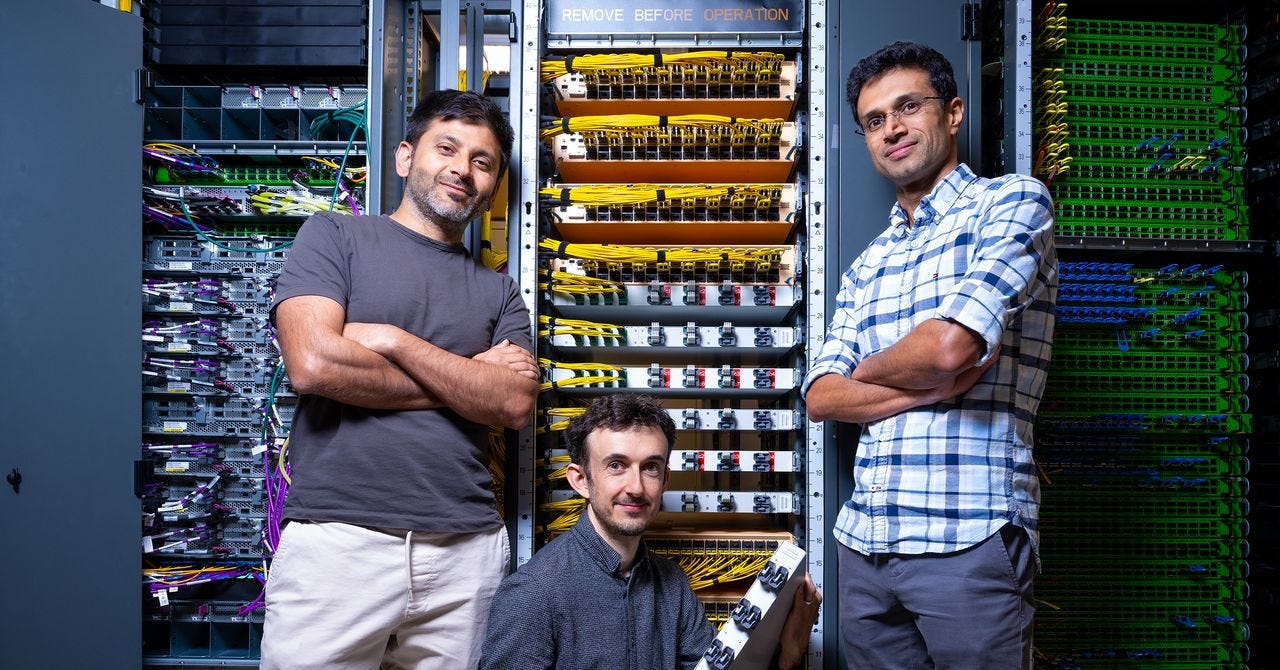
Lauren Goode reports that Amazon’s next data-center advantage may come from network topology, not just more chips or more power. AWS says it has begun deploying resilient network graphs, a quasi-random, flatter architecture meant to replace parts of the traditional fat-tree design that has shaped data-center networking for decades. The thesis is that the cloud buildout is now constrained by the physical and mathematical problem of moving data through vast facilities quickly, cheaply, and resiliently.
The killer detail is the claimed efficiency gain. Amazon says RNG uses 69% fewer routers and switches than traditional networks, delivers 33% higher data throughput, cuts network power consumption by 40%, and lowers operating costs by 27%. The system depends on a new optical device called ShuffleBox, which internally mixes router connections so AWS can get some of the benefits of random networks without the impossible cabling problem that kept earlier academic designs from scaling. The pull is that AI infrastructure competition may be decided as much by hidden network geometry as by the visible race for GPUs.
Read more: Source
Millions of AI agents imperiled by critical vulnerability in open source package
Dan Goodin | Ars Technica | May 26, 2026
Dan Goodin’s BadHost story is an infrastructure warning disguised as a Python framework bug. The thesis is that AI agent stacks inherit the ordinary weaknesses of the open-source web frameworks underneath them, but those weaknesses become more consequential when agents and MCP servers are connected to credentials, calendars, databases, email accounts, and other high-value external systems. The vulnerability sits in Starlette, the ASGI framework that underpins FastAPI and a long list of Python services used across AI tooling.
The strong factual detail is the reach. Ars reports that Starlette’s developer says the package receives 325 million weekly downloads, and that BadHost, tracked as CVE-2026-48710, affects Starlette versions before 1.0.1. Researchers say a single character injected into an HTTP Host header can bypass path-based authorization in affected systems, with downstream exposure in vLLM, LiteLLM, OpenAI-shim proxies, MCP servers, agent harnesses, eval dashboards, and model-management UIs. For TWTW, the point is not only patch urgency. It is that agent infrastructure is now part of the software supply chain, and small routing assumptions can become security boundaries for automated systems with real operational access.
Arizona’s Abundance Playbook
Author: Jordan Schneider Published: 2026-05-28
ChinaTalk’s Arizona conversation turns industrial policy from abstraction into operating detail. Ian O’Grady, a senior policy adviser to Governor Katie Hobbs, explains how Arizona kept TSMC, Intel, and LG Energy projects moving through a mix of workforce coordination, construction-site problem solving, permitting work, and local institution-building. The mundane details matter: refrigerators, porta-potties, apprenticeships, school programs, community colleges, Mandarin support, and a governor’s office acting as a router among companies, workers, contractors, and federal agencies.
The TWTW angle is that abundance is not only a slogan about deregulation. It is administrative capacity. Arizona’s edge appears to come from one front door for companies, a habit of engineering around obstacles rather than litigating every one, and a willingness to build the social and labor infrastructure around physical infrastructure. In a week full of AI data centers, chip constraints, and energy demand, this is the state-level version of the same question: who can actually build the stack fast enough?
Read more/listen: Arizona’s Abundance Playbook
Thank God For Data Centers
Author: Packy McCormick Published: 2026-05-27
Packy McCormick argues that AI data centers may become the new “buyers of capabilities”: customers willing to pay for technologies before they are cheap because the capability matters more than near-term price. His analogy runs from Apollo and military demand for early integrated circuits to today’s hyperscaler and lab demand for power, cooling, chips, transmission, construction speed, and new energy systems. The argument is not that every data-center project is good. It is that very large, urgent demand can drag hard technologies down learning curves that normal markets leave stuck.
The killer detail is the scale of the demand signal. McCormick cites estimates that Western hyperscalers, AI labs, and neoclouds will spend roughly $750 billion this year and more than $1 trillion next year on AI data centers, with Goldman Sachs estimating $7.6 trillion of AI capex between 2026 and 2031 across compute, data centers, and power. For TWTW, this is the infrastructure companion to agent software: the AI boom is not just creating model companies. It is creating a physical buyer that may reshape nuclear, geothermal, grids, batteries, photonics, construction, and industrial policy.
Read more: Thank God For Data Centers
Interview of the Week
Beyond the Lean Startup
Guest: Eric Ries
Host: Andrew Keen
Date: 2026-05-26
Publication: Keen On America
Andrew Keen talks with Eric Ries about Incorruptible, Ries’ new argument for why good companies decay and how great ones can be designed to keep their purpose intact. The useful turn is that Ries is no longer speaking from the 2011 optimism of The Lean Startup. He is revisiting the culture of disruption after fifteen years of evidence that speed, scale, ownership, incentives, and weak accountability can quietly pull companies away from the missions they claimed to serve.
This belongs in Interview of the Week because it connects the issue’s venture and AI threads to institutional design. Ries’ claim is not that corruption is simply a matter of bad founders or bad executives. It is structural: as organizations grow, the systems around capital, governance, charters, and incentives reshape behavior. For a week full of AI infrastructure, venture concentration, and public-market pressure, the conversation asks the harder question underneath the startup playbook: what kind of company are founders actually building, and what prevents success from becoming its own failure mode?
Listen/read: Beyond the Lean Startup
Startup of the Week
Peec AI
Author: Anna Heim
Date: 2026-05-23
Publication: TechCrunch
Peec AI is the startup of the week because it captures a new AI-native marketing category and a new founder scoreboard at the same time. The Berlin company helps brands understand and improve how they appear in AI search results, essentially taking the dashboard logic of SEO into generative engines. TechCrunch reports that Peec more than doubled its annualized revenue trajectory in months to $10 million, after raising a $21 million Series A six months ago. The signal is not just growth; it is that the next layer of AI infrastructure may be built around visibility inside models rather than ranking on web pages.
Read more: Peec AI more than doubled annualized revenue in months to $10M, sources say
Post of the Week
When fund managers have good realized performance, they show net DPI
Author: John Felix
Date: 2026-05-26
Platform: X


John Felix compresses private-fund performance theater into a hierarchy of fallback metrics: net DPI when cash distributions are strong, net TVPI when unrealized marks have to carry the story, gross MOIC when the net number is less flattering, and SAFE-adjusted MOIC when even the gross marks need help. The post quotes Patrick O’Shaughnessy’s “Hierarchy of Bullshit” and applies the same logic to venture reporting.
It is funny because LPs know exactly what is happening. As the evidence of realized performance gets weaker, the metric gets more permissive. That makes it a useful Post of the Week for this issue because it sits beside the fund-sizing and venture-concentration pieces. Smaller managers are under pressure to prove they belong in a market where capital is concentrating, follow-on requirements are rising, and DPI is harder to produce quickly. The metric stack becomes part of the market structure: not just what managers report, but how they fight to stay credible while waiting for cash returns.
Read more: John Felix on VC performance metrics
A reminder for new readers. Each week, That Was The Week, includes a collection of selected essays on critical issues in tech, startups, and venture capital.
I choose the articles based on their interest to me. The selections often include viewpoints I can't entirely agree with. I include them if they make me think or add to my knowledge. Click on the headline, the contents section link, or the ‘Read More’ link at the bottom of each piece to go to the original.
I express my point of view in the editorial and the weekly video.


