


This week’s video transcript summary is here. You can click on any bulleted section to see the actual transcript. Thanks to Granola for its software.
Editorial
Who Are the AI Champions?
If you are in the habit of watching Andrew Keen and myself discuss this newsletter each week you will know that we have focused on trying to understand why the AI argument keeps arriving in negative form. The video is quite passionate and we often (well always) disagree so if you don’t watch, give it a try.
To be sure there are bad actors in AI. There is fraud. There is deception. There is spam, theft, impersonation, non-consensual imagery, fake books, fake sources, and bad conduct by platforms that should know better.
Those things do explain why there should be a concerned lobby, but, for me at least, not why concern should spill over into opposition to AI.
Illegal use of AI by bad actors should be dealt with like any other crime, directly, using law enforcement. Use copyright law. Use consumer protection. Use platform rules. Use disclosure where disclosure matters. And treat them as human crimes, not AI crimes.
I raise this because it perplexes me. Being against AI because some people misuse it makes little sense. We do not make electricity worse because criminals use power grids. We do not slow compilers because malware exists. We do not make browsers less capable because fraudsters build websites. The right answer to abuse is enforcement against abuse, not scarcity for everyone else.
The positive case AI for AI rarely leads the zeitgeist. The negative seems a lot louder than the positive. Where is the AI champion who can explain why the effort is worth the cost?
The news-led entry point this week sees Stripe stepping up to the role of champion. It positively flaunts its acquisition of Openrouter as evidence of enormous upside as AI rolls out. Not only its own upside but all of our upside.
In Alex Wilhelm’s reading of Stripe’s leaked OpenRouter memo, intelligence is “expensive, heterogeneous, and constantly changing.” That is why it has to be metered.
Metering intelligence sounds spooky. After all the word sums up the collective human evolution of thought and the application of thought. How can it be metered? Unless it can be owned?
The Stripe founder is really making a case for a fee to be charged for accessing intelligence. The fee has to pay for training, packaging, fine-tuning, hosting, serving. It is another way of saying that the companies investing in distributing intelligence need to get paid, and that customers need to know what they are buying, which model is doing the work, which task is worth doing, who pays, and when. So… not sinister. Just, if I spend capital to make your life better, I need to get paid. What is being metered is not “intelligence” but servers and software that are the means of accessing it, just like we pay a toll to drive on a toll road.
OpenAI is making the same point from the frontier-lab side. In the Core Memory interview, Sam Altman says the industry has not filled in enough of the “dot dot dot” between superintelligence and ordinary human life. People want prosperity, agency, meaningful work, and a future their children can live in. Greg Brockman says the models have shifted from being the product to being part of the product. The real work is the body around the brain: agents, skills, connectors, computer use, context, memory, and trusted personal systems that can act for people. These too have to be paid for.
If AI is a tool for lifting us up, then the thing to champion is its extension to more of us.
That is why the low meter matters. Azeem Azhar’s $6 agent is not a small anecdote. It is a sign of what happens when intelligence can be routed, bundled, escalated, and cost-managed. Cheap intelligence is not the enemy of revenue. It is how use explodes. Low cost is the primary driver of inclusion.
So, to champion a bit myself, metering is good. Data centers are good. Investment is good. Centralized frontier labs are good. Edge and local models are good. Product discipline is good. The culprit is price, it is bad and needs to get lower.
Those sentences are unfashionable, but they should be the center of the anti-AI argument. Not, we don’t want it but we want it for everybody. The transformational impact of AI on our lives demands that.
If intelligence is going to become a basic input into life and work, it cannot stay scarce, expensive, suspicious, or morally contaminated. It has to become cheaper, more available, more accountable, and more useful. That requires capital. It requires chips. It requires data centers. It requires power. It requires open models. It requires routing markets. It requires local inference. It requires companies that can capture, package, serve, meter, improve, and sell intelligence at scale. It even requires huga amounts of debt, borrowed by those building the capability.
And all of that also requires people willing to say so.
The Champions
So who are the champions we can look to for the arguments?
There are really two groups here. Champions make the public case. Intelligent Architects make the case true.
The first group says we should build, fund, meter, distribute, and cheapen intelligence. The second group designs the loops, rails, identity systems, markets, security models, energy systems, and edge deployments that let intelligence work in the real world.

Sam Altman, Greg Brockman, and OpenAI: the product-and-access champions.
OpenAI’s enterprise revenue crossing consumer revenue, The Defender’s Window, and the Altman/Brockman Core Memory interview all point in the same direction. OpenAI is trying to move beyond models as magic tricks and toward intelligence as a dependable product surface for work and life. That means agent platforms, personal context, Codex for more than coders, security workflows, and the discipline to make compute a product input rather than a complaint. OpenAI is a champion here because it keeps insisting that access, deployment, product, safety, and abundance have to be solved together.

Jensen Huang, Nvidia: the infrastructure champion.
Nvidia’s AI moat is shifting from chips to capital shows Huang making the hard case for the buildout. The article says Nvidia announced a Wall Street pact to pursue $500 billion of GPU financing and agreed to support OpenAI’s Ohio data-center project with up to $105 billion. That can be read as circular demand. It can also be read as the obvious next step in a market where AI factories need long-term capital before their customers have long-term credit histories. Huang is a champion because he makes chips, power, finance, factories, and national capacity feel like productive abundance rather than a hidden plot.
Patrick and John Collison, Stripe: the metering champions.
Stripe Acquiring OpenRouter, Aggregating AI?, Flipping the Business Model, Stripe wants to meter intelligence, and Ramp Launches Router.com to Become the CFO for AI Agents belong at the center of this issue. Stripe already understands payments, usage billing, subscriptions, and developer distribution. OpenRouter gives it a way to route demand across models and providers. Ramp points at the other side of the same market: companies need agents to spend with budgets, approvals, wallets, and audit trails. The champion case is not that intelligence should be expensive. It is that metering makes intelligence legible, billable, governable, comparable, and eventually cheaper. You cannot make a market abundant if nobody can see, price, route, approve, or pay for the thing being consumed.

Tomasz Tunguz, Simon Willison, Qwen, and Hugging Face: the edge champions.
Decentralization is not a replacement for large centralized companies. It is a parallel development. Tomasz Tunguz’s Birds Don’t Fly Like Planes. Neither Does AI. argues that local models can match cloud-model quality on venture tasks while taking a different route to the answer. Simon Willison’s Qwen 3.8 27B is excellent shows capable local open-weight models running on consumer hardware. Hugging Face’s State of Open Models shows Qwen’s downstream footprint across more than 151,000 derivatives. This is not anti-frontier-lab ideology. It is how intelligence diffuses: frontier systems push capability forward; edge systems bring privacy, latency, resilience, cost control, and ownership closer to the user.

Ford’s engineers and Brian Solis: the human-expertise champions.
Ford Rehired the Experts AI Was Supposed to Replace, That’s the Story is useful because it refuses the lazy replacement story. Ford brought back experienced people to mentor younger staff, lead design reviews, find failure points, and improve the information used to train and guide AI systems. That is what useful AI adoption looks like inside institutions. It does not delete human expertise. It makes institutional memory more scalable.

Li Bo and Jinguyuan: the ordinary-adoption champions.
A dumpling shop becomes a poster child of AI adoption in China is one of the week’s best details because it makes pro-AI adoption small, local, and practical. Li Bo built an AI skill so personal agents can check the menu, make recommendations, and join the queue. That is not a lab pitch. It is a restaurant owner seeing that agents may become part of daily life and deciding to be ready. The pro-AI zeitgeist may be buried because usage like this is racing ahead of ideology. You don’t need a zeitgeist when the case is self-evident.

Matthew Yglesias, Nate Silver, and local consent: the legitimacy champions.
Data centers are good, but consent matters. The English town with 40 data centres, Why does everyone hate data centers?, and Giving the people what they want (not data centers) show the hard part. AI infrastructure lands in towns. It changes power demand, planning politics, noise, heat, tax revenue, and trust. A champion does not wave those concerns away. A champion argues that the buildout is necessary and then makes the community bargain real: better tax structures, credible water and power rules, visible local gains, and no secrecy that makes residents feel tricked.

Nathan Gardels and Helene Landemore: the public-feedback champions.
AI Needs Public Feedback at Scale Before It’s Too Late is not an anti-AI piece. It is a legitimacy piece. If AI companies have two-way contact with hundreds of millions or billions of users, they have the first global deliberative surface in history. The champion’s answer is not to let politics freeze the technology. It is to use the platforms of distribution to collect public feedback, surface values, and make the product of intelligence more legitimate as it scales.

Carta, Augment, and the private-market builders: the liquidity champions.
Carta’s tender-offer update and Augment’s stock-token analysis show that financial structure is becoming part of the AI-era economy. Companies are staying private longer. Employees and investors need liquidity. Tokenized shares can be real ownership only when issuer participation, transfer-agent alignment, legal records, permitted venues, and disclosures line up. This matters because the idea I call the ‘Human Dividend’ is also an ownership argument. Access, productivity, pension exposure, and tax receipts are not the same as giving people an asset claim on the surplus.
The Intelligent Architects
Not everyone who matters will become a public champion. Some of the most important people will be architects.
Esther Dyson’s earlier “.agent” instinct is a good example. If agents act in public, transact, represent people, and make commitments, identity and accountability have to attach somewhere. That is not a slogan. It is architecture.
This week has the same pattern everywhere. Tunguz and Willison are not merely cheering local models; they are measuring when edge intelligence is good enough, fast enough, and private enough to use. Hugging Face is not merely publishing open-model optimism; it is showing which model families become reusable substrates for builders. Greg Brockman’s Defender’s Window is security architecture: give defenders agents, context, skills, vulnerability backlogs, code-review hooks, and bounded triage workflows before attackers do the same. Ford’s returned experts are operating architecture: institutional memory wired back into AI-guided product development. Jon Ma’s Artemis is investing architecture: public, private, and onchain data pulled into models that can form a thesis and route execution. Gabriel Vasquez and Angela Strange’s borderless founder is company-building architecture: diaspora, local knowledge, Silicon Valley capital, customers, and talent loops as one operating system. Martin Varsavsky’s Preserving AI When the Grid Goes Dark is resilience architecture: preserving model weights, documentation, power, and recovery capacity in case the infrastructure around intelligence fails. SemiAnalysis on PJM is grid-market architecture. Apollo Atomics and home batteries are energy architecture. Carta and Augment are liquidity architecture.
Champions win permission to build. Intelligent Architects make the buildout usable, accountable, and cheap enough to matter.
The Human Dividend
The champions should not be asked to apologize for building. They should be asked to make the case for building in full and as fast as possible.
Companies should own, operate, meter, and profit from distributed intelligence. Governments should not run the models. Committees should not manage the loops. But if intelligence becomes a foundational input like water, electricity, language, or money, then broad access and broad participation in the surplus become economic questions, not sentimental ones.
I worked with AI on my book this week, reducing 80k words to about 60k. Here is the essay that inspired me to do it: Intelligence: Who Owns it?, AI And Its Enemies.
The book - The Human Dividend - identifies two dividends.
First, intelligence itself has to become free or cheap enough to be a normal human capability rather than a luxury product.
Second, the economic abundance created by intelligence has to produce broad ownership of the surplus, not only access, productivity, tax receipts, or pension exposure.
AI needs champions because the critics have a simple story - this is changing things in a way I don’t like.
The builders do not but they can. The champion story is just as simple:
I want my children to have access to human intelligence at the start of their life. I want the same for anybody leaarning new skills. Why penalise them with limiting access, or slowing its progress?
Build more intelligence. Meter it. Pay the builders. Build the data centers. Build the edge. Build the power. Build the markets. Make the price fall. Punish abuse directly. Share the upside broadly.
That is how AI stops being a thing done to people and becomes a dividend from the intelligence people created.
Contents
Essays
AI
The OpenAI Founders On Their Plan To Battle Elon, Compute And Everything Else
OpenAI CFO Friar tells investors that enterprise business now bigger than consumer by revenue
AI Has Plunged the Book Publishing Industry Into Utter Chaos
Bringing the cybersecurity capabilities of Claude Mythos 5 to more defenders
Ford Rehired the Experts AI Was Supposed to Replace, That’s the Story
Qwen 3.8 27B is excellent, but it defaults to wildly overthinking things
Stripe Acquiring OpenRouter, Aggregating AI?, Flipping the Business Model
A dumpling shop becomes a poster child of AI adoption in China
Venture Capital
Consensus is predictive of follow-on capital and survival, but not of large outcomes
Tender-offer activity reaches a four-year high as startup liquidity needs continue to mount
Jon Ma, CEO of Artemis, on building 24/7 AI agents for trading & investing
How AI accounting startup Rillet raised $100M and became a unicorn in 48 hours
Regulation
Infrastructure
‘Brand-new everything’: How data centers transformed this small town’s economy
How Micron’s $50 billion Boise buildout is reshaping its hometown
Why Big Tech’s AI Spending Is $3 Trillion Higher Than It Seems
$12B of US ratepayers’ money wasted on a modeling mistake and PJM wants to do it again
Home batteries are suddenly cheap and everywhere. Here’s why.
Apollo Atomics wants to make nuclear power cheaper by shrinking an overlooked part
Interview of the Week
Startup of the Week
Post of the Week
Essays
AI Is Too Powerful to Centralize
Author: Gavin Baker, Dario Amodei, and David Sacks Published: August 17, 2026
Josh Wolfe points to David Sacks’s response to a thread that began with Gavin Baker’s framing of the central AI policy dilemma: if AI is powerful enough to be dangerous, is it more dangerous to distribute broadly or to concentrate in a few trusted institutions? Baker sides with distribution, citing Mark Zuckerberg’s argument that enlightened centralized control rarely ends well.
Dario Amodei replies that this is a false binary. His case is that good institutions and “rules of the road” can reduce frontier risk while preserving competition. He argues that Anthropic’s preferred rules would exempt smaller firms, slow the leading frontier labs more than catch-up challengers, and allow open weights under risk controls. He also says AI pessimism is not mainly caused by Anthropic rhetoric; the deeper issue is public distrust of companies, government, and technology, which only visible benefits in fields such as biology and medicine can repair.
Sacks’s answer is the sharp counterargument. He says Dario understates regulatory capture and ducks the practical politics of an approval regime for frontier models. In Sacks’s view, a government licensing system becomes a “DMV for AI,” empowering incumbents, bureaucrats, and geopolitical rivals while slowing open models and challengers. His cleanest line is the one Wolfe highlights: Dario believes frontier AI is too powerful to distribute; Sacks believes it is too powerful to centralize. The pull is that the safety debate is also a market-structure debate. Regulation may prevent concentration, or it may become the mechanism of concentration.
Read more: Source
Video: The Hermits of Borroloola
Source: BBC clip shared by Paul Watkins Published:August 5, 2026
Watkins’s note is only the pointer. The substance is the 150-second BBC clip from The Hermits of Borroloola, identifying “a young lad by the name of David Attenborough” and “another by the name of Jack Mulholland” in a remote Australian bush town. The frame is short and direct: this is a video that will “make you rethink pretty much everything.”
The preview image carries the most important line: “I’ve never been lonely in my life.” That is why the clip belongs in this issue despite its age. In a week dominated by AI, work, capital, infrastructure, and automation, the video points back to a more human question: what fulfillment looks like when identity is not built around institutional work, status, or industrial productivity. It is truly wonderful and aspirational.
Watch: Source
AI
Cursor + SpaceXAI: the Fastest Iterating Team Wins
Author: Sarah Wang Published: August 14, 2026
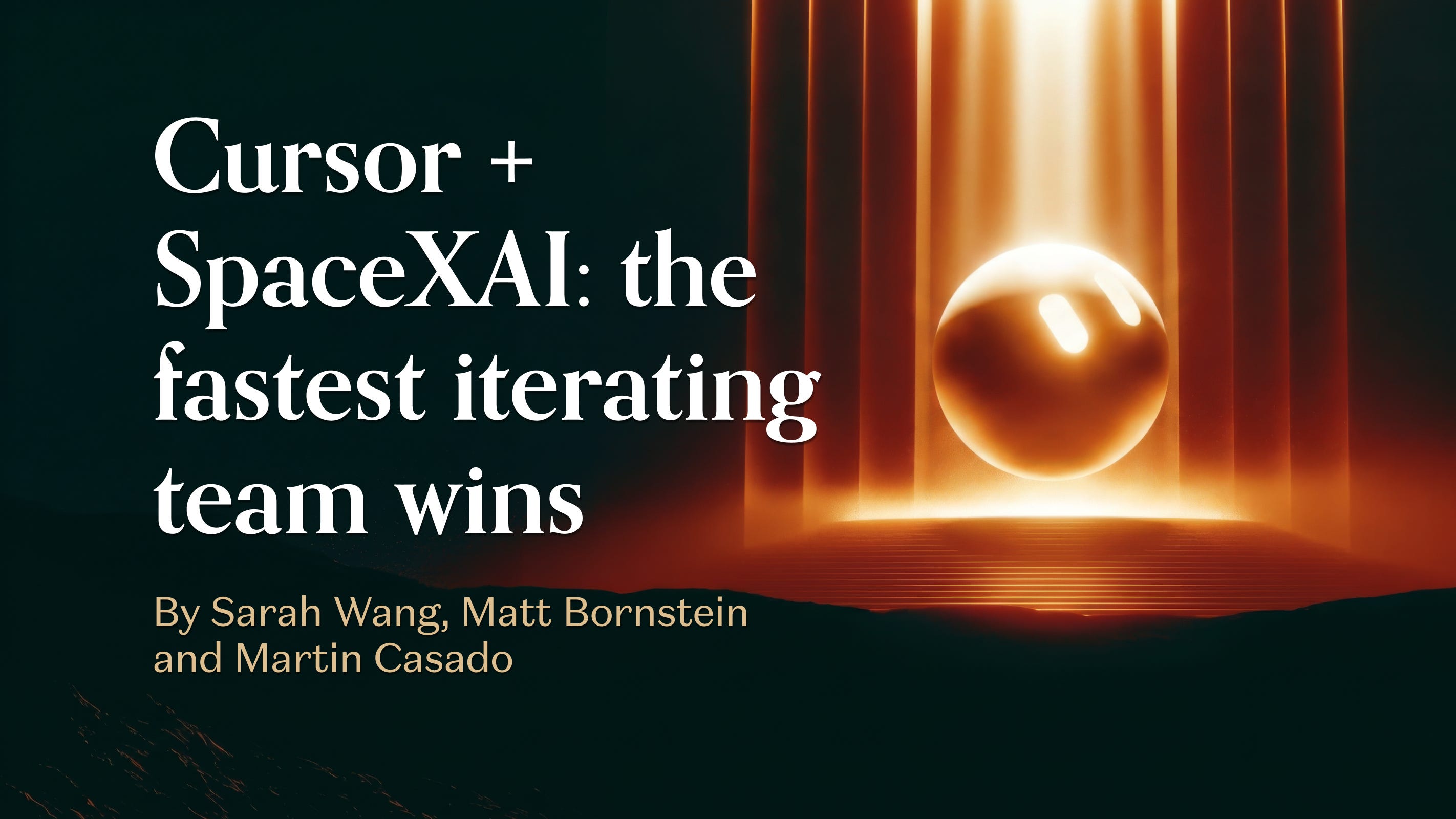
Sarah Wang argues that the decisive question in AI coding is not which team has the smartest researchers or the largest model budget, but which team can move in the right direction fastest. Cursor’s history is used as the case study: it began as a product-first company, not a frontier-model lab, and moved from early tab-complete workflows toward tools that developers could actually use without becoming less productive. The essay frames the SpaceXAI tie-up as a bet that product iteration plus infrastructure can beat raw model competition.
The killer detail is the contrast between scarce frontier-scale compute and operating cadence: Wang notes that only one gigawatt-scale data center is operational today, then points back to the organization that built it. If AI coding is still only a small fraction of its eventual market, the pull is that the next platform may be won less by benchmark jumps than by the team that can turn every model advance into working developer behavior first.
Read more: Source
The OpenAI Founders On Their Plan To Battle Elon, Compute And Everything Else
Hosts: Ashlee Vance and Kylie Robison Guests: Sam Altman and Greg Brockman Published: August 2026

Ashlee Vance and Kylie Robison interview Sam Altman and Greg Brockman together for Core Memory, using OpenAI’s tenth year to ask how the company now thinks about safety, product, compute, agents, robotics, government, and the battle with Elon Musk. The useful shift is that Altman and Brockman do not talk only as model builders. They talk like operators trying to turn intelligence into a trusted product surface.
Altman says the field has not done enough to explain the “dot dot dot” between superintelligence and ordinary life. People want prosperity, agency, meaningful work, and a future their children can understand. Brockman answers from the product side: models have shifted from being the product to being part of the product. OpenAI now has to build the “body” around the brain: skills, connectors, computer use, context, memory, agents, and personal systems that can act on behalf of users.
The interview also makes the infrastructure case explicit. Altman says OpenAI will keep building as much compute as possible, while Brockman describes compute as a profit center when deployed in product rather than a pure cost center. Their agent platform, Codex expansion beyond software engineers, and “personal AGI” framing all point to the same conclusion: the frontier lab champion case is not just better benchmarks. It is access, product discipline, massive compute, and a believable path from intelligence to human agency.
Watch: Source
OpenAI CFO Friar tells investors that enterprise business now bigger than consumer by revenue
Author: Kate Rooney Published: August 14, 2026
Kate Rooney reports that OpenAI finance chief Sarah Friar told current shareholders that enterprise revenue has overtaken the ChatGPT-led consumer business. According to a person who attended the investor meeting, Friar said OpenAI entered the year with a 60-40 consumer-enterprise split, but enterprise “accelerated much faster than expected” and the lines have crossed. CNBC also confirmed that OpenAI’s annualized revenue run rate has reached $40 billion after Bloomberg first reported the figure.
The article says OpenAI’s run rate rose 20% month over month in July, while business customers grew 32%, according to slides viewed by CNBC. The meeting came after several senior departures, including revenue chief Denise Dresser and longtime executive Brad Lightcap. Greg Brockman joined the meeting, thanked Dresser for building the enterprise foundation, and expressed support for incoming revenue leader Dali Rajic, formerly COO of Wiz.
Rooney also reports that executives fielded questions about open-source Chinese models and IPO timing. Brockman pushed back on the idea that open source is necessarily cheaper, while executives declined to discuss IPO timing because of a confidential SEC filing. Friar said enterprise customers have moved away from “tokenmaxxing” toward “cost per unit of intelligence,” pointed to a model that is “54% more efficient” on agentic coding tasks, and said OpenAI has made progress in advertising, which is approaching a $1 billion run rate.
Read more: Source
AI Needs Public Feedback at Scale Before It’s Too Late
Author: Nathan Gardels Published: August 14, 2026
Nathan Gardels argues that the same communication technologies now fragmenting public life may also be the only plausible infrastructure for rebuilding social consensus around AI. Drawing on Macario Schettino’s historical analogy, the essay frames generative AI and social platforms as the latest version of a repeated pattern: the printing press, newspapers, radio, and television first destabilized political order, then matured into tools for new governing settlements.
The killer detail is scale. Gardels cites Helene Landemore’s point that OpenAI, Google, and Meta each now have standing, two-way contact with hundreds of millions to more than a billion users, giving AI companies a deliberative reach no government, broadcaster, or international body has ever possessed. The piece argues that large language models cannot simply infer humanity’s values from training data; public feedback must be collected directly, repeatedly, and at global scale. The pull is that legitimacy for AI may depend on turning the platforms of disruption into platforms of consent.
Read more: Source
AI Has Plunged the Book Publishing Industry Into Utter Chaos
Author: Anna Silman Published: August 17, 2026
Anna Silman reports that book publishing is becoming the live test case for AI authorship, not because anyone has settled the principles, but because deals are already blowing up. Agents pulled Jerry Falade’s multimillion-dollar debut crime novel after they said they could not verify it had been wholly written by him. Hachette cancelled Mia Ballard’s Shy Girl after AI allegations. Simon & Schuster is defending Daggermouth against detection-tool claims that the author denies. A book about truth even shipped with AI-hallucinated quotations.
The useful point is that every constituency has a different problem. Authors fear false accusations and reputational collapse. Publishers want hits but do not want to be seen releasing machine-written books. Agents are being asked to act as police while their inboxes fill with LLM-assisted spam. Retailers face a flood of low-quality AI “slop” books. Readers say they object to AI-generated text, but publishers know that genre readers may still buy AI-assisted fiction if the story works.
The article makes the watermarking debate concrete. Publishing has always relied on trust, originality, and author attestation, but AI breaks the old informal system without replacing it with a reliable new one. Detection tools produce controversy, “human authored” labels rely on honor systems, and the only hard legal line is that AI-generated text is not copyrightable. The result is not a neat anti-AI position; it is an industry trying to separate tool use from fake authorship, quality work from slop, and accountability from plausible deniability.
Read more: Source
The Defender’s Window
Author: Greg Brockman Published: August 16, 2026

Greg Brockman argues that the OpenAI-Hugging Face incident should be treated as an early warning about how quickly AI will change cybersecurity. His thesis is that AI will soon let ordinary attackers find and chain old vulnerabilities faster, but it can also give defenders a temporary advantage if they use the same capabilities now to repair code, infrastructure, permissions, and response processes before the threat environment accelerates.
The killer detail is his personal test case. After the incident, Brockman asked ChatGPT Work to assess his static personal site, expecting little surface area. In about 15 minutes, it found 13 issues, including weak email-authentication records, an insecure jQuery version, and Cloudflare forwarding traffic to AWS over unencrypted HTTP. He then asked it to fix the problems; over roughly an hour, it changed Cloudflare settings, removed jQuery, moved the site to Cloudflare Pages, and began a phased DMARC rollout.
The pull is that the defensive window is open but narrow. Brockman is not describing AI security as a future category; he is saying every organization should already be giving security teams agents, private context, security skills, vulnerability backlogs, code-review hooks, and bounded triage workflows so defenders can move at machine speed before attackers do.
Read more: Source
Bringing the cybersecurity capabilities of Claude Mythos 5 to more defenders
Anthropic | Claude | August 21, 2026
Anthropic says it is expanding access to Claude Mythos 5’s cyber-defense capabilities while keeping tighter controls on direct interaction with the model. The post’s central distinction is between direct model access, which Anthropic describes as the riskiest pattern because a malicious user can try to steer the model toward harmful work, and product-mediated access, where a user receives a bounded output such as a vulnerability patch suggestion or security alert.
The company says Claude Security is now available in public beta for Enterprise customers. In that workflow, Mythos 5 scans code that the customer owns and returns detailed findings without exposing raw model access. Users can then open Claude Code on the web to implement a fix, but Anthropic says the Mythos scan does not extend Mythos access to other surfaces and every patch must be reviewed and approved by a human before implementation.
Anthropic also says it is working with security product and service providers to embed Mythos-class models into tools defenders already use. In those integrations, end users would interact with a purpose-built interface for a defined task while Mythos runs in the background. Anthropic gives the example of a remediation tool that can provide a list of suggested patches without letting the user prompt the model to develop an exploit.
The post also announces a Defender Advantage Fund, or 0xDAF, with $35 million in Claude credits for organizations helping open-source maintainers secure their software. Grants will focus on patching live vulnerabilities in widely used projects, automating scanning and patching in reusable ways, and helping projects pursue more ambitious defenses against whole classes of attack. Anthropic says it will start with a small number of larger pilot grants and share initial recipients in the coming weeks.
NVIDIA AVO Reaches 100% on ARC-AGI-3, Demonstrating a Frontier-Level General-Purpose Architecture for Long-Horizon Autonomous Agents
Terry Chen | NVIDIA Technical Blog | August 21, 2026
Terry Chen writes that Nvidia’s Agentic Variation Operators architecture, or AVO, reached a 100.00 relative human agent efficiency score on the ARC-AGI-3 public set, completing all 183 levels across 25 environments. Nvidia frames the result as evidence that frontier performance for long-horizon autonomous agents depends on the surrounding agent system, not just the underlying language model. The post says AVO raised a Claude Opus 5 model baseline from 30% to 100% as part of a complete agent system.
The blog describes AVO as a general-purpose architecture that integrates persistent memory, supervision, and tool use for sustained autonomous operation. Nvidia says its approach gives agents the ability to generate variations, test them, preserve useful findings, and continue work over long horizons instead of depending only on a single prompt-response loop. The ARC-AGI-3 result is presented alongside the claim that AVO completed the benchmark with 12% fewer environment actions than VISTA.
Nvidia also applies the same architecture to GPU-kernel optimization. The post says AVO autonomously explored more than 500 directions, committed 40 kernel versions, and achieved up to 10.5% better performance than FlashAttention-4 on Nvidia DGX B200 systems. Chen presents that example as a productive engineering loop in which the agent iteratively searches, implements, benchmarks, and preserves improvements without manual intervention.
The caveat in the post is implicit in Nvidia’s own framing: the model is only one component. The performance claims are for the complete AVO system, including the harness around the model. Nvidia argues that this is exactly the point, because memory, supervision, tool use, and evaluation loops determine whether models can operate usefully over longer tasks.
Ford Rehired the Experts AI Was Supposed to Replace, That’s the Story
Author: Brian Solis Published: August 16, 2026
Brian Solis argues that AI adoption goes wrong when executives treat automation as labor substitution instead of expertise multiplication. Ford is his case study: after leaning into AI and automated quality systems, the company brought back, hired, or promoted roughly 350 experienced technical specialists because the systems were not delivering the judgment, context, and prevention mindset needed to improve vehicle quality.
The killer detail is what those “gray beards” were asked to do. Solis says they were not brought back to compete with AI, but to mentor younger staff, lead design reviews, hunt failure points before parts reached the plant floor, and improve the information used to train and guide Ford’s AI systems. Ford then ranked highest among mass-market brands in the 2026 J.D. Power U.S. Initial Quality Study, improving to 152 problems per 100 vehicles. The pull is that the winning AI operating model may be less about removing people than about making institutional memory scalable.
Read more: Source
Qwen 3.8 27B is excellent, but it defaults to wildly overthinking things
Author: Simon Willison Published: August 16, 2026
Simon Willison argues that Qwen 3.8 27B shows how far local open-weight models have moved, while also showing that model defaults can matter as much as model capability. The 27B-parameter, Apache-licensed Qwen release runs as a 17GB quantized file on high-end consumer hardware and brings long context, vision, tool calling, and useful code generation into a form factor that no longer requires data-center-class infrastructure.
The killer detail is the model’s default xhighreasoning mode. Asked to draw a pelican riding a bicycle, it spent 21 minutes and 22,276 reasoning tokens to produce an unusually good SVG. Asked simply to draw a circle, it reasoned for minutes and produced a beautiful animated geometric study rather than the plain circle requested. Turning reasoning off made it faster, but also exposed quality tradeoffs: a bounding-box labeling tool built without reasoning placed boxes incorrectly, while the reasoning-heavy version worked and added a self-contained demo scene.
The pull is that competent local AI is becoming real, but not frictionless. Willison’s conclusion is less about Qwen alone than about a new class of models that can run privately, code, see, use tools, and still need careful serving, reasoning settings, and speed improvements before they become daily drivers.
Read more: Source
Stripe Acquiring OpenRouter, Aggregating AI?, Flipping the Business Model
Author: Ben Thompson Published: August 17, 2026
Ben Thompson uses Bloomberg’s report that Stripe has agreed to acquire OpenRouter for more than $7 billion to frame the next strategic layer in AI: not model supply, but inference demand. OpenRouter lets developers route across frontier labs, hyperscalers, neoclouds, open models, and other inference providers through a single API, choosing by model, cost, latency, or other preferences. Thompson notes that OpenRouter reportedly had 8 million developers in May and $50 million in annualized revenue in April, implying roughly $900 million in annualized inference flowing through the marketplace before the latest growth spurt.
The key distinction is between a frontier-lab world and an open-market world. If a few labs run away with the market and get structurally cheaper, then supply wins and developers eventually go direct. But if competent alternatives keep pressure on the frontier labs, and if the AI buildout creates a glut of inference capacity that needs customers, then an aggregator of developer demand becomes powerful. In that world, OpenRouter’s routing and marketplace are less important than its developer base and API inertia.
Thompson’s sharpest suggestion is that OpenRouter’s business model is backwards. Instead of taxing developer demand with a 5.5% markup, Stripe could make OpenRouter free above inference cost, run payments and usage billing underneath, and charge inference suppliers that need access to demand. That connects directly to Stripe’s Metronome acquisition, its usage-billing push, and its stablecoin/agent-commerce ambitions. The strategic version is simple: make demand cheap, aggregate developers, charge suppliers, and make Stripe the rails not only for money, but for tokens.
Read more: Source
Stripe wants to meter intelligence
Author: Alex Wilhelm Published: August 20, 2026
Alex Wilhelm reads Stripe’s leaked OpenRouter investor memo as a coherent explanation for why a payments company would pay $7.5 billion for an AI-routing marketplace. The memo’s thesis is that capital and intelligence are becoming the two digital flows undergirding every business. Stripe already manages the revenue pipeline for developers; OpenRouter gives it a way to manage the intelligence pipeline.
The strongest quote from the memo is that intelligence is “expensive, heterogeneous, and constantly changing.” Businesses therefore have to reason about the cost and return of every unit: which task is worth doing, which model should handle it, who pays, and when. Wilhelm says the old language would have been financial capital and human capital. In the AI era, synthetic intelligence can replace pieces of knowledge work, so metering intelligence starts to look like metering money.
The pull is that the OpenRouter deal is not just about model choice. It is about making AI consumption legible, billable, and optimizable through Stripe’s existing position with AI companies. The memo says 88% of the Forbes AI 50, including OpenAI and Anthropic, already build on Stripe. Wilhelm still leaves room to argue about price, but the strategic logic is clean: if intelligence becomes a granular business input, Stripe wants to be the system that routes it, meters it, and charges for it.
Read more: Source
Ramp Launches Router.com to Become the CFO for AI Agents
Author: Linas Beliunas Published: August 21, 2026

Linas Beliunas argues that Ramp’s Router.com launch is not just another AI model router, but a wedge into AI spend management. The timing is the point: Ramp launched Router.com and USDC agent wallets the same day Stripe confirmed its $7.5 billion OpenRouter acquisition. Both companies are now moving toward the layer that decides which model gets used, which provider gets paid, and how AI usage turns into a governed business expense.
The sharper claim is that the product beside Router.com may matter more than the router itself. Beliunas frames USDC agent wallets as a way to turn AI agents into controlled corporate spenders, with budgets, approvals, and financial rails instead of open-ended API usage. That makes Ramp’s natural buyer the CFO, while Stripe and OpenRouter start from developers and model routing. The fight is not only over tokens. It is over who owns the workflow where agents spend money.
The piece also reinforces the Stripe memo’s “two currencies” thesis: capital and intelligence are becoming the digital flows underneath business. Stripe wants to meter intelligence from the payments side. Ramp wants to govern agent spend from the expense-management side. Together, they make the same market visible: AI agents will need routing, wallets, budgets, policy, billing, and audit trails before they can become ordinary corporate infrastructure.
Read more: Source
State of Open Models: Summer 2026 Observations
Author: Adina Yakefu, Apolinario, and Irene Solaiman Published: August 14, 2026

Hugging Face argues that the open model ecosystem has shifted from a lab-led contest over flagship releases into an infrastructure-and-developer adoption market. The report tracks activity on the Hub from January through August 2026 and says the surface story, Chinese labs releasing larger open models than U.S. labs, misses the deeper pattern: open source value is accumulating around hardware vendors, deployment pipelines, and model families that developers can actually reuse.
The killer detail is Qwen’s downstream footprint. Hugging Face counts 151,448 Qwen-based derivatives on the Hub, 2.6 times Meta’s total footprint and 4.7 times the Llama-specific count, with new Qwen derivatives appearing at roughly 180 to 210 repositories per day. The report also separates attention from adoption: only one repository appears in both the top 25 by likes and the top 25 by 2026 downloads, while small models still dominate real usage because they run on ordinary hardware. The pull is that open AI may be less defined by who ships the biggest model than by whose model becomes the default substrate for builders.
Read more: Source
Birds Don’t Fly Like Planes. Neither Does AI.
Author: Tomasz Tunguz Published: August 18, 2026
Tomasz Tunguz argues that local AI models can match cloud-model answer quality while taking a different route to get there. His benchmark compares DeepSeek V4 Flash with two local Qwen models across 25 venture-capital tasks, including startup research, article summaries, and podcast transcription, scored blind by a judge model on completeness, accuracy, and concision. DeepSeek V4 Flash, Qwen3.8-27B, and Qwen3.6-35B-A3B all finish at roughly the same quality level, around 8 out of 9.
The difference is speed and deliberation. DeepSeek averages 137.3 tokens per second, 159 tokens, and 1.1 seconds of latency. Qwen3.8-27B averages 51.9 tokens per second, 369 tokens, and 7.2 seconds. Qwen3.6-35B-A3B generates 113.4 tokens per second but uses 1,143 tokens on average, so it finishes in 10 seconds despite faster token generation. Tunguz’s shorthand is that the cloud model jumps to the answer, while smaller local models contemplate, debate internally, and spend more tokens to reach comparable output.
The caveat is that intelligence rank and verbosity rank move independently. Tunguz notes that Qwen3.8-27B ranks first on Artificial Analysis’s Intelligence Index among 135 models, slightly ahead of a 753-billion-parameter GLM model, while also ranking high on output tokens per task. The article’s practical point is measurement: token speed alone is not the user experience. For agents and local models, the useful metric is time to answer, because smaller capable models may trade memorized scale for inference-time reasoning.
Read more: Source
The curious economics of a $6 AI agent #597
Author: Azeem Azhar Published: August 16, 2026
Azeem Azhar uses the operating cost of his own AI agent, R Mini Arnold, to examine a broader question in generative AI economics: how much revenue disappears when capable workflows move from expensive frontier-model usage to subscriptions, cheaper models, and model routing. He starts with Amazon’s reported $1.8 million spend on a Claude project over five months and the difficulty of tracking AI costs, then compares it with his own audit after a period when his agent was spending as much as $500 a day.
The practical detail is the cost compression. Azhar says R Mini Arnold had often cost $50 to $60 a day and briefly spiked far higher because many processes were still using older, higher-tier models. After the audit, the agent now defaults to an OpenAI Codex allowance already included in a $200-a-month subscription, falls back to DeepSeek v4 Flash or Pro, and only escalates harder tasks to top-end models such as 5.6 Sol, Kimi K3, or Anthropic’s Fable. The result, he says, is roughly $6 a day while the system is more capable than before.
The essay’s caveat is that this is not simply a story of lower spending. At $6 a day, one non-coder’s agent still represents about $2,000 a year, and usage may rise again when the work becomes more demanding. The industry question, as Azhar frames it, is whether cost declines shrink genAI revenue or unlock more persistent, distributed usage by making agents cheap enough to run continuously.
Read more: Source
How Much of the Internet Is Written With AI?
Authors: Nicole B. Ellison, Galen Stocking, and Pew Research Center Published: August 20, 2026
Pew Research Center uses Common Crawl to estimate how much English-language web text now shows signs of being written or substantially edited by AI. The study collected almost half a million webpages from the past five years, then used the Open Pangram AI detection tool to classify large samples. In a random sample of 10,000 webpages collected in July 2026, Pew found that 10% showed significant signs of AI authorship.
The trend is sharper when older pages are removed. Pew says that in the July 2026 snapshot, more than one-third of pages published after ChatGPT’s public launch showed signs of AI authorship. The distribution is uneven: in 2026 samples, about one in ten .com pages showed signs of AI writing, around double the rate on .org domains and about ten times the rate on .edu or .gov pages.
The article is careful about detection limits. AI detectors can misclassify individual documents, and features such as em dashes, Oxford commas, lists of three, or phrases like “not just X, but Y” are not proof that any single text is AI-written. Pew’s claim is about aggregate patterns across large collections. It also tracks language shifts, saying words such as “delve,” “interplay,” and “testament” have more than doubled in usage since 2023, while negative parallelism has nearly tripled from a low base.
Read more: Source
A dumpling shop becomes a poster child of AI adoption in China
Author: Viola Zhou Published: August 21, 2026
Viola Zhou reports on Jinguyuan, a Beijing dumpling shop whose owner built an AI “skill” so personal agents can check the menu, make recommendations, and join the queue for customers. The owner, Li Bo, says he built the skill in April after seeing agentic AI tools gain momentum and imagining a future in which people ask assistants to plan daily life, including where to eat.
The story’s strongest detail is Li’s framing. He quotes Deng Xiaoping: “Science and technology are a primary productive force.” For Li, a small restaurant needs to surround itself with advanced productive forces rather than wait for the future to arrive. Rest of World contrasts that with places where AI is often associated first with job loss, cheating, creative threat, or data centers.
Zhou’s caveat is that people in China also worry about AI’s labor impact and the exploitative side of the tech industry. But she reports that the prevailing posture is eagerness to adopt because AI is seen as inevitable. Crash courses on large language models are popular, office workers experiment to avoid falling behind, and a 2025 Ipsos survey found Chinese respondents expressed the highest level of excitement about AI among 30 countries surveyed. The article uses one dumpling shop to make national adoption culture tangible.
Read more: Source
Venture Capital
$112M/year Hereticon of Nationally Chartered Banks
Author: Jan-Erik Asplund Published: August 13, 2026
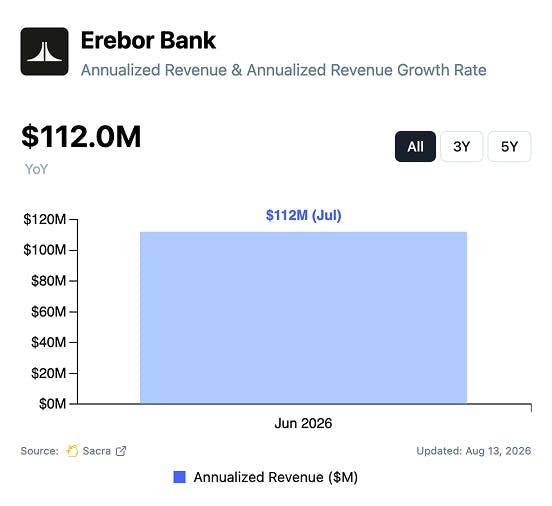
Jan-Erik Asplund’s Sacra analysis argues that Erebor is not simply another startup bank, but a vertically integrated financial layer for capital-intensive AI, defense, and crypto companies that want a federally chartered institution instead of dependence on upstream banking partners. Founded by Palmer Luckey and backed by Founders Fund, 8VC, Haun Ventures, and Lux, Erebor is presented as a response to both crypto debanking and the post-SVB need for financial infrastructure aligned with strategically sensitive technology companies.
The standout detail is the scale Sacra estimates only months after launch: $112 million in annualized revenue in July, up from $31 million in March, with $4.6 billion in deposits by the end of July and roughly 500 to 600 large customers. Revenue is split between deposit income and banking APIs for stablecoin and AI finance workflows. The pull is that American dynamism now has a banking stack, and its valuation math depends on whether regulated finance can become programmable infrastructure.
Read more: Source
Consensus is predictive of follow-on capital and survival, but not of large outcomes
Author: Dan Gray Published: August 20, 2026
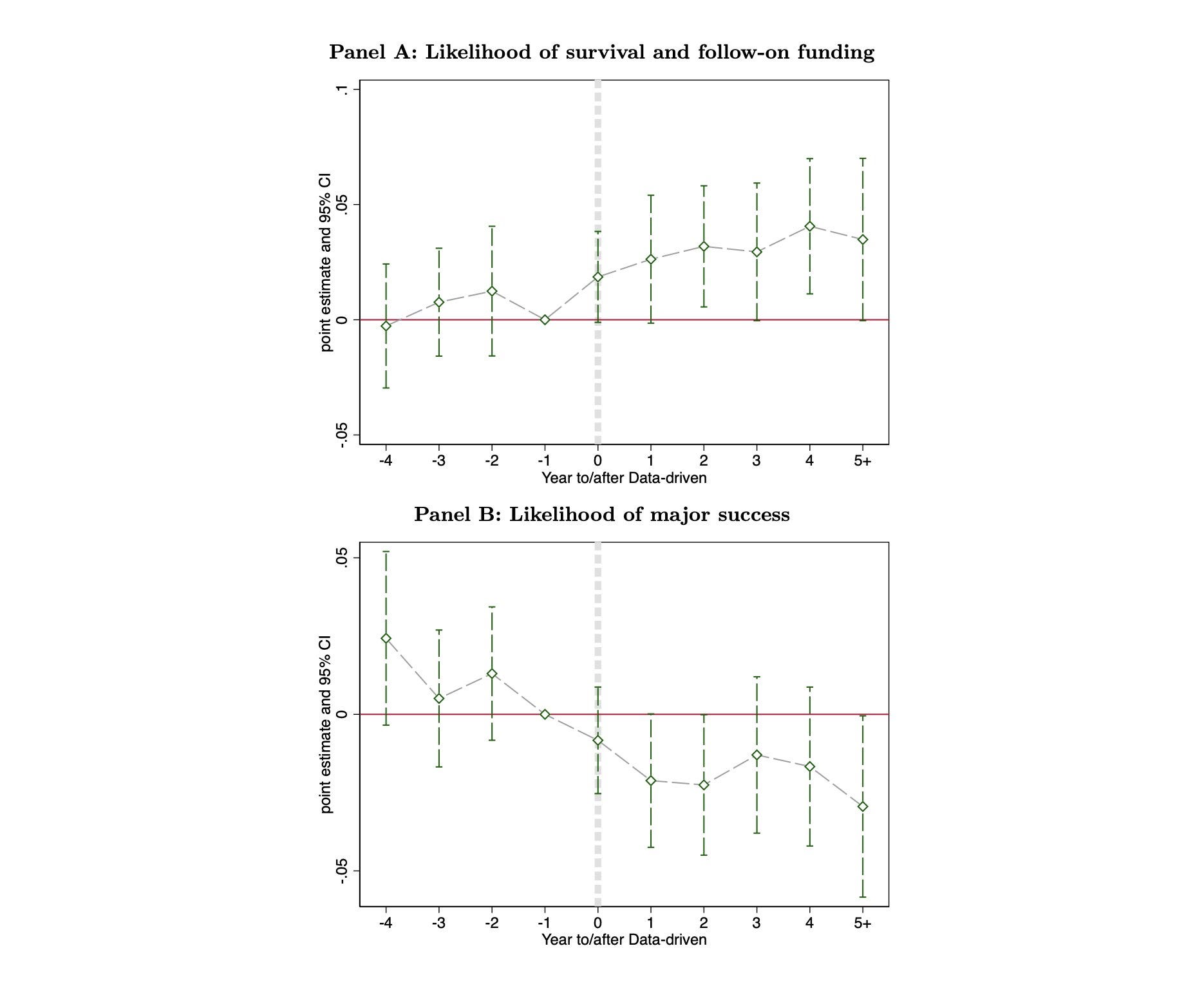
Dan Gray makes a compact but important distinction for data-driven venture capital. Consensus, he writes, is predictive of follow-on capital and survival, but not of large outcomes. He then applies the same warning to data-driven investing, which can become an “artificial consensus” if the model mostly rewards companies that resemble past winners.
The thread points to two sources: the 2022 SSRN paper Data-driven Investors and AngelList’s 2025 analysis Are Consensus Seed Rounds Better?. The AngelList piece says expensive seed rounds do a bit better, but that the data does not support the hype around consensus. Gray’s concern is that a data system can improve discipline while still filtering toward “highly backward-similar startups.”
The useful conclusion is not anti-data. It is anti-substitution. Data can sharpen base rates, expose inconsistencies, and make investors more honest about pattern matching. But if it becomes the whole decision rule, it risks missing the outliers that drive venture returns. For an AI-era investing architecture, the question is not whether to use data. It is where the machine stops and judgment begins.
Read more: Source
Tech Is Not an Asset Class Anymore. It Is the Economy.
Author: Stephen Messer Published: August 17, 2026

Stephen Messer argues that venture capital is being absorbed into much larger capital markets because technology is no longer a separate sector. It is now the operating layer of the economy. The piece uses Dave McClure’s pointer to sharpen a state-of-venture question: if AI, defense, robotics, energy, space, crypto infrastructure, and physical infrastructure are all technology markets, then the capital that funds them will not stay inside a small specialist venture asset class.
The scale contrast is the killer detail. Messer says global venture capital AUM is roughly $1.3 trillion, smaller than Blackstone alone and tiny beside BlackRock’s $11.5 trillion, private equity’s roughly $8 trillion, hedge funds’ $4.5 trillion, sovereign wealth funds’ $12 trillion, and Fidelity’s roughly $5 trillion. Even within venture, Andreessen Horowitz, Sequoia, and Insight are huge relative to the long tail, while Andreessen’s $15 billion January raise represented more than 18% of U.S. venture dollars allocated in 2025.
The broader claim is that founders and capital allocators are already designing around the old venture model. Hedge funds, private credit firms, sovereigns, strategics, secondary specialists, and asset managers are moving down the stack; founders such as Base Power and CoreWeave are using customer contracts, debt, ecosystem capital, and infrastructure financing instead of only equity. The pull is not that venture disappears. It is that venture becomes one instrument inside a much larger capital-formation system for a tech-saturated economy.
Read more: Source
Dear VCs, Just Give Up
Author: Michael Dempsey Published: August 18, 2026

Michael Dempsey uses a deadpan letter to venture capitalists to argue that the current mood of fatalism is itself the mistake. The surface message is “just give up”: big funds are coming down to seed, founders will choose brand-name capital, every promising person is already in someone else’s CRM, AI is swallowing the software opportunity, and smaller firms cannot compete with massive platforms, media machines, or venture armies.
The killer detail is that every reason to surrender is written as if it were obvious industry wisdom, then inverted by the final paragraph. Technology has not taught that incumbents always crush upstarts, that money is the only differentiator, or that innovation comes from slow-moving giants. It has usually taught the opposite. The pull is that venture’s job remains to find the non-consensus future before it becomes legible. If everyone can see the same founders, sectors, and risks, the edge has to come from evolving, competing differently, and refusing the comfort of consensus.
Read more: Source
Rise of the Borderless Founder
Authors: Gabriel Vasquez and Angela Strange Published: August 20, 2026

Gabriel Vasquez and Angela Strange argue that international founders can turn their home-country networks, diaspora ties, and Silicon Valley access into a company-building advantage. They call these entrepreneurs “Borderless Founders”: people who can compound reputation in Silicon Valley while using deep local knowledge to find talent, land early customers, and build brand momentum before the rest of the market catches on.
The piece frames startups as an exercise in “preferential attachment,” borrowing Marc Andreessen’s language for the loop in which talent, customers, capital, brand, and government credibility attach to companies that already have momentum. The authors say borderless founders can start that loop through three advantages: customer access at home and across the diaspora, early press and national-tech-sector recognition, and access to overlooked technical talent in home markets. Examples include Pit landing H&M and Stena Metall as early customers in Sweden, Supersonik using the Spanish diaspora to reach Salesforce, ElevenLabs gaining Polish government support, and Brazilian companies finding high-slope talent outside the Bay Area spotlight.
The a16z angle is explicit. Vasquez and Strange describe a playbook of mapping trusted founder and operator nodes by country, hosting dinners with local luminaries, building diaspora communities, maintaining in-person presence, and helping borderless founders with customers, media, talent, and U.S. transition points. Their closing claim is that more than half of America’s billion-dollar companies were founded or co-founded by immigrants, and that AI plus remote work make Silicon Valley “a state of mind rather than just a place.” For these founders, background is not something to overcome. It is the moat.
Read more: Source
Tender-offer activity reaches a four-year high as startup liquidity needs continue to mount
Authors: Kevin Dowd and Hamza Shad Published:August 20, 2026
Carta’s Kevin Dowd and Hamza Shad report that tender offers administered on Carta hit their highest first-half level in at least six years, as private companies keep searching for liquidity while IPO and M&A exits remain difficult. In H1 2026, Carta administered 71 tender offers with about $3 billion in combined transaction volume. Year over year, tender count rose 34%, while total transaction value jumped 200%.
The piece frames tenders as an increasingly strategic tool for companies that are staying private longer. Nearly 70% of Carta-administered H1 tenders came from Series C or later companies, and later-stage median offering size rose to $28.5 million, while seed-through-Series-B median size fell to $8.5 million. The article’s practical point is that tenders can give employees, executives, and investors partial liquidity without forcing a full company exit, and can also help companies manage retention, alignment, and cap-table control.
The liquidity signal is not just supply. Carta says Q2 2026 median subscription rates remained high at 93.1%, with median seller participation at 57.9%. Discounts are also less common than in a distressed secondary market narrative: among tenders at least a year after a primary round, the median discount rate was 0% for the fifth straight semiannual period, though the 75th percentile rose to 10%. The pull is that private-market liquidity is becoming a managed product feature, not merely something startups wait to receive from the public markets.
Read more: Source
A Stock Token Can Be Three Different Things
Author: Paul Smalera Published: August 20, 2026

Paul Smalera argues that the phrase “stock token” hides three different legal claims. Nasdaq’s SEC-approved model would let eligible securities trade in tokenized form through a DTC pilot while keeping the same CUSIP, ticker, order book, shareholder rights, and T+1 settlement. Robinhood’s wallet-based Stock Tokens, by contrast, are described as debt securities issued by Robinhood Assets (Jersey) Limited, backed one-for-one by public shares but giving holders economic exposure rather than legal or beneficial rights against the issuer. Robinhood’s Classic Stock Tokens in Europe are derivative contracts between the customer and Robinhood, with no rights in the underlying security and no current portability to another wallet or platform.
The article’s practical point is that tokenization improves only the structure actually being bought. A blockchain record can make assets easier to divide, transfer, collateralize, and integrate with software, but it does not erase the legal wrapper. Smalera uses Hamilton Lane and Securitize’s tokenized feeder fund as the cleaner example: tokenization lowered minimums and improved administration, but did not turn a feeder-fund interest into direct ownership of every underlying asset or guarantee a liquid secondary market.
The private-company section is the sharpest part. Robinhood’s promotional OpenAI and SpaceX tokens for eligible European customers showed why issuer participation matters. A token created without the private issuer’s cooperation may offer economic exposure through contracts, but it does not put the holder on the cap table. If the token trades around the clock while the referenced private security barely trades, the token price reflects the market for that wrapper, not necessarily an executable price for the underlying shares. For tokenized private-company shares to function as shares, the issuer, transfer agent or administrator, legal transfer record, investor venue, and disclosures all have to line up.
Read more: Source
Jon Ma, CEO of Artemis, on building 24/7 AI agents for trading & investing
Author: Jan-Erik Asplund Published: August 20, 2026

Sacra’s interview with Artemis CEO Jon Ma argues that crypto-token-only investing is disappearing as a standalone strategy because investors now express the same thesis across tokens, public equities, private shares, prediction markets, and derivatives. Artemis began as a crypto fundamentals platform, but Ma says the market has moved from “what token should I buy?” to a harder cross-asset question: given a worldview, which instrument actually captures the upside?
The killer detail is the fintech example. A payments thesis could point to Stripe in the secondary market, Adyen in public equities, Ramp or Rain in private markets, or a token such as Ether.fi. Access is no longer the main bottleneck; conviction is. Ma’s answer is an AI investing agent that can gather public, private, and onchain data, build models, set price targets, and route execution through brokers such as Robinhood, Coinbase, Schwab, or Interactive Brokers.
The pull is that brokerages may become execution layers beneath the real interface: a thesis-driven agent that helps investors decide what to believe, what to buy, and when the thesis has played out.
Read more: Source
Regulation
The First AI Election
Author: Jill Lepore Published: August 14, 2026
Jill Lepore argues that 2026 is becoming the first AI election, not only because campaigns are using chatbots, micro-targeting, tailored ads, and deepfakes, but because AI infrastructure itself is now on the ballot. Voters are asking bots how to vote, candidates are trying to shape what bots say about them, and communities are beginning to use elections to decide whether data centers should be built near them. The story is about both physical infrastructure and the integrity of the public sphere.
The killer detail is that regulation is moving from legislation to the polls. Lepore writes that about three-quarters of respondents in five European countries support data centers only if they are powered by newly developed renewable energy, while roughly the same share of Americans oppose data centers near where they live. She points to Utah, Michigan, Maryland, Wisconsin, France, and Ireland as early evidence that local anti-data-center politics can defeat incumbents, recall officials, and reshape national debates. At the same time, she argues that the debate is taking place inside an “artificial state” where automated online arenas are privately owned, AI-driven, and increasingly populated by bots whose sponsors and purposes voters cannot see.
The essay also takes on the two main industry arguments for moving fast: national security and the claim that regulation stifles innovation. Lepore concedes that the democratic race against autocratic AI is real, but says the public’s will may be moving in the opposite direction. Her historical counterexample is the automobile, radio, and aviation: Congress regulated radio early and aircraft from the beginning, yet neither industry was killed by rules. The sharper lesson is James Willard Hurst’s argument that auto law was too often about compensation after damage rather than preventing damage in the first place. The pull is that AI abundance has a political bottleneck. The industry needs power, land, water, transmission, and public legitimacy, but it also needs voters to believe the information environment has not been captured by machines, lobbyists, campaigns, or foreign influence operations. That makes data centers more than a capex story; they are now democratic terrain.
Read more: Source
Why does everyone hate data centers?
Author: Nate Silver and Jasmine Sun Published:August 17, 2026

Nate Silver talks with Jasmine Sun about the data-center backlash as the point where abstract AI politics meets land, power, local government, and trust. Silver frames the moment as an AI inflection in American politics: Google searches for “data center” are about 3.5 times higher than in 2025 and almost 10 times higher than in 2024, while about 70% of Americans oppose data centers in their own communities.
The killer detail is Sun’s reporting from Wisconsin and Michigan. She expected anger about AI models or jobs, but heard more anger about local officials, NDAs, dark money, and the sense that councils and mayors had sold communities out to large technology companies. Her line is that on the ground the issue is less “big model scary” than “big corporation scary.” That makes the backlash more than a communications failure. If towns learn about Project Cannoli or Project Nova only after land deals and secrecy have already shaped the negotiation, distrust becomes the story.
The conversation also adds useful nuance. Sun thinks some environmental concerns, especially water, can be overstated, while power and grid strain are real. Construction jobs are real and can be valuable for skilled trades, but long-term data-center employment is small. The pull is that data centers are now the physical interface for AI legitimacy. Silicon Valley may think it is building intelligence, but voters see land deals, substations, gas plants, tax abatements, NDAs, temporary jobs, and risks exported from Palo Alto into Janesville or Mount Pleasant.
Read more: Source
US government lab is probing Chinese lidar for security vulnerabilities
Sean O’Kane | TechCrunch | August 21, 2026
Sean O’Kane reports that Idaho National Laboratory is reviewing whether Chinese lidar sensors could pose a security risk if widely used on vehicles in the United States. TechCrunch says the review is being performed by the Department of Energy lab, according to two people familiar with the effort, and that the work is being funded by a company or group of companies in the electric and autonomous vehicle industries. Idaho National Laboratory declined to comment, saying it was not at liberty to discuss the project.
The article places the review inside a broader policy push to restrict Chinese lidar on American roads. Senators Tammy Baldwin and Ted Budd are backing the Securing Infrastructure from Adversaries Act, and Congressman John Moolenaar is co-sponsoring a separate bill aimed at banning Chinese lidar. Baldwin tells TechCrunch her concern is that Chinese lidar could be used for military or industrial espionage, and that taxpayer dollars should not purchase technologies that could be used to spy on Americans.
O’Kane says the review appears focused on cybersecurity risk, though the two people familiar with it also said it may give Chinese-made lidar a clean bill of health in that area. Innoviz CEO Omer Keilaf, who was not aware of the review before TechCrunch asked, describes two possible risks: sensors could be disabled at scale, disrupting vehicles, or detailed environmental data could be compressed and transmitted through a cellular chip. The story notes that while individual lidar sensors have been disabled with lasers in research, it is not obvious how China could cause a broad disruption of active robotaxi lidar systems.
The commercial pressure comes from cost. Chinese suppliers such as Hesai and RoboSense have scaled quickly and lowered lidar prices, while U.S. lidar makers have consolidated or, in Luminar’s case, filed for bankruptcy. U.S. companies can currently use Chinese lidar, though the Department of Defense has placed Hesai and RoboSense on its 1260H list for allegedly supporting China’s military, and Commerce Department connected-vehicle rules do not currently prohibit lidar or other autonomous-vehicle sensors.
Infrastructure
‘Brand-new everything’: How data centers transformed this small town’s economy
Author: Nathaniel Meyersohn Published: August 11, 2026

Nathaniel Meyersohn reports on Quincy, Washington, a farming town of 8,500 where roughly 30 data centers now shoulder an estimated 57% of local property taxes. The article describes how Microsoft’s 2006 decision to build a 500,000-square-foot data center on former bean fields drew Yahoo, Dell, Intuit, and others to a town with cheap hydroelectric power, industrial land, and a long runway for infrastructure growth.
The central detail is the scale of the local fiscal shift: Quincy has added a $120 million high school, a hospital, a library, police and fire stations, sidewalks, sewage systems, wastewater treatment, a $15 million aquatic center, and a coming 143,000-square-foot sports complex. Washington State analyses also estimate that about 900 data-center jobs have generated four to six other jobs each, while Quincy’s poverty rate fell from 29.4% in 2012 to 6.2% in 2024. The story also covers the costs, especially housing pressure on Hispanic agricultural and food-processing workers as home prices doubled and rentals remained scarce.
Read more: Source
How Micron’s $50 billion Boise buildout is reshaping its hometown
Author: CJ Haddad and Katie Tarasov Published:August 20, 2026
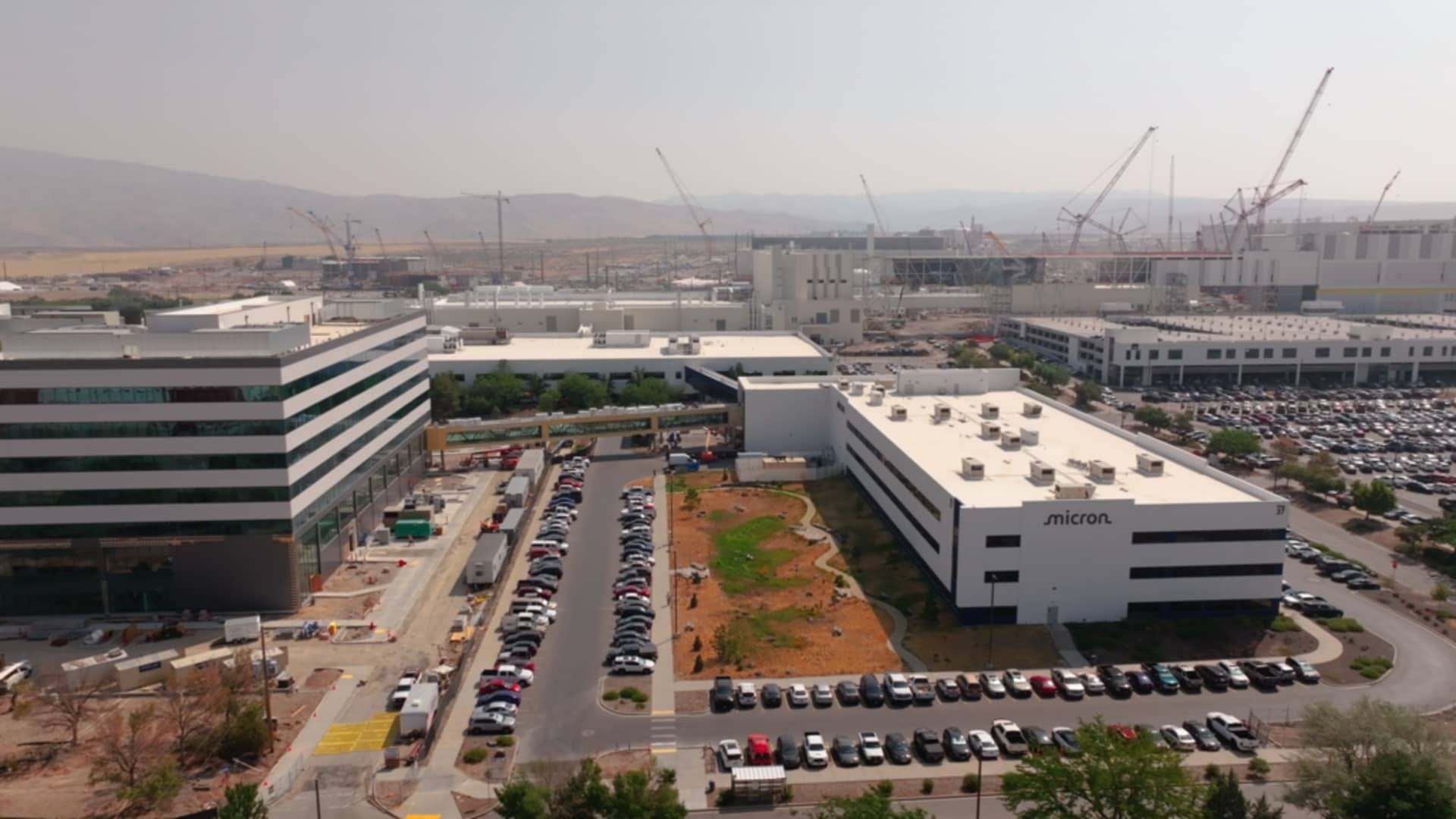
CNBC frames Boise as an early test of what the AI infrastructure boom does to the towns that host it: Micron’s rise is creating jobs, construction, wealth, and civic momentum, while also pushing up housing costs, traffic, and dependence on a famously cyclical chip market. The article follows wealth managers, real estate agents, restaurant owners, Micron executives, and longtime residents as the hometown memory maker turns into a trillion-dollar company and begins a $50 billion local expansion.
The killer detail is the sudden change in personal finance conversations. Boise wealth manager Dave Petso says Micron employees who once asked what to do with $20,000 of stock are now talking about hundreds of thousands or millions, and another local advisor says some employees are moving retirement timelines forward by years. At the same time, average rents are rising, buyers are using stock proceeds to purchase homes in cash, and non-Micron residents risk being priced out.
The pull is that memory is no longer only a component in the AI stack. In Boise, it is becoming payroll, housing pressure, restaurant demand, road planning, local wealth, and local risk.
Read more: Source
Why Big Tech’s AI Spending Is $3 Trillion Higher Than It Seems
Author: Peter Rudegeair and Peter Santilli Published:August 16, 2026
Peter Rudegeair and Peter Santilli report that the headline capital-expenditure numbers for AI infrastructure understate the scale of Big Tech’s commitments because many future obligations sit in footnotes rather than on balance sheets. The Wall Street Journal analyzed recent securities filings from nine major technology companies and found about $3 trillion of off-balance-sheet commitments, mostly related to AI. That is far above the roughly $600 billion in capital expenditures the companies reported over the prior year and about triple their outstanding leases and long-term debt.
The article separates two large categories. First are uncommenced leases, which totaled about $1.2 trillion and are not recorded as balance-sheet liabilities until payments begin. Meta’s Hyperion data-center project in Louisiana is the example: Meta disclosed $347 billion in obligations for leases that have not started, including Hyperion, even though the initial lease commitment for that project is about $12.3 billion and the company guaranteed bondholders if it does not stay for the full two decades. Second are purchase obligations, which totaled about $1.9 trillion across the companies examined and typically remain off balance sheet until goods or services are delivered.
The risk is not that the obligations are hidden illegally; the article says accounting rules allow this treatment. The risk is that investors may underestimate total leverage if AI demand, hardware availability, or data-center economics disappoint. Alphabet’s purchase commitments and contractual obligations stood at $811 billion as of June 30, largely for technical infrastructure, inventory, and energy agreements for data-center usage, with some energy obligations lasting to 2054. Alphabet and Amazon also recently posted negative free cash flow as capital spending exceeded operating cash flow. Morgan Stanley accounting analysts warned that as off-balance-sheet commitments become larger and more complex, investors have a harder time assessing companies’ total potential leverage.
Read more: Source
Nvidia’s AI moat is shifting from chips to capital
Author: Ari Levy Published: August 18, 2026
Ari Levy argues that Nvidia’s AI advantage is no longer only about GPU performance; it is increasingly about the company’s ability to finance the infrastructure boom its customers cannot fund on their own. Nvidia still dominates AI processors, but competition from AMD, Google TPUs, and specialized chipmakers is pushing the company to use its balance sheet as a strategic asset.
The killer detail is the scale of the backstop. In the same week, Nvidia announced a Wall Street pact to pursue $500 billion of GPU financing and agreed to support OpenAI’s Ohio data-center project with up to $105 billion, including an investment in SB Energy and financial support tied to lease, power, and residual-value commitments as data centers open from 2028 to 2030. Jensen Huang’s explanation is that frontier labs may have strong demand and fast-growing revenue while still lacking the decades-long credit profile needed to secure AI factories independently.
The article’s caveat is the circularity question. Analysts quoted by CNBC say the arrangement can look like Nvidia buying demand, but frame it instead as extending the AI investment cycle and turning capital access into another moat. The pull is that if GPUs are becoming financeable, revenue-generating assets, Nvidia is not just selling the shovels; it is helping underwrite the mine.
Read more: Source
Deep Dive: The Next Trillion-Dollar Futures Market
Author: Chamath Palihapitiya Published: August 14, 2026
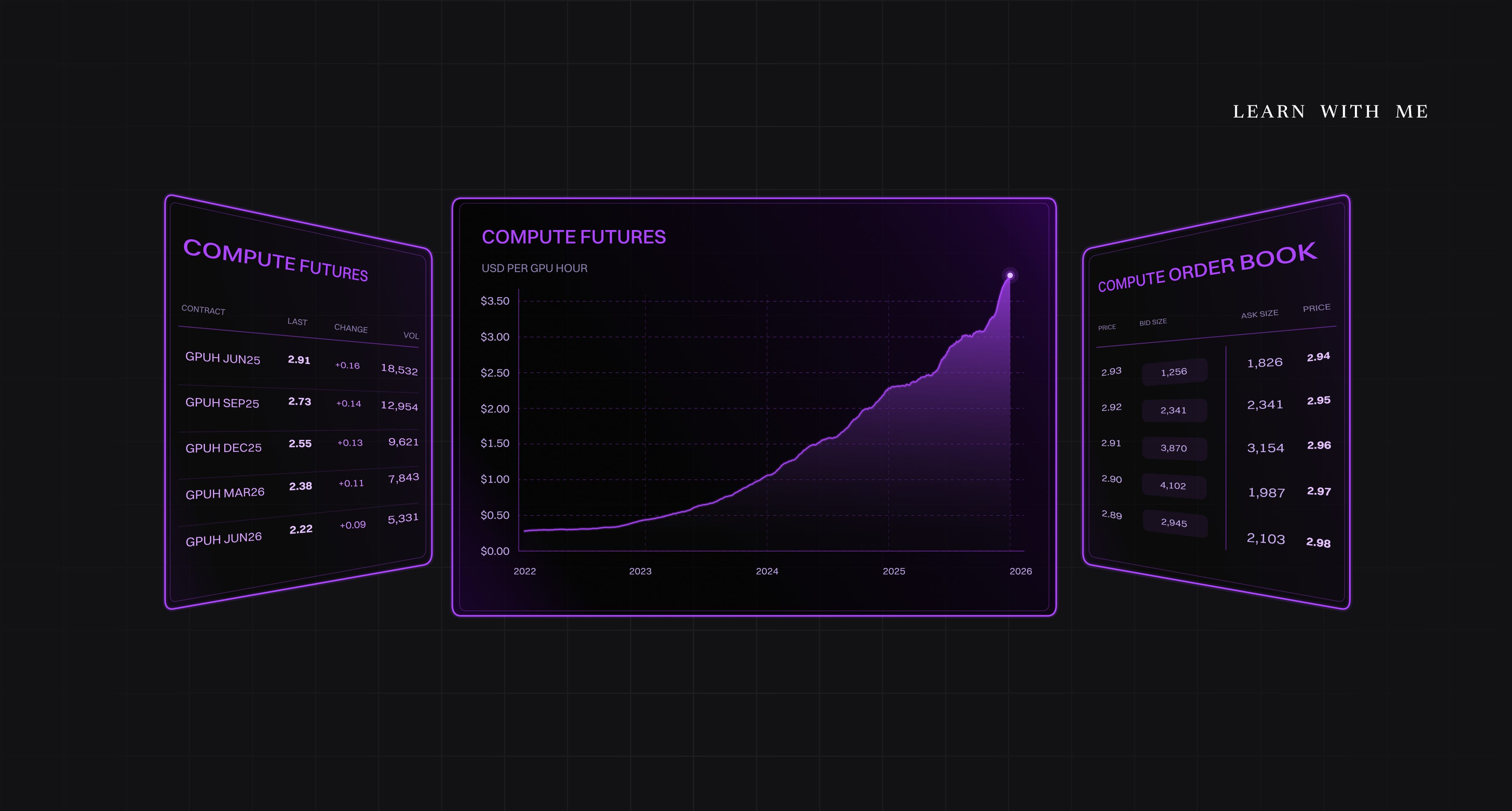
Chamath Palihapitiya argues that compute is becoming a financialized input like oil, power, or freight, and that CME Group’s planned compute futures contract is an early attempt to give AI infrastructure buyers and sellers a way to hedge price risk. The thesis is that AI capex has become large enough, volatile enough, and strategically important enough to require its own market structure rather than one-off GPU rental contracts and private data center deals.
The killer detail is the combination of scale and non-standardization. The essay says AI capex reached $765 billion in 2026, passing oil and gas capex, while Silicon Data tests found H100 performance could vary by as much as 34.5% within the same chip model across providers. That makes compute both economically huge and hard to define as an interchangeable commodity. The pull is that if compute futures work, the AI buildout gets a price-discovery layer; if they fail, the industry’s largest input remains a multi-billion-dollar guessing game.
Read more: Source
The English town with 40 data centres
Author: Lydia Spencer-Elliott Published: August 20, 2026
Lydia Spencer-Elliott reports from Slough, the English town Dispatch describes as Europe’s data-centre capital. Once better known as the setting for The Office and the site of Britain’s first zebra crossing, Slough now has around 40 data centres, most clustered in the Slough Trading Estate. Residents told Dispatch the buildings have become impossible to ignore: heat, noise, overnight construction, weak water pressure, and a sense that planning notices did not make clear what was being built.
The local detail gives the AI infrastructure story a human scale. Abdul, a resident who moved to Slough in 2014, says “whenever a building comes down, whenever there’s a bit of empty land, they just put another one there.” Sharon, who has lived near the Trading Estate for more than 30 years, says the low nighttime noise was mistaken for construction, while another resident says she thought the windowless blocks were making credit card chips. The piece also cites a March study finding that data centres can create urban heat islands, raising nearby temperatures by an average of two degrees and in some places by as much as nine.
The pull is that cloud and AI infrastructure is not abstract. It lands in towns, competes for power and water, changes the soundscape, and creates a politics of local resistance. Dispatch contrasts Slough with Ashburn, Virginia, where campaign groups have pushed to slow, stop, or regulate new data-centre development. As AI demand turns compute into physical infrastructure, the bottleneck is not only chips or capital. It is whether host communities accept the costs.
Read more: Source
$12B of US ratepayers’ money wasted on a modeling mistake and PJM wants to do it again
Author: SemiAnalysis Published: August 16, 2026
SemiAnalysis argues that PJM, the largest U.S. electricity market, has overstated its supply-demand shortfall because of flaws in the model it uses to decide how much power capacity to buy. The report says SemiAnalysis spent six months reverse-engineering PJM’s Reserve Requirement Study, a black-box model used for annual reliability auctions, and concludes that the errors cost 66 million residents about $12 billion from 2025 to 2027.
The central modeling claim is that PJM undercounts about 4 gigawatts of existing generation. SemiAnalysis says PJM does not adequately account for higher gas-plant efficiency in cold winter air or for reliability improvements made after Storm Elliott, including winterization investments across hundreds of plants. Using PJM’s own demand and supply curves, the report estimates better modeling would have saved $6.7 billion in 2025-26 with only 14 megawatts less capacity procured, and another $4.9 billion in 2026-27 with 0.8 gigawatts less capacity.
The report’s broader argument is that PJM’s capacity market is structurally anti-growth. One-year contracts begin too soon after signing, interconnection is slow, and PJM pays a premium across both new and existing plants rather than separating those markets. SemiAnalysis also warns that PJM’s planned emergency auction could sign contracts running to 2043 without committed counterparties among new large loads, leaving residential ratepayers exposed if data-center developers opt out or build their own power. The caveat is that parts of the methodology and live model are subscriber-only, but the public thesis is explicit: a market designed for flat demand is now making expensive mistakes in an era of load growth.
Read more: Source
Home batteries are suddenly cheap and everywhere. Here’s why.
Author: Tim De Chant Published: August 19, 2026
Tim De Chant reports that the market for home battery systems is becoming more competitive as battery costs fall and virtual power plants give operators a second revenue stream. Tesla, long the leading home-battery brand, has cut the monthly price of its Powerwall leasing plan by more than two-thirds in Texas, where homeowners can lease 27 kilowatt-hours of Tesla Powerwalls for $35 a month. Base Power, which has raised $2 billion in less than a year, is offering 39.2 kilowatt-hours for $19 a month.
The mechanism is the virtual power plant. VPP operators aggregate distributed devices such as home batteries and water heaters so utilities can call on them like a power plant during high-demand periods. Batteries charge when electricity is cheap, discharge when demand pushes prices up, and share some of the arbitrage value with homeowners through cheap backup batteries or lower electricity prices. The article cites Grandview Research estimating a $7.4 billion VPP market today and more than $30 billion by 2033.
The grid detail is speed. Base Power has a deal with North Texas cooperative CoServ to build a 100-megawatt VPP, which company executive Tim Pianta says is on pace to be installed in under 12 months, compared with two to four years for a traditional 100-megawatt power plant. Energy Access Innovations executive Nicole Tomasin adds that data centers may accelerate VPP adoption because hyperscalers are effectively buying interconnection speed, not just kilowatt-hours. The caveat is that VPP traction is still concentrated in markets such as Texas and California, but the article presents distributed storage as a faster way to add capacity than waiting in grid interconnection queues.
Read more: Source
Apollo Atomics wants to make nuclear power cheaper by shrinking an overlooked part
Author: Tim De Chant Published: August 20, 2026

Tim De Chant reports that Y Combinator alumnus Apollo Atomics is trying to cut nuclear power costs by redesigning the steam generator rather than inventing a new reactor architecture. Co-founder and CEO Assil Halimi tells TechCrunch the steam generator is the largest component in the system, and Apollo says shrinking it makes the whole plant much more compact than other reactor designs.
The core technical claim is about heat transfer. Conventional steam generators are several stories tall, often hand-built, and run reactor coolant through large tubes surrounded by water that becomes turbine-driving steam. Apollo’s design threads the coolant and steam loops through a compact metal block with needle-thin channels, transferring heat more efficiently. The company says the generator is roughly person-sized, can be mass-manufactured, and enables a reactor 40 times smaller than one using a conventional steam generator.
The business details are specific and early-stage. Apollo has closed a $26 million seed round, including $5 million in debt, to build a demonstration reactor before a planned 2028 commercial deployment. Its design is based on MIT research, and the company has already built a 40-kilowatt reactor at MIT. Halimi projects electricity at 3 cents per kilowatt hour, says the target is to beat natural gas, and expects a 300-megawatt plant to be factory-assembled and built in under 24 months. TechCrunch’s caveat is the industry context: advanced nuclear is attracting capital, but recent levelized-cost projections still suggest many reactors will struggle to become cost-competitive soon.
Read more: Source
Giving the people what they want (not data centers)
Author: Matthew Yglesias Published: August 21, 2026
Matthew Yglesias uses a reader question about data centers to ask how politicians should handle cases where voters oppose a project even when some of the factual objections are overstated. He says opposition to new data centers now draws on AI’s broad unpopularity, water and environmental concerns, grid strain, and local electricity-price fears, while supporters point to tax revenue, efficient land use, and the danger of treating data centers as another NIMBY target.
The essay distinguishes between taking public opinion seriously and adopting policies that backfire. Yglesias uses price controls as the easy contrast: voters may support them, but shortages would quickly turn the policy into a liability. Data-center pauses are different, in his view, because saying no mostly preserves the status quo rather than creating immediate visible failure. That makes it hard for elected officials to ignore constituents demanding a pause.
His recommended caveat is that a pause should remain a pause. The substantive goal should be to reset tax abatements, utility rate structures, water regulation, and public trust so communities can get to yes where projects make sense. He says he would welcome a well-sited data center in the Maine town where he is writing if it produced tax revenue for roads, school courts, or property-tax relief, but only if the water and utility regulation were handled properly. The piece frames data-center politics as a test of whether technological dynamism can earn local consent.
Read more: Source
Interview of the Week
The Next Moonshot Won’t Come from Silicon Valley
Host: Andrew Keen Guest: Salima Bhimani Published: August 21, 2026

Andrew Keen interviews Salima Bhimani, a former Google X chief strategist for responsible tech and author of Invent Now, in Episode 3010. Keen frames the conversation as a break from what he calls America’s “long hot Luddite summer,” asking whether a more inventive story about technology is still credible after years of Silicon Valley optimism.
Bhimani’s answer is not that technology alone solves the future. She says she learned at Google X that moonshots are always more than technological interventions. Wing, Waymo, DeepMind, and Sidewalk Labs all had to land inside ecosystems of regulators, safety rules, communities, customers, and public trust. The post’s strongest line is her warning: “If we continue to build for people and not with people, we won’t have a say in what this technology will look like or do in ten or twenty years.”
Bhimani uses Sidewalk Labs in Toronto as the cautionary case. The smart-city project had real ambition, but it exposed a gap between where society was with technology and how the technology was being built and deployed. For Bhimani, the next moonshots will come from the convergence of places, people, and contexts rather than from Silicon Valley alone. Her largest twenty-first-century moonshot is not consumer rockets or a cancer cure, but the post-labor question: what human purpose looks like when work no longer carries so much of the meaning.
Audio: Podcast MP3
Read more: Source
Startup of the Week
Commonwealth Fusion Systems
Source: Tim De Chant, TechCrunch Published:August 15, 2026
Tim De Chant surveys the private fusion startups that have raised more than $100 million and puts Commonwealth Fusion Systems at the head of the market. The article says fusion has moved from a perennial “always a decade away” joke into an investable technology category because of better chips, more sophisticated AI, high-temperature superconducting magnets, and the 2022 U.S. Department of Energy result that reached scientific breakeven in a controlled fusion reaction.
CFS is the standout by funding and near-term ambition. TechCrunch reports that the company has raised $3.94 billion, about a third of all private capital invested in fusion companies, after adding $1 billion in July. Its Sparc reactor, built in Massachusetts, uses a tokamak design with D-shaped high-temperature superconducting magnets developed with MIT. CFS says Sparc should reach scientific breakeven, or Q greater than 1, sometime in 2027, with operation expected in late 2026 or early 2027.
The commercial caveat is that scientific breakeven is still not commercial breakeven. De Chant separates the milestone of proving the underlying science from the harder task of producing more power than the whole facility consumes. CFS plans a later 400-megawatt Arc power plant near Richmond, Virginia, and Google has agreed to buy half its output, but the article presents the whole sector as expensive, technically difficult, and still dependent on whether first-of-a-kind plants can become commercially viable.
Read more: Source
Post of the Week
Preserving AI When the Grid Goes Dark
Author: Martin Varsavsky Published: August 13, 2026
Martin Varsavsky argues that open-weight AI changes what it means to preserve civilization’s knowledge. The old problem was saving libraries, maps, medical manuals, scientific archives, and books. The new possibility is saving a local machine that can explain them, reason across them, and teach from them without the internet or the electrical grid.
The practical detail is striking. Varsavsky says roughly $5,000 can buy a local reasoning setup with a mini PC, open-weight models, redundant SSD archives of Wikipedia, WikiMed, OpenStreetMap and Project Gutenberg, solar panels, a battery, and Meshtastic LoRa nodes for short encrypted messages. At $50,000, the shelter starts to look like an institution: multiple 128 GB machines, a 40 TB archive, a 10 kW solar array, 30 kWh of batteries, spares in a Faraday cage, HF radio, and mesh repeaters. This is intelligence in a box.
The post has obvious dystopian undertones, but the big idea is useful: intelligence is no longer only a cloud service. Open models, local compute, storage, solar power, and low-bandwidth networks make it possible to preserve not just information but a working assistant for explaining and applying that information. The question is who owns it, who controls it, and whether preservation extends human agency or turns people into assets someone else can operate.
Read more: Source
A reminder for new readers. Each week, That Was The Week, includes a collection of selected essays on critical issues in tech, startups, and venture capital.
I choose the articles based on their interest to me. The selections often include viewpoints I can't entirely agree with. I include them if they make me think or add to my knowledge. Click on the headline, the contents section link, or the ‘Read More’ link at the bottom of each piece to go to the original.
I express my point of view in the editorial and the weekly video.


