


This week’s video transcript summary is here. You can click on any bulleted section to see the actual transcript. Thanks to Granola for its software.
There was an issue with this only going to paid subscribers, so sending it again. Apologies to those who get it twice. I appreciate being paid so feel free to upgrade if you enjoy TWTW.
Editorial
Intelligence: Who Owns it?
This week the word “AI” feels too small.
AI is a technology. Intelligence is its product. And if intelligence is the product, the question is no longer just: Which model is best? Who has the cheapest tokens? Who owns the weights? Who controls the data center? Those are important questions, but they are lower in the stack.
The bigger question is simpler and more political:
Who owns intelligence?
That sounds abstract until you make it concrete. Intelligence is becoming something companies can capture, package, serve, meter, route, improve, and sell.
It can write code, answer questions, design molecules, automate offices, run agents, draft legal work, advise scientists, serve consumers, and reshape workflows. It is not merely software. It is a general-purpose capability. And all humans could benefit from more of it.
General-purpose capabilities have a habit of becoming public questions. But the default answer, that public good is best delivered by government, is the wrong answer in this context.
The Product Is Intelligence
We should stop talking about AI as a feature and start talking about intelligence as the universal thing that is delivered as an input to the world.
Water is an input. Electricity is an input. Literacy is an input. Connectivity is an input. Once a society depends on them, access stops being optional. Nobody needs government to build every well, power plant, school, or network. But everybody understands that a civilization cannot be organized around less than universal and reliable access to foundational inputs.
Intelligence is reaching that level of importance now that we all know it is real.
Government should not own it, operate it, or develop it. Quite the opposite. Companies are the right actors to build fast, compete hard, improve models, serve customers, and discover the real use cases. Self-interest is a useful framing here. Markets are good at finding demand, reducing costs, and turning invention into services people actually use.
Companies are the right operators, developers, and owners. But that does not settle the real question of who owns the benefits. That is an economic question.
If intelligence becomes metered infrastructure, what happens to the value it creates?
The Ownership Stack
This week’s articles keep circling the same issue from different directions but in the nature of ‘circling’ never quite nail it.
Jamin Ball’s “Own Your Weights” starts with the enterprise version of the question. Owning a model file is not enough. The durable asset is the loop: the data flywheel, the evaluations, the reinforcement system, the workflow learning, and the operating context that lets capability compound.
Benedict Evans’ “Ways to Think About Token Pricing” adds the market layer. Tokens may become essential, abundant, and cheap, like mobile data. But being essential does not guarantee that the token layer captures the value. The money may move up the stack to whoever owns the workflow, the customer, the distribution, or the application.
Alex Karp’s fight with the labs, reported in “Alex Karp Is Saying What Every Angry CEO Is Thinking About AI”, is the same argument in sharper enterprise language. Companies are afraid that model providers will not just sell intelligence, but learn from customer workflows and then move into the markets where those workflows create value. The “All-in” group are echoing Karp’s view.
And “What Is Loop Engineering, and Who Owns It?” names the new contested terrain. The loop is where intelligence meets the world. Whoever owns the loop owns the learning. Whoever owns the learning owns the compounding asset.
That is why “who owns intelligence?” is not a slogan. It is the question under the model layer, the application layer, the enterprise layer, and the economic layer.
Because intelligence is the product, the tools creating it are fragmented and competitive. So there is no logic in trying to discuss this at the level of a single company or set of tools and models.
The Old Promise Was That Commerce Would Tame Power
The essays this week give the historical backdrop.
Deirdre McCloskey, in “What Really Caused the Industrial Revolution”, argues that modern growth came not simply from capital accumulation, but from a change in permission: ordinary people were allowed to innovate, trade, build, and be honored for it.
That matters because intelligence could be another expansion of permission. It could make more people capable of building, learning, creating, coding, researching, translating, selling, and coordinating. It could lower the cost of competence.
But only if access is broad.
Paul Krugman’s “AI in an Age of Oligarchy” warns that the same technology lands differently in different political economies. A new general-purpose technology entering a broad, open, upwardly mobile society is one thing. The same technology entering a concentrated economy, with extreme wealth and weak counterweights, is another.
Tim O’Reilly’s Economist essay, “Elon Musk is building a form of capitalism that Adam Smith would hate”, makes the governance point more directly. The old liberal hope was that commerce would tame arbitrary power. Markets, boards, courts, shareholders, disclosure, and competition would discipline the prince.
But what if the prince uses markets to escape discipline?
Henry Farrell’s “political economy of billionaire derangement” pushes the same point. Founder culture, monopoly ambition, peer rivalry, weak correction mechanisms, and vast private control can amplify appetites rather than restrain them.
The danger with intelligence is not that companies build it. They should. Companies build it, meter it, use public tolerance and public infrastructure to scale it, learn from everyone who uses it. All of those things are inevitable and healthy. Market forces will sort out winners from losers. The real danger is that the winners treat all of the surplus produced as purely private.
Metered Intelligence Creates Surplus
If metering is not the problem, what is?
The problem is pretending that metered intelligence creates value only for the metering entity. Metering water is only tolerated as a public good. If the public were blackmailed by a private water company with the threat of no water we would all rebel.
Once we understand that the product of AI is intelligence we can see that every time intelligence is used, there is the immediate transaction: the user pays, the provider serves.
But there is also system value. Usage creates signals. Workflows reveal patterns. Prompts, corrections, failures, preferences, integrations, edge cases, and business processes all help define where intelligence is useful and how it should improve. Intelligence breeds intelligence.
Even when customer data is contractually protected, the market learns. The platform learns where demand is. The product team learns which workflows matter. The ecosystem learns which jobs are vulnerable, which tasks are automatable, and which parts of the economy can be reorganized around machine intelligence.
So the surplus is not born in a vacuum.
It rests on public science, public education, public data exhaust, public law, public infrastructure, public energy systems, public tolerance for data centers, and billions of human interactions. It is served by companies, but it is not made only by companies.
This is why “Americans Deserve a Dividend From AI Companies’ Riches” belongs at the center of this week’s issue. The detail can be debated. The principle is harder to dismiss. If intelligence becomes a new foundational resource, then some part of the wealth it creates should flow back to the people whose society makes it possible. Intelligence did not suddenly appear. AI is built on the entire history of human intelligence. It benefits from it and at the same time evolves it.
Not Nationalization. A Human Wealth Fund.
If intelligence belongs to everybody, some conclude that government ownership of intelligence is the right outcome.
Governments are not well suited to build, operate, or improve intelligence. They will move too slowly, regulate too early, politicize the wrong things, and confuse economic participation with operational control.
Andrew McAfee’s “Why I Didn’t Sign the AI Open Letter” is useful here. His objection is not that the technology is unimportant. It is that steering too hard before we understand the shape of the change can become its own failure mode. Marc Andreessen’s satire of AI regulation is less policy than temperament, but it captures a real Silicon Valley fear: that regulation can become permission, capture, and incumbency before it becomes wisdom.
That fear should be taken seriously.
But it does not answer the economic question. It answers only the operational one.
How can the economic benefits of intelligence be distributed? The better answer is a sovereign human wealth fund.
Call it a sovereign wealth fund if you must, but the phrase is too national. Intelligence will not respect borders. The leading companies are global. The models, chips, data centers, agents, platforms, and workflows will be transnational from the beginning. If the value created by intelligence is global, then the mechanism for sharing some of that value should begin with the companies global enough to capture it. The nice thing about xAI, OpenAI, and Anthropic is that they are supranational.
These companies own and operate intelligence. Let them compete. Let them profit. Let them keep the incentives that make the system improve. But if intelligence is the new water, the wealth it creates cannot belong only to the companies that meter it. And they, themselves, have the power to fix it, even more than governments.
Access will become a Human Right; Ownership Is the Economic Design
This is where human rights come in. There is no right to access an AI model, yet. But there will soon be a need to change that.
Not as a claim that every person is entitled to every frontier model at every moment for free. That is not serious. Capacity has costs. Models have costs. Inference has costs. Data centers have costs. Although those costs will decline over time, possibly quite quickly as self-learning models address costs.
The claim is more basic: in a world where intelligence becomes a primary input into education, work, health, science, citizenship, creativity, and economic agency, baseline access to intelligence starts to look like a civic requirement.
That could mean public access layers. It could mean education credits. It could mean open models. It could mean AI dividends. It could mean public-interest compute. It could mean taxes on rents. It could mean a company-initiated human wealth fund that returns some of the upside to society without handing the operating system to the state. The latter could couple wealth growth with universal distribution of ownership.
The exact mechanism matters. But the distinction matters more.
Government should not own intelligence. It should be universally available. And people should have a claim on the wealth intelligence creates.
The Frontier Is Also Physical
The abstraction is not weightless.
“The Fight Against AI Data Centers Is Just Beginning”, “New York becomes the first state to enact a data center moratorium”, Reuters on pollution from Musk’s xAI power project, and DataGravity’s “Who Captures Value in AI Infrastructure?” all say the same thing from the ground up.
Intelligence uses land. It uses power. It uses water. It uses chips. It uses grid capacity. It uses neighborhoods. It uses public patience.
That makes the value question unavoidable. A society can accept the buildout if the buildout is legible as shared progress. It will resist it if the costs are local, the profits are private, and the benefits feel enclosed.
Who Owns the “Loop”?
The week ends where it began.
“Anthropic and Blackstone” are betting that implementation is the next trillion-dollar business. “Vint Cerf” is working on identity for agents on the open internet. “GPT-Red” points toward systems that improve their own robustness. “Kimi K3” adds another open frontier model to the global mix.
The model race continues. The deployment race is accelerating. The governance race is behind.
My view is this:
The central product of this era is intelligence. Companies have figured out how to capture it, package it, serve it, and meter it. That is good. It should stay in the hands of builders who have the incentive to make it better.
But intelligence is too foundational to become just another private toll booth. A significant part of it will turn out to be free to users.
As intelligence becomes a general-purpose resource, then access to it becomes a human-capability question, and the surplus from it becomes an economic-justice question. Not because government should run it. Because government should not run it. The operating layer belongs with companies. The wealth question belongs with everyone. But companies are best placed to turn that into a process of distribution.
The question is not whether companies should build intelligence. They should.
The question is whether humanity gets a stake in the wealth created by the thing that may soon become its most important shared input.
Contents
Essays
AI
Alex Karp Is Saying What Every Angry CEO Is Thinking About AI
Anthropic, Blackstone bet the next trillion-dollar AI business is implementation, not just models
Vint Cerf is working on a plan to unleash AI agents on the open internet
The Pulse: What can we learn from Bun’s rapid Rust rewrite with AI?
Why AMI Labs’ Alexandre LeBrun won’t call his AI “AGI” or “superintelligence”
Venture Capital
Regulation
Infrastructure
Interview of the Week
Startup of the Week
Post of the Week
Essays
Deirdre McCloskey on What Really Caused the Industrial Revolution
Yascha Mounk and Deirdre McCloskey | Persuasion | July 11, 2026

Yascha Mounk interviews Deirdre McCloskey about her argument that the modern world’s economic liftoff came less from capital accumulation than from a change in ideas. McCloskey says both left and right versions of the conventional story rely too heavily on investment: the left stresses exploitation and surplus value, while the right stresses virtuous saving by capitalists. Her objection is historical and economic. Human beings had always invested, from irrigation works and Roman roads to seed grain, and simple accumulation quickly runs into diminishing returns.
McCloskey’s alternative is that northwestern Europe, first Holland, then Britain and Scotland, and then the North American colonies, developed a liberal ideology that changed who was allowed to innovate and be honored for it. The conversation links that shift to the erosion of inherited hierarchy, the spread of dignity for ordinary commercial life, and a moral vocabulary in which liberalism is not merely procedural but connected to virtues and values. The point is not that machines, coal, trade, and institutions did not matter, but that they do not explain the scale and timing of modern enrichment without a cultural permission structure for innovation.
The interview also turns to the contemporary defense of liberalism. Mounk frames the series around the worry that liberalism is often treated as too thin to command allegiance, while its opponents speak more directly to moral passions. McCloskey’s case is that liberal societies became rich because they dignified experimentation and ordinary enterprise, and that liberals need to recover the moral language behind that claim.
AI in an Age of Oligarchy
Paul Krugman | Paul Krugman | July 12, 2026
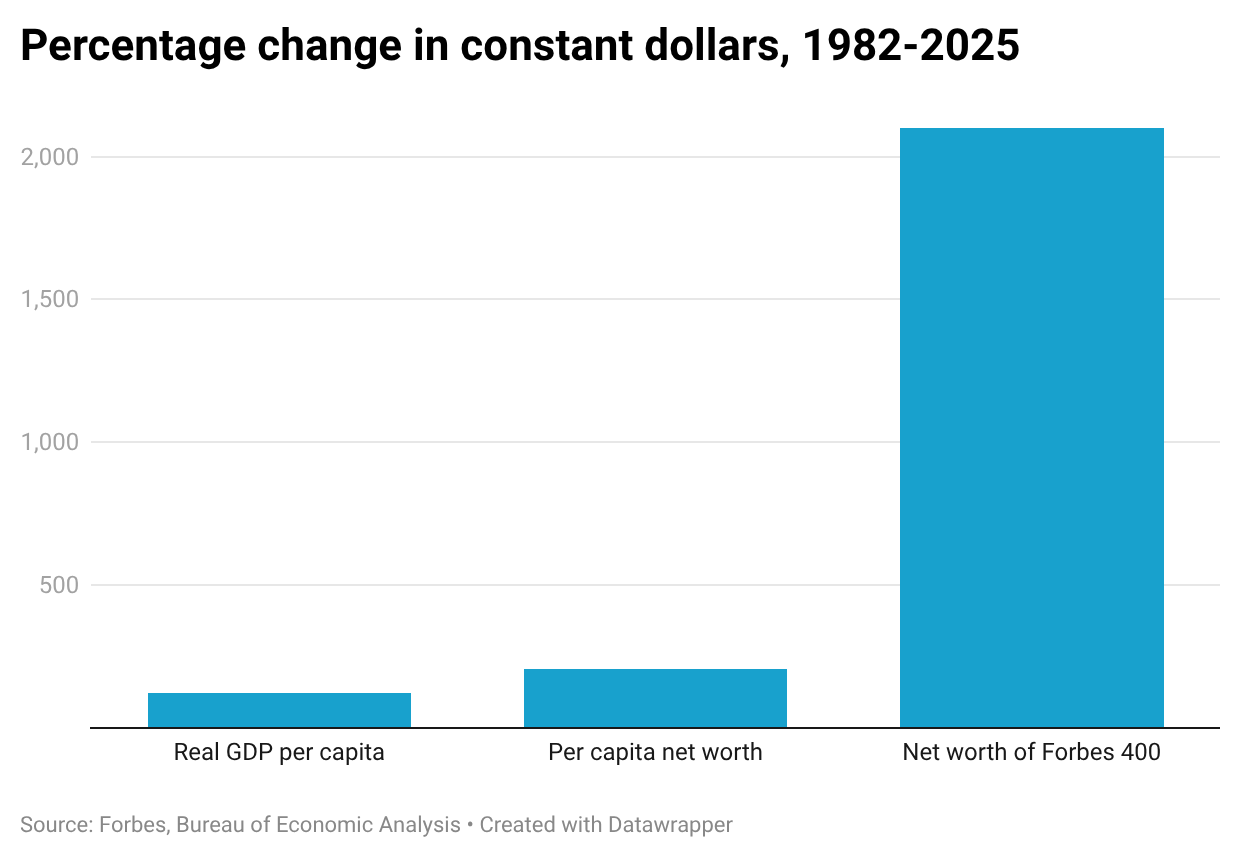
Paul Krugman frames AI as a major technological shock arriving inside an already unequal political economy. The post says AI’s economic and social effects may take years to understand, but argues that the setting matters now: America has much greater wealth concentration and political inequality than it did in the 1950s and 1960s, when progressive taxation, stronger regulation, and more active antitrust might have contained some of the destructive effects of a new technology.
Krugman’s opening claim is that the same technology would likely have different consequences in a more level society. In today’s United States, he writes, extreme wealth is both a cause and effect of policies that favor a small elite, including low effective taxes on capital and high incomes, weak enforcement of worker protections and antitrust, and cuts to programs that benefit ordinary Americans.
The article is explicitly more about oligarchy than AI. Krugman says the paid sections document the rise of the “.0002%,” the economics and politics of extreme wealth, how oligarchy will shape AI’s impact, and possible policy paths. His caveat is that AI itself may still produce a pushback against oligarchy, but absent that, he expects the pre-existing concentration of wealth and power to magnify AI’s downsides.
Elon Musk is building a form of capitalism that Adam Smith would hate
Author: Tim O’Reilly Published: July 12, 2026

Tim O’Reilly argues that Elon Musk is using the legal forms of shareholder capitalism to escape the restraints that shareholder capitalism was supposed to impose. The article begins with SpaceX’s public-market structure: ordinary public investors get little meaningful governance power, Musk keeps roughly 85 percent of the votes through super-voting shares, buyers waive jury trials and class actions, the company qualifies as controlled, and removal of Musk depends on the share class he controls. In O’Reilly’s framing, that is not ordinary founder control; it is a design for being answerable to no one, possibly beyond Musk’s own lifetime.
The killer detail is the article’s turn through Albert Hirschman, Montesquieu, James Steuart, Adam Smith, and Keynes. Older defenses of commerce held that markets would tame princely passions because the self-interest of merchants was safer than arbitrary rule. O’Reilly says Musk reverses that hope. The market discipline that was supposed to cage the prince has become the lever by which the prince raises capital, removes feedback loops, and carries private power into politics, government, Mars, robots, AI, or whatever ambition comes next.
The pull is the link to AI governance. O’Reilly says corporations are already a kind of artificial intelligence: narrow-input systems that act at a scale no individual human can match. Their partial controls include independent boards, shareholder votes, courts, disclosure, regulators, public pressure, and activism. If the leaders building frontier AI strip those alignment mechanisms out of their own companies, the governance of the company becomes a preview of the governance of the machine.
Read more: The Economist
Murky Mirror: Truth and Consequences
Author: Esther Dyson Published: July 14, 2026
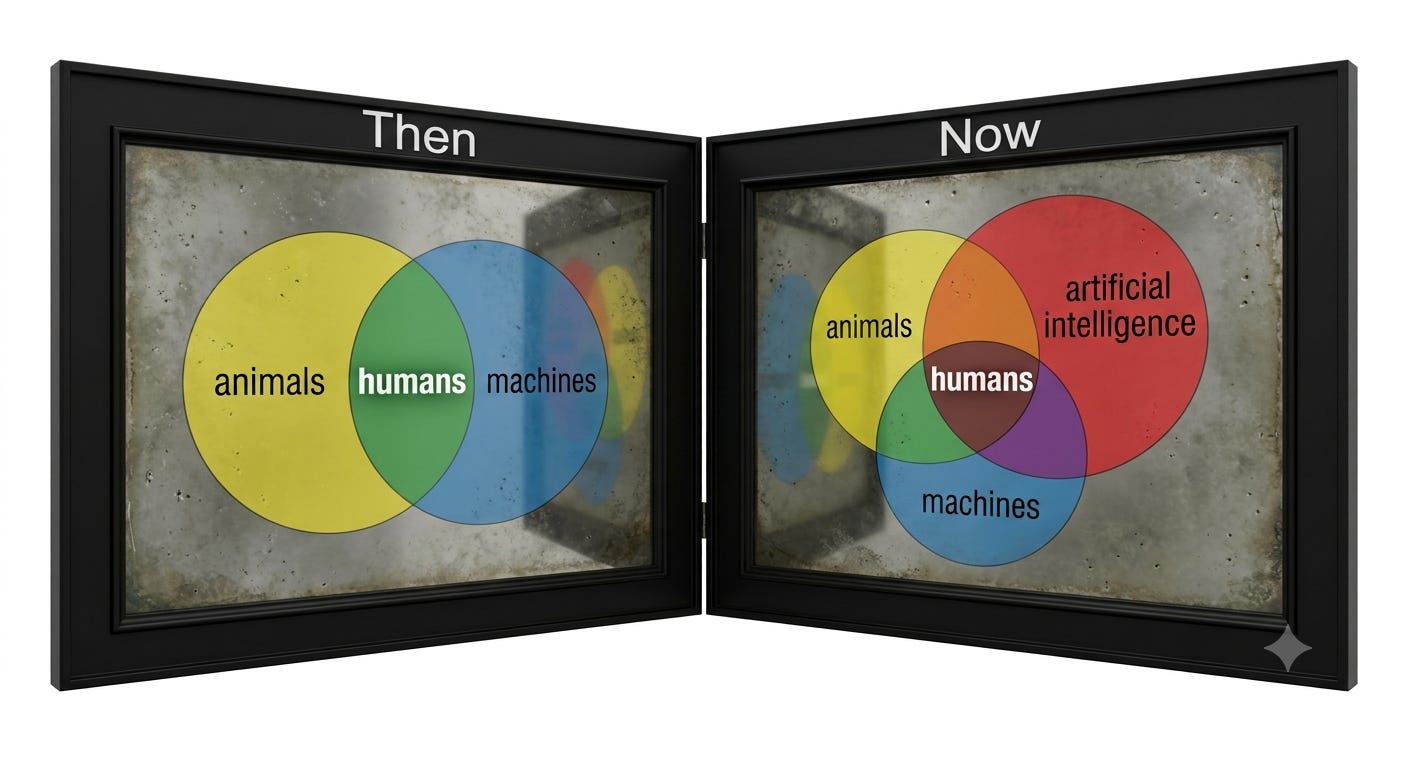
Esther Dyson argues that today’s institutional crisis is better viewed through the 14th century than through recent political history. Using Barbara Tuchman’s A Distant Mirror as her frame, she compares a world of famine, plague, church schism, feudal predation, and purposeless war with a present in which institutions again feel brittle, incentives are badly aligned, and power is shifting into forms that are hard to govern.
The killer detail is the historical analogy between land, corporations, and AI. Dyson moves from nobles who controlled serfs and territory, to the East India Company as a quasi-sovereign business, to today’s AI systems and data centers as a possible new sector that crosses and weakens both nation-states and companies. The question is whether AI becomes a new kind of private land, owned by a new nobility, or an open prairie that many people can cultivate.
The pull is human attention. Dyson says the central question is not what AI will do to people, but how people will react to it: whether they can value love, kindness, embodied attention, and artisanal human presence in a world of seductive artificial offerings.
Read more: Source
The political economy of billionaire derangement
Author: Henry Farrell Published: July 15, 2026
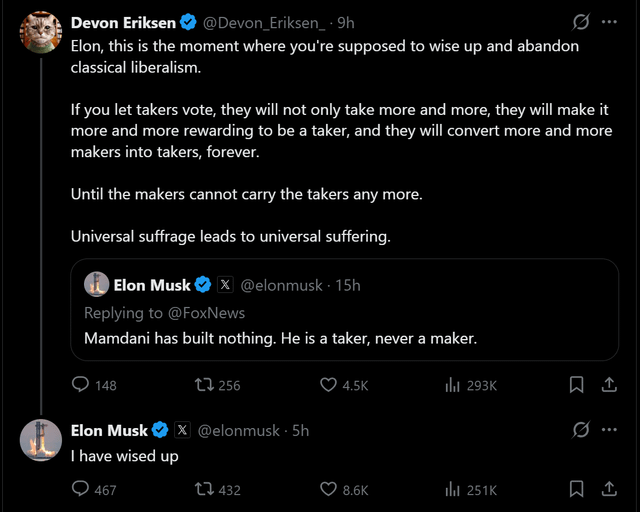
Henry Farrell argues that the visible political radicalization of some Silicon Valley billionaires is not a random personality quirk, but a product of the political economy that made them. Starting from Tyler Cowen’s dismissal of “billionaire derangement syndrome” and Tim O’Reilly’s warning that Elon Musk is using shareholder capitalism to escape shareholder restraint, Farrell flips the phrase: the question is why billionaires themselves can become deranged.
The killer detail is Farrell’s use of Peter Thiel as both theorist and example. Thiel’s Stanford lectures described startups as monarchies and founders as figures vested with unusual power, while Silicon Valley culture rewarded eccentricity, monopoly ambition, and founder exceptionalism. Farrell says those ideas combined with dense founder-investor networks, peer rivalry, and weak correction mechanisms to amplify rather than discipline princely appetites.
The pull is the ideological problem for classical liberals who once saw tech wealth as an ally of markets and freedom. Farrell says commerce did not tame the passions; in parts of Silicon Valley, the passions have begun to devour markets, institutions, and the liberal story that justified them.
Read more: Source
Is there any “oligarchy” to fight?
Matthew Yglesias | Slow Boring | July 16, 2026

Matthew Yglesias argues that “oligarchy” is a rhetorically powerful but analytically loose way to describe American politics. The post begins from Bernie Sanders’ “Fighting Oligarchy” tour, Amy Klobuchar’s warning about a MAGA “broligarchy,” and the long afterlife of the Martin Gilens and Benjamin Page paper that was widely summarized as showing that only the rich matter in policy outcomes. Yglesias says the evidence supports a weaker claim: affluent people and business leaders have unusual access and influence, but that is not the same as rule by a small cabal.
His main distinction is between inequality and oligarchy. The Gilens-Page measure treated the top 10 percent of households as “the wealthy,” and later critics found that rich and middle-class preferences usually align; in the cases where they differ, the rich win about 53 percent of the time. Yglesias also says business executives get special access partly because their decisions are materially important to communities, jobs, investment, and local tax bases, not only because of campaign donations.
The post preserves Jerusalem Demsas’ counterpoint from their podcast discussion: privileged donor and business access can still violate democratic equality even if the oligarchy label overstates the structure of power. Yglesias’ narrower claim is that Democrats should be precise about what problem they are trying to solve, because donor influence can also push the party left on climate and cultural issues in ways that alienate many voters.
Read more: Slow Boring
AI
Nearly 200 Economists and Tech Leaders Warn of A.I. Threats
Author: Ben Casselman Published: July 13, 2026
Ben Casselman reports on “We Must Act Now,” a statement warning that artificial intelligence could transform the economy faster than any previous technology and that policymakers need to move faster to understand and respond. The statement says AI may become radically more powerful over the next 10 years, bringing risks such as large-scale job displacement as well as opportunities such as higher living standards. Nearly 200 people signed, including 15 Nobel laureates, the chief economists of OpenAI and Anthropic, Anthropic co-founder Jack Clark, former Google CEO Eric Schmidt, and venture capitalist Vinod Khosla.
The killer detail is who joined the warning. Casselman notes that the signatories include economists who have historically been skeptical of Silicon Valley’s most dramatic AI job-loss forecasts, including Daron Acemoglu and Simon Johnson, the MIT professors who won the 2024 Nobel in economics. Erik Brynjolfsson, who helped organize the statement, says there has been a notable change in the profession and that economists and policymakers are not ready for the “tsunami” he sees coming.
The pull is the measurement problem. The statement does not offer a specific policy menu, but calls for economists, policymakers, and industry leaders to understand the economics of transformative AI and steer it toward complementing humans. Brynjolfsson says one high priority is better data on AI’s spread and impact, because current measures tell conflicting stories about job losses and which workers are most exposed.
Read more: The New York Times
Why I Didn’t Sign the AI Open Letter
Author: Andrew McAfee Published: July 13, 2026

Andrew McAfee explains why he did not sign “We Must Act Now,” the AI economy statement organized in part by his longtime collaborator Erik Brynjolfsson. McAfee agrees with the letter’s starting point that AI is likely to become radically more powerful over the next decade and that it is a general-purpose technology. His objection is not to urgency or to studying AI’s economic effects, but to the framing of risk, displacement, and institutional steering as the first move.
The killer detail is McAfee’s line edit. He says the original letter comes close, then “bounces off the crossbar” by calling for incentives, guardrails, and institutions to steer AI before we know enough about its actual impacts. He points to mixed current evidence: labor-market canaries, but also rising software job postings, low unemployment for younger workers, rising real median income, and claims that AI-adopting companies are adding workers faster than low-adopting peers. His worry is that the letter leans toward upstream governance and dirigisme when the evidence may call for capability building instead.
The pull is his replacement statement. McAfee keeps the three-paragraph structure but changes the emphasis: AI is likely to become radically more powerful; like earlier world-changing technologies it will raise living standards while also bringing harms and shocks; and economists, policymakers, and technology leaders should build the capabilities to respond quickly and effectively. It is a concise version of the permissionless-innovation case inside the AI policy debate.
Read more: The Geek Way
Own Your Weights
Author: Jamin Ball Published: July 10, 2026
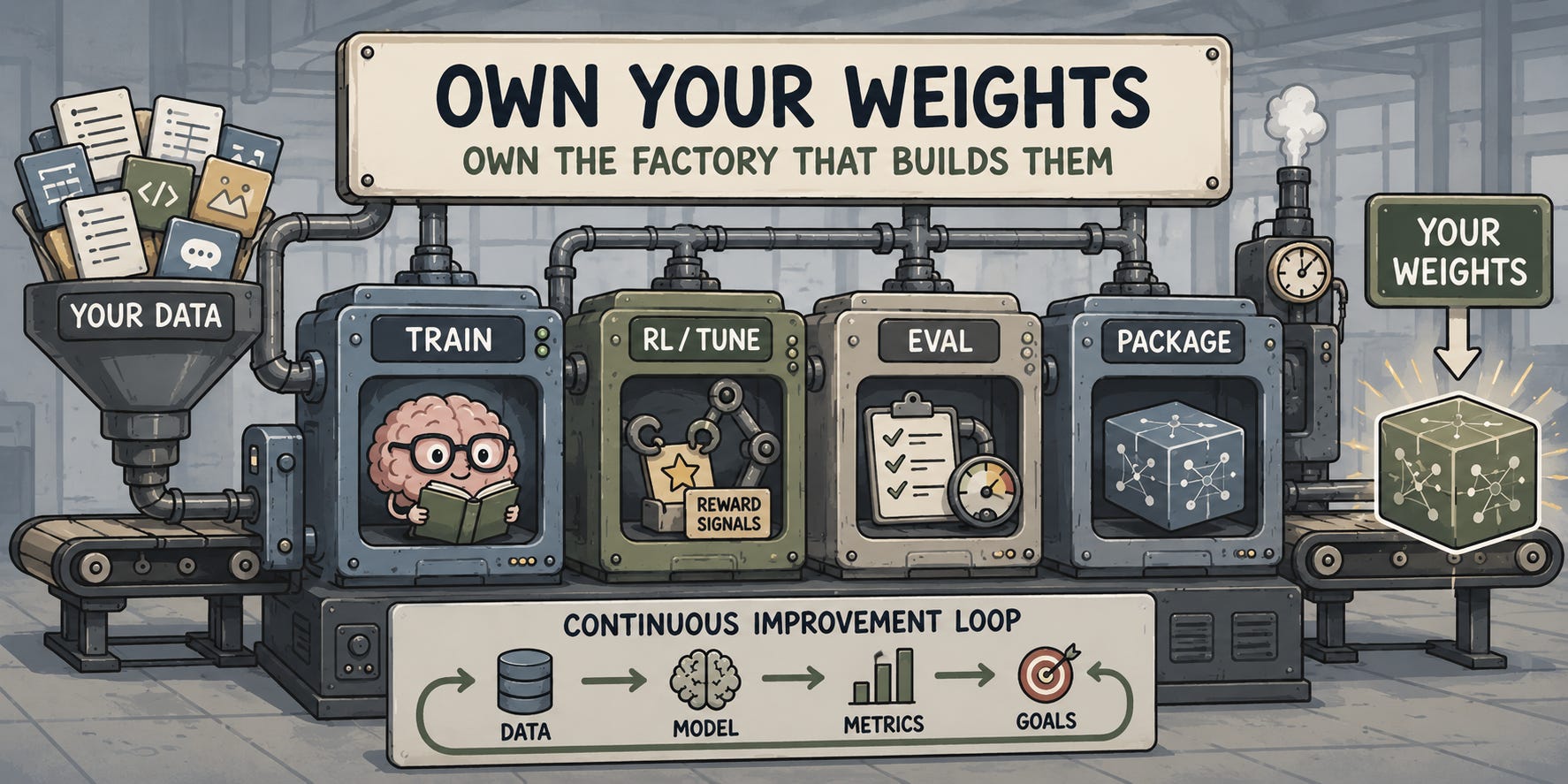
Jamin Ball argues that the enterprise AI debate about whether companies should “own their weights” or rent models from frontier labs is asking too narrow a question. A model weight file gives a company control over a point-in-time artifact, but not durable control over the capability stack. In his framing, the weight file is a melting ice cube: it does not get worse in absolute terms, but it falls behind as frontier systems improve and enterprise needs change.
The killer detail is what Ball says companies really need to own: the data flywheel, reinforcement learning infrastructure, and evaluation harness that produce and improve the model. Simply deploying an open-weights model and declaring sovereignty leaves the enterprise with yesterday’s capability and no way to compound workflow-specific learning.
The pull is that enterprise AI control may be less about model ownership than operating ownership. The defensible layer is the system that turns company data, edge cases, business definitions, and evaluations into continuously improving performance.
Read more: Clouded Judgement
Ways to Think About Token Pricing
Author: Benedict Evans Published: July 9, 2026
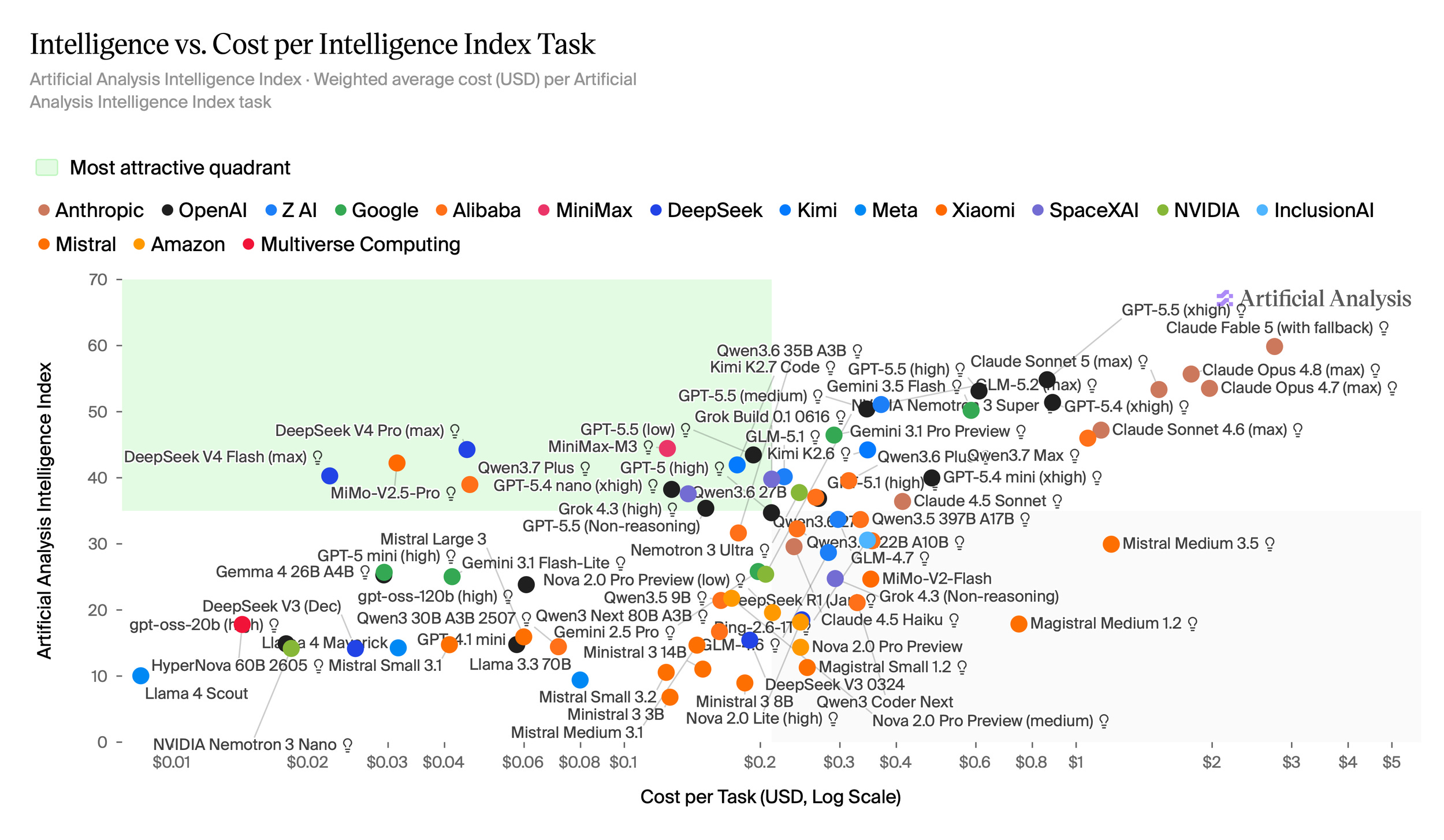
Benedict Evans argues that today’s AI token prices are a temporary signal from a supply-constrained market, not a reliable guide to long-term value capture. The open question is whether foundation models keep durable pricing power or become commodity infrastructure as data-center capacity, inference efficiency, and model competition all shift. His current read is that the visible market dynamics point toward commoditization unless something materially changes.
The killer detail is the mobile data analogy. Evans says cellular networks became a trillion-dollar industry with hundreds of billions in capex after data usage exploded, but carrier stocks went nowhere because value moved up the stack. Tokens may behave similarly: an opaque unit tied to marginal cost, sold through bundles, essential to everything, yet not necessarily where profits accrue.
The pull is uncertainty, not prediction. Evans lists paths to model dominance, including network effects, less competition, regulation, export controls, or a lab pulling ahead on execution, but says each requires a new fact not yet visible. Without that change, the model layer looks more like infrastructure beneath the products that capture value.
Read more: Source
Alex Karp Is Saying What Every Angry CEO Is Thinking About AI
Author: Tim Higgins Published: July 11, 2026
Tim Higgins reports that Palantir CEO Alex Karp has turned corporate frustration with AI labs into a public argument about enterprise control. Palantir released a white paper, “Institutional Sovereignty in the Age of AI,” laying out steps companies and governments can take to protect themselves from OpenAI, Anthropic, and other foundation-model providers. The article links that paper to Karp’s CNBC appearance, where he said “something has gone completely wrong” in the relationship between AI labs and customers and argued that enterprises are paying for tokens that create little value.
The killer detail is the value-capture question. Higgins writes that Karp’s critique has resonated because AI labs may gain power and insight from customer data, workflows, and decision-making, even when enterprise policies say customer data are not used for training. David Sacks amplified the concern by arguing that Anthropic is moving from the model layer into vertical applications such as science, security, legal, and coding, raising the fear that model providers will watch where value is being created and then move into those markets directly.
The pull is that Karp is not alone, even if his style is unusually combative. Higgins notes that Satya Nadella has also warned that companies need to retain the learnings created when they use AI models, while Mark Zuckerberg has framed Meta’s new model release partly around lower-cost frontier intelligence. The article presents Karp’s campaign as one sign that established technology companies and large enterprises are trying to define where they fit when AI labs become central infrastructure, application competitors, and potential IPO giants at the same time.
Read more: The Wall Street Journal
The AI Agents Are Coming for Microsoft Office
Alex Wilhelm | Cautious Optimism | July 11, 2026

Alex Wilhelm argues that one of the week’s quieter AI questions is whether the productivity market that Microsoft successfully moved into subscription software is now being attacked by agentic tools. The piece begins with the infrastructure backdrop: SK Hynix raised $26.5 billion in a U.S. listing while building U.S. HBM and advanced-packaging capacity, and memory, chip, and foundry companies are now priced for sustained AI demand.
Wilhelm then says the AI conversation has shifted quickly from raw capability to cost per task. He cites new model releases and vendor language emphasizing cheaper agentic and coding models, faster performance, and lower dollars per task. That matters because lower costs make it more plausible for AI systems to take on routine knowledge work at scale rather than remain a premium coding assistant market.
The core of the article is Microsoft Office. Wilhelm notes that Microsoft turned Office from a one-time purchase into Microsoft 365, a large recurring revenue business with tens of millions of subscribers and a major productivity segment. Now, he says, late-stage unicorns and AI labs are pushing into the same territory: Anthropic’s Cowork was reportedly used mostly outside software development, OpenAI merged ChatGPT and Codex into a tool for creating sheets, slides, docs, web apps, and long-running work, and other companies are building agentic coworkers that connect business data to documents, workflows, schedules, alerts, and apps.
The article’s caveat is that Microsoft has survived major platform shifts before. The argument is not that Office disappears quickly, but that the definition of office software is broadening from documents and spreadsheets into AI systems that can create, monitor, and act across workplace data.
What Is Loop Engineering, and Who Owns It?
Author: Nilesh Barla Published: July 11, 2026

Nilesh Barla argues that “loop engineering” is becoming a distinct discipline because production AI agents now fail less at single prompts than at runtime: when to stop, what state to preserve, and how to recover after a bad step. Prompt engineering shapes one model call, and context engineering shapes what the model sees, but loop engineering shapes what a sequence of calls actually does.
The killer detail is the three-primitives frame. Barla says a real agent loop needs halt conditions, state carryover, and recovery paths, then maps teams across five maturity levels. At the lowest level, an agent is just a model call in a for-loop with a step cap and raw history; by the higher levels, the system has structured state, explicit planning, replay, evaluation, and self-repair.
The pull is organizational. If agents are becoming production systems rather than demos, someone has to own the runtime itself. The loop engineer is the role Barla gives to the person responsible for making long-running agent work dependable.
Read more: Adaline Labs
The Fight Against AI Data Centers Is Just Beginning
Emma Roth | The Verge | July 12, 2026
Emma Roth argues that community resistance to data centers has moved from an early warning sign into a national political fight as AI facilities grow larger, more power-hungry, and more visible to nearby residents. The article starts with Apple’s failed 2015 plan for a $1 billion data center in Athenry, Ireland, where a small group of residents challenged the project over noise, light pollution, flooding, traffic, and wildlife effects until Apple abandoned it in 2018.
The current data-center buildout is presented as much larger and more contentious. Roth writes that residents now cite rising energy costs, water quality, noise, light pollution, and greenhouse gas emissions, while the U.S. Energy Information Administration expects commercial energy demand to surpass residential demand this year because of AI data centers and Goldman Sachs expects data-center power demand to double by 2027.
The central evidence comes from Data Center Watch, which says protesters blocked or delayed at least 75 U.S. projects worth $130 billion from January to March, with active opposition groups more than doubling from 396 at the end of 2025 to 833 by the end of the first quarter of 2026. Roth also cites QTS abandoning a $12 billion Wisconsin campus, Delaware City regulators blocking a 580-acre project under the Coastal Zone Act, opposition stopping a QTS project in Prince William County, and pressure that pushed Kevin O’Leary to downsize the proposed 40,000-acre Project Stratos in Utah.
The policy section describes a split between federal acceleration and local resistance. President Trump has treated data centers as part of the AI race with China and fast-tracked construction, while some Republican candidates are distancing themselves from that position ahead of midterms. Sanders and Ocasio-Cortez have proposed a moratorium until price and environmental protections exist, bipartisan lawmakers are backing ratepayer-protection measures, and states including Florida, Idaho, and Washington have passed rules on cost shifting, water use, and tax breaks. Roth’s caveat is that the policy patchwork is still incomplete, leaving many communities to fight project by project.
6 months to live for open models
Author: Nathan Lambert Published: July 12, 2026
Nathan Lambert argues that open-weight AI models are facing their most serious policy test so far because U.S. officials are beginning to discuss concrete controls rather than abstract safety concerns. He says reported White House conversations about a new executive order may initially target Chinese-origin models and government use, but could create a broader review habit for frontier open models. His forecast is that a model above the capability range of GPT-5.5, Claude Opus 4.8, or GLM-5.2 could trigger a ban or indefinite delay within six months.
The post separates two policy fights that are becoming intertwined: distillation and frontier capability. Lambert says the distillation campaign against Chinese models has become a form of regulatory capture because Anthropic and other closed-model companies would gain economically if Chinese open models were banned. He does not dismiss IP protection, but argues that if a closed model’s capabilities are dangerous enough to justify restricting open models, the lab also has to explain why those capabilities are exposed through a queryable API. He cites unauthorized access to Anthropic’s Mythos private beta as evidence that APIs are not automatically secure.
The broader claim is that a unilateral U.S. ban would hurt positive actors more than bad actors if comparable open models remain available elsewhere. Lambert says the only durable ceiling would require global agreement, which does not exist, and that open models can improve safety by allowing broad inspection, adaptation, and understanding. His proposed near-term off-ramps are a strong U.S. open model release from companies such as Microsoft, Meta, or Reflection, and a broader coalition of open-source beneficiaries lobbying for safe rollout rather than prohibition.
Read more: Source
Americans Deserve a Dividend From AI Companies’ Riches
Author: Scott Stanford Published: July 14, 2026
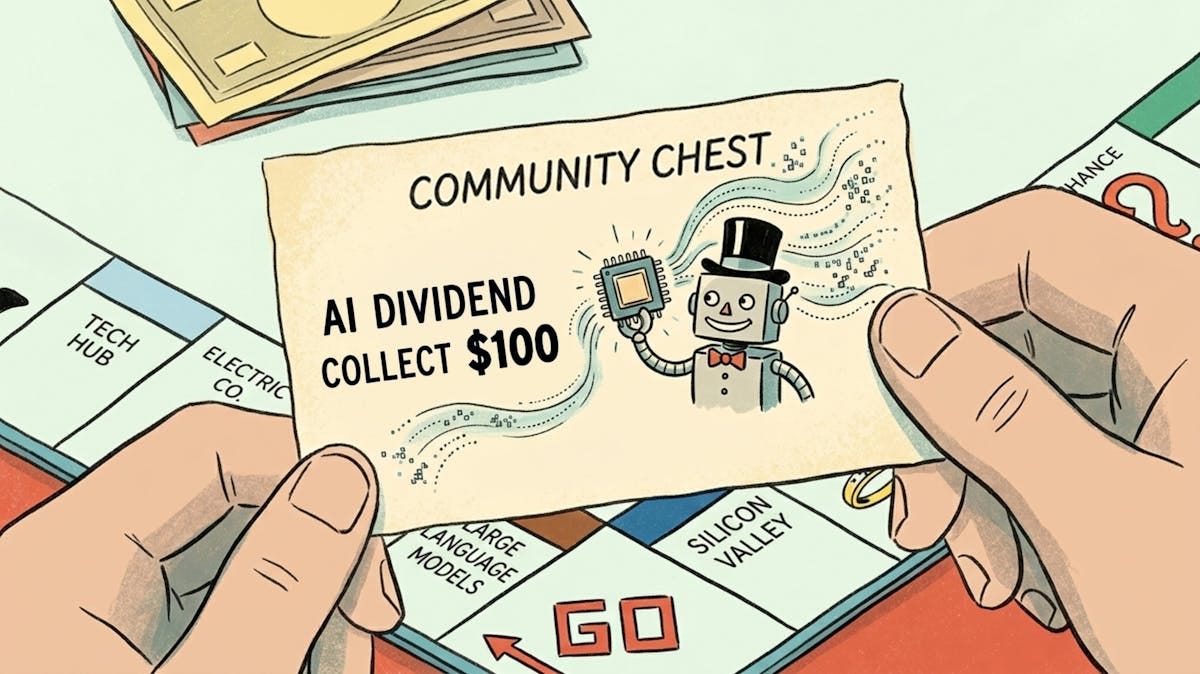
Scott Stanford argues that proposals to give the government a stake in AI companies miss the point unless ordinary citizens directly receive and control the upside. Sam Altman has discussed giving up equity in OpenAI, Washington already owns a stake in Intel, Nvidia is sharing China chip revenue, and Bernie Sanders wants large AI labs to contribute half their stock to a sovereign wealth fund. Stanford says those ideas all park value with the state, not with people.
The killer detail is New Carlisle, Indiana, where AWS’s Project Rainier is turning cornfields into one of the world’s largest AI superclusters. The project is planned to run up to a million chips, draw more than two gigawatts of power, and represents an investment that has grown from $11 billion to $13.8 billion. Stanford uses that local transformation to argue that AI’s public bargain should be visible at the household level.
The pull is design. A citizen AI dividend would have to specify who earns a stake, how they hold it, and when they see cash. Without that mechanism, the AI wealth debate remains a fight over government balance sheets rather than public ownership.
Read more: Source
Who Gets to Define the Frontier?
Author: Mark Daley Published: July 14, 2026

Mark Daley argues that Demis Hassabis is right to call for a serious institution to verify frontier AI systems, but that the power to test models is also the power to govern them. Hassabis’s proposed Frontier AI Standards Body would get privileged pre-release access to advanced models, testing compute, held-out evaluations, support from national labs and security agencies, third-party auditors, and eventually authority to block models from the American market or coordinate a slowdown.
The killer detail is Daley’s constitutional objection. He says the proposal sometimes looks like a scientific lab, a standards body, an industry regulator, a licensing authority, and an emergency security council at once. Combining those roles because each requires technical expertise would be like putting the central bank, auditor-general, and Supreme Court in one building and calling it efficient.
The pull is standard-setting. Daley’s concern is not that verification is unnecessary, but that whoever writes the tests, decides what passes, adjudicates disputes, and grants market access may end up defining the frontier itself.
Read more: Source
GPT-Red: Unlocking Self-Improvement for Robustness
OpenAI | OpenAI | July 15, 2026
OpenAI describes GPT-Red as an internal automated red-teaming model trained to find prompt-injection vulnerabilities at a scale human red teams cannot match. The post says AI systems increasingly encounter third-party data through browsers, connected apps, local files, and tools, creating opportunities for malicious instructions hidden in emails, webpages, tool responses, or code repositories. Human red-teaming remains part of OpenAI’s safety process, but the company says it is time-intensive and cannot generate enough diverse adversarial examples for model training.
The system is trained through self-play reinforcement learning, with GPT-Red rewarded for eliciting valid failures and defender models rewarded for resisting attacks while still completing their tasks. OpenAI says the training environments specify threat models across settings such as local files, webpage banners, email bodies, and tool outputs. The model is kept separate from deployed production models because it is intentionally trained with malicious capabilities.
OpenAI reports that GPT-Red generalized beyond its training set, including an internal replication of the indirect prompt-injection arena from Dziemian et al. (2025), where it found successful attacks in 84% of scenarios compared with 13% for human red-teamers. The post also says GPT-Red transferred attacks from simulation to a live autonomous vending-machine agent, causing price changes and order cancellations, and outperformed a prompted GPT-5.5 baseline against a Codex CLI agent on held-out data-exfiltration tasks.
The article’s main robustness claim is that OpenAI has used GPT-Red and predecessor models in training since GPT-5.3, with later GPT releases becoming more resistant to prompt injections. It says GPT-5.6 Sol has six times fewer failures on OpenAI’s hardest direct prompt-injection benchmark than the best production model from four months earlier, that a “Fake Chain-of-Thought” attack class fell from more than 95% success against GPT-5.1 to below 10% against GPT-5.6 Sol, and that GPT-5.6 Sol fails on only 0.05% of GPT-Red’s direct prompt injections. OpenAI says general capabilities and targeted over-refusal evaluations were not harmed, and says a preprint with more details will follow.
Anthropic, Blackstone bet the next trillion-dollar AI business is implementation, not just models
Rebecca Bellan | TechCrunch | July 15, 2026
Rebecca Bellan reports that Ode with Anthropic is the $1.5 billion AI implementation company launched by Anthropic with Blackstone, Hellman & Friedman, Goldman Sachs, and other backers. The article says the venture reflects a growing belief among frontier AI labs that enterprise adoption requires more than better models: customers need engineers who can embed inside businesses and turn AI into working systems.
Ode was originally conceived by Blackstone after it used both large consulting firms and smaller AI services boutiques across its portfolio companies. TechCrunch reports that Fractional AI, an AI engineering services startup, stood out and was acquired by the joint venture shortly after the venture was announced. Fractional now forms the foundation of Ode, which has 100 engineers and works closely with Anthropic’s applied AI team to identify where the technology can affect specific businesses.
Ode CEO Chris Taylor tells TechCrunch that the company could someday become a trillion-dollar business if it scales without losing quality. He says an ideal customer is one whose CEO treats the AI project as a top one or two priority, whether it is a major product feature or the reworking of a core business process. Ode will operate under a “Claude-first” principle, using Anthropic technology whenever possible, but the article says it can use rival AI products when needed.
The article’s central implementation argument comes from Ode chief technologist Eddie Siegel, who says model selection matters but is not where most of the engineering effort goes. He compares it to the choice of programming language in software: one ingredient in a system that still has to be engineered. Bellan writes that Ode’s challenge is hiring and training enough elite generalist engineers, many of them former founders, while competing with OpenAI’s The Deployment Company and consulting giants that have built their own forward-deployed engineering teams.
Vint Cerf is working on a plan to unleash AI agents on the open internet
Tim Fernholz | TechCrunch | July 15, 2026

Tim Fernholz reports that Vint Cerf, after leaving Google, is advising Innovation Labs on an open architecture for identifying AI agents online. Innovation Labs is a subsidiary of Identity Digital, a DNS registry company, and its proposal is to use domain-name infrastructure as part of a system for agent identity, accountability, and auditability. The premise is that agents will need a way to identify themselves if they move beyond proprietary systems and begin interacting across the open internet.
The concrete proposal is DNSid, a registry that links an AI agent to an existing internet domain and uses cryptographic proofs to log its registration over time. Innovation Labs says it is trialing the standard with unnamed hyperscalers and identity companies. Cerf frames the problem around authority and accountability: what authority an agent has, where that authority came from, who is accountable for the agent’s behavior, how its identity is established, and why anyone should trust it.
The article’s caveat is that standards are still emerging and agents are more active than static domains. Cerf says the period may be both fascinating and exasperating because the functionality is powerful and interoperability is unresolved. He compares the adoption problem to TCP/IP: competing systems may not work together until users push for functional interoperation. He also says an agentic economy is not inevitable, but that people will try to build it because delegating work to agents will be easier.
Read more: TechCrunch
xai-org/grok-build, now open source
Author: Simon Willison Published: July 15, 2026
Simon Willison argues that xAI’s decision to open-source Grok Build is best understood as a trust repair move after a severe privacy failure. The CLI had triggered backlash when users realized that running it in a directory could upload the entire directory to xAI’s Google Cloud buckets, including one user’s reported SSH keys, password manager database, documents, photos, and videos. xAI disabled the feature, said previously retained coding data would be deleted, and released the code under Apache 2.0.
The killer detail is what the codebase reveals. Willison counts 844,530 lines of Rust, only about 3% of which appears vendored, and finds remnants of the upload system still present but disabled: gcs.rs contains Google Cloud upload code, while upload_session_state() now returns a hard-coded session_state_upload_unavailable error. He also notes copied or ported tool implementations from Codex and OpenCode, prompt files, and a terminal Mermaid renderer.
The pull is that terminal coding agents are becoming large, intricate software systems in their own right. The privacy failure mattered because these tools operate inside the directories where developers keep their most sensitive work; the open-source release matters because trust now depends on inspecting what an agent can see, send, and do.
Read more: Source
The Pulse: What can we learn from Bun’s rapid Rust rewrite with AI?
Author: Gergely Orosz and Ivan Klaric Published: July 16, 2026

Gergely Orosz and Ivan Klaric argue that Bun’s AI-assisted rewrite from Zig to Rust is a practical sign of how software engineering changes when models can take on large, bounded migrations with clear feedback loops. The piece does not treat the rewrite as magic: Jarred Sumner first spent hours turning design judgment into a detailed porting guide, then used adversarial review, parallel agents, compiler errors, and tests to force the work toward correctness.
The killer detail is the scale. Bun had 535,496 lines of Zig, 1,448 files, and 22 million monthly downloads, making a conventional rewrite a year-long freeze the team could not justify. Using Fable, Sumner split the work across 64 agents, produced about 6,500 commits, and got the migration done in 11 days at an estimated API cost of $165,000.
The pull is economic, not theatrical. If a one- or two-year migration can become an 11-day project, AI coding is not just faster autocomplete; it changes which technical debts are worth paying down.
Read more: Source
Orphan risks at the frontier of artificial intelligence
Author: Andrew Maynard Published: July 16, 2026

Andrew Maynard argues that frontier AI safety frameworks are creating “orphan risks”: harms that companies can see, but do not formally own because they are hard to quantify, do not fit catastrophic-risk thresholds, or fall outside audit-friendly compliance machinery. His target is not existing frontier safety work, but the narrowing effect that happens when private companies decide which risks count as governable.
The killer detail is Maynard’s contrast between measurable model dangers and threats to value. He points to Meta’s three-day Galactica collapse, OpenAI’s 2023 board crisis, safety-team departures, and wellbeing litigation as examples of risks that damaged trust, culture, legitimacy, or users without fitting cleanly into conventional model-risk categories. The proposed fix is an orphan-risk register: a public record of risks a company considered and chose not to manage, with reasons.
The pull is accountability. Frontier developers’ internal scoping choices have become a de facto layer of public governance, so the question is no longer only which risks they manage, but which risks they quietly leave outside the frame.
Read more: Source
The Lab of the Future Should Feel Like a Data Center
Latent.Space with Andy Beam and Rafa Gomez-Bombarelli | Latent.Space | July 16, 2026
Latent.Space interviews Lila Sciences CTO Andy Beam and chief science officer for physical sciences Rafa Gomez-Bombarelli about the company’s attempt to build an AI-run science factory. The post describes Lila’s thesis as treating the lab itself as an “infinite token generator”: if internet data drove the first era of AI scaling, experimentally verified scientific data may be the next scarce training source. Lila is trying to produce that data with robotics, lab instruments, orchestration software, and AI models wired into the wet lab.
The central analogy is the lab as data center. Instruments are nodes on a graph, a magnetically levitating transport layer moves materials between them, and experiment scheduling looks like a compute queue. Beam says Lila is not simply an automation company, because the point is not just throughput; it is flexibility, generalization, and experiment capture. The post says Lila has built more than 10 trillion experimentally validated “scientific reasoning tokens,” not internet text or biological sequences.
The interview ranges across biology, chemistry, drug discovery, materials science, and the limits of automation. It notes that Lila rebuilt one gas-sorption measurement to run roughly 2,500 times faster, claims its general models can transfer priors from small-molecule chemistry to metal-organic frameworks for carbon capture, and describes model-suggested platinum-group-free electrocatalysts that moved from looking boring or wrong to becoming strong performers. The caveats are physical: experiments have runtimes, biology cannot always be accelerated, chains of thought can be unreliable narrators, and reward hacking becomes more dangerous when a model controls a real lab.
Read more: Latent.Space
Why AMI Labs’ Alexandre LeBrun won’t call his AI “AGI” or “superintelligence”
Kate Park | TechCrunch | July 16, 2026
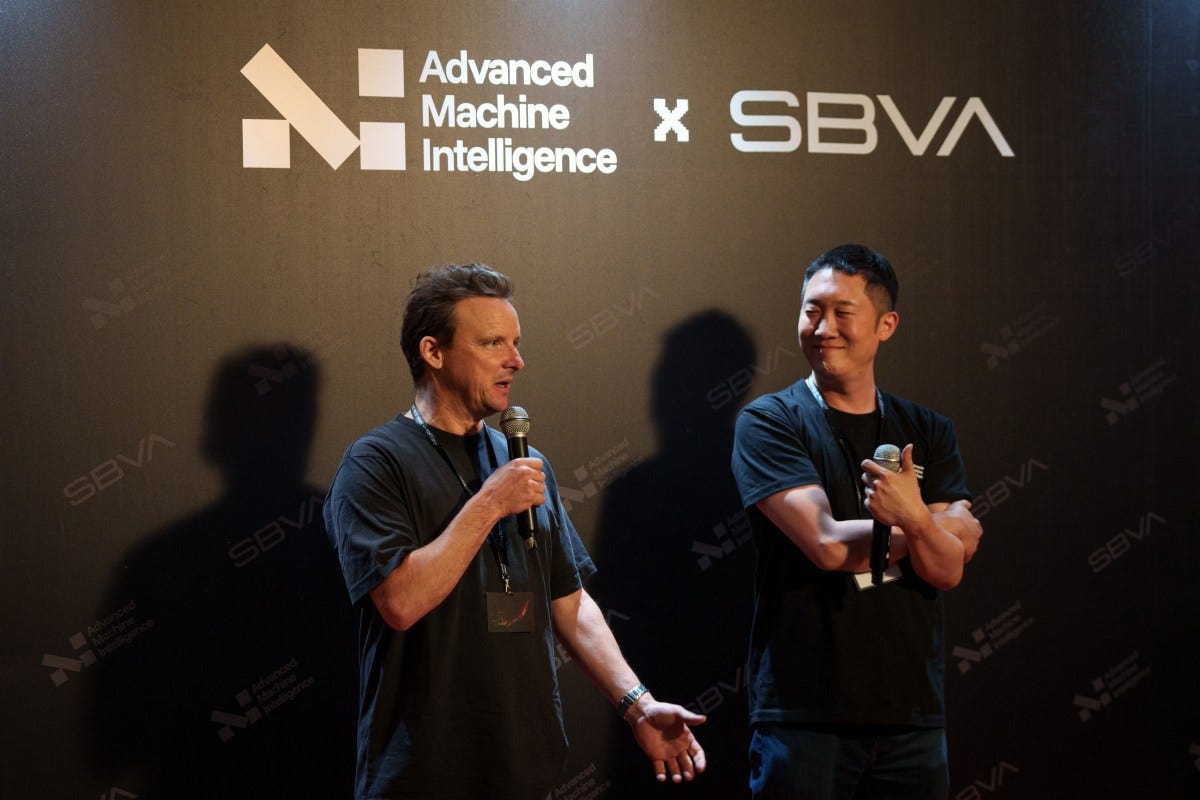
Kate Park interviews AMI Labs CEO Alexandre LeBrun about why Yann LeCun’s world-model startup avoids the language of “AGI” and “superintelligence.” LeBrun says the terms are not useful because they lack stable definitions: “We never used the word AGI. And I just noticed that nobody is using it anymore; they switched to superintelligence.” His argument is that the practical frontier is not a label, but whether AI systems can understand and predict real-world states.
The article explains the world-model thesis by contrasting language prediction with physical-state prediction. A large language model predicts the next word; a world model predicts the next state, such as what happens when a glass tips over. LeBrun says LLMs remain complementary and efficient for language, but the physical world is where current AI is weak. Robotics is the clearest case: hardware has advanced quickly, but robots are still brittle outside controlled routines because they lack context and situational understanding.
AMI is still pre-product, but TechCrunch reports that LeBrun was in Seoul looking for industrial partners, researchers, and global companies. He says world models cannot be built entirely inside a lab because they need access to real environments. That is why South Korea appeals to AMI: robotics, semiconductors, manufacturing, and fast adoption create the kind of hardware-heavy context that software-only AI has barely touched.
Read more: TechCrunch
Kimi K3 Tech Blog: Open Frontier Intelligence
Kimi | Kimi | July 16, 2026
Kimi introduces Kimi K3 as an open 3T-class frontier model aimed at coding, knowledge work, reasoning, multimodality, and long-context agentic use. The source describes the model as a 2.8T-parameter system built on Kimi Delta Attention and Attention Residuals, with native multimodality and a 1M-token context window. It says Moonshot AI plans to release model weights by July 27.
The post presents K3 through benchmark and use-case sections rather than as a general product announcement. It reports results across coding, productivity, agentic, and multimodal evaluations, including DeepSWE, Terminal-Bench 2.1, Program Bench, SWE Marathon, FrontierSWE, PostTrain Bench, OfficeQA Pro, SpreadsheetBench 2, MCP Atlas, AutomationBench, BrowseComp, GDPval-AA v2, AA-Briefcase, MMMU-Pro, MathVision, BabyVision, OmniDocBench, and PerceptionBench. The source says all reported K3 results use maximum reasoning effort with temperature and top-p set to 1.0, and that different benchmark comparisons use KimiCode, Claude Code, or Codex harnesses depending on the test.
Kimi’s caveats are unusually concrete. The limitations section says K3 was trained in preserved thinking-history mode, so quality may become unstable if an agent harness does not pass historical thinking content correctly or if an ongoing session switches to K3 midstream. It also says K3’s emphasis on long-horizon tasks can make it excessively proactive when it encounters minor issues or ambiguous intent, and recommends imposing explicit behavioral constraints for applications that require strict boundaries. The post adds that K3 remains behind Claude Fable 5 and GPT 5.6 Sol in user experience despite being competitive overall.
Venture Capital
Three Years In
Author: Tomasz Tunguz Published: July 10, 2026
Tomasz Tunguz marks Theory Ventures’ third anniversary by arguing that AI’s central market effect is time compression. In his telling, model release cycles, company revenue milestones, enterprise adoption, and venture categories have all accelerated. Seed, Series A, and Series B still exist as financing labels, but they no longer cleanly describe company maturity when some seed rounds are larger than IPOs and the best AI companies can mature much earlier than prior software companies.
The killer detail is the shift from models to inference. Tunguz argues that inference has become the dominant AI market because workloads and buyer preferences are fragmenting: video, batch, local, agentic, and real-time tasks each create different infrastructure needs. He compares this to databases splitting into OLTP, OLAP, vector, and streaming categories, with AI pushing the same specialization into inference infrastructure.
The pull is that Theory sees the AI-native venture firm as part of the same pattern. The firm says it has analyzed twice as many investment opportunities with three investors working alongside a nine-person intelligence organization, using agents and research systems to map markets, source companies, and support diligence. The piece is both a market map and a statement about how venture itself is being rebuilt by the technology it funds.
Read more: LinkedIn
Venture Has Rarely Looked More Bifurcated
Author: Beezer Clarkson Published: July 14, 2026

Beezer Clarkson points to PitchBook’s Q2 report as evidence that the U.S. venture market has split into two very different realities. AI now accounts for more than 60 percent of all U.S. venture deal value, meaning the headline market can look active and well-funded even while much of the non-AI market is dealing with a much colder liquidity and fundraising environment.
The thread uses that split as the setup for Clarkson’s latest Origins episode with Alec Litowitz, founder of Magnetar and QStar Capital and one of Citadel’s original founding partners. Clarkson says markets like this are periods of genuine uncertainty, not merely ordinary risk, which is why Litowitz’s Adaptability Quotient framework is relevant.
The embedded clip makes the liquidity point concrete. Litowitz says DPI is “the resolution of uncertainty” because it converts an uncertain investment into actual cash returned to LPs. In his framing, a realized dollar is a real mark, while TVPI remains uncertain until it is realized.
The killer detail is the distinction between pricing risk and resolving uncertainty. Litowitz’s perspective matters because QStar is a SpaceX investor and Clarkson says the conversation happened just before one of venture’s most consequential IPOs. The episode’s stated questions are why venture remains a way to gain exposure to innovation, how AI is changing what is investable, why liquidity is ultimately a function of time, and why uncertainty requires a different decision framework from risk.
Read more: X
The Best Angel Investors in the US: Who Backs the Most Unicorns, and Who’s Active Now
Author: Ilya Strebulaev Published: July 10, 2026
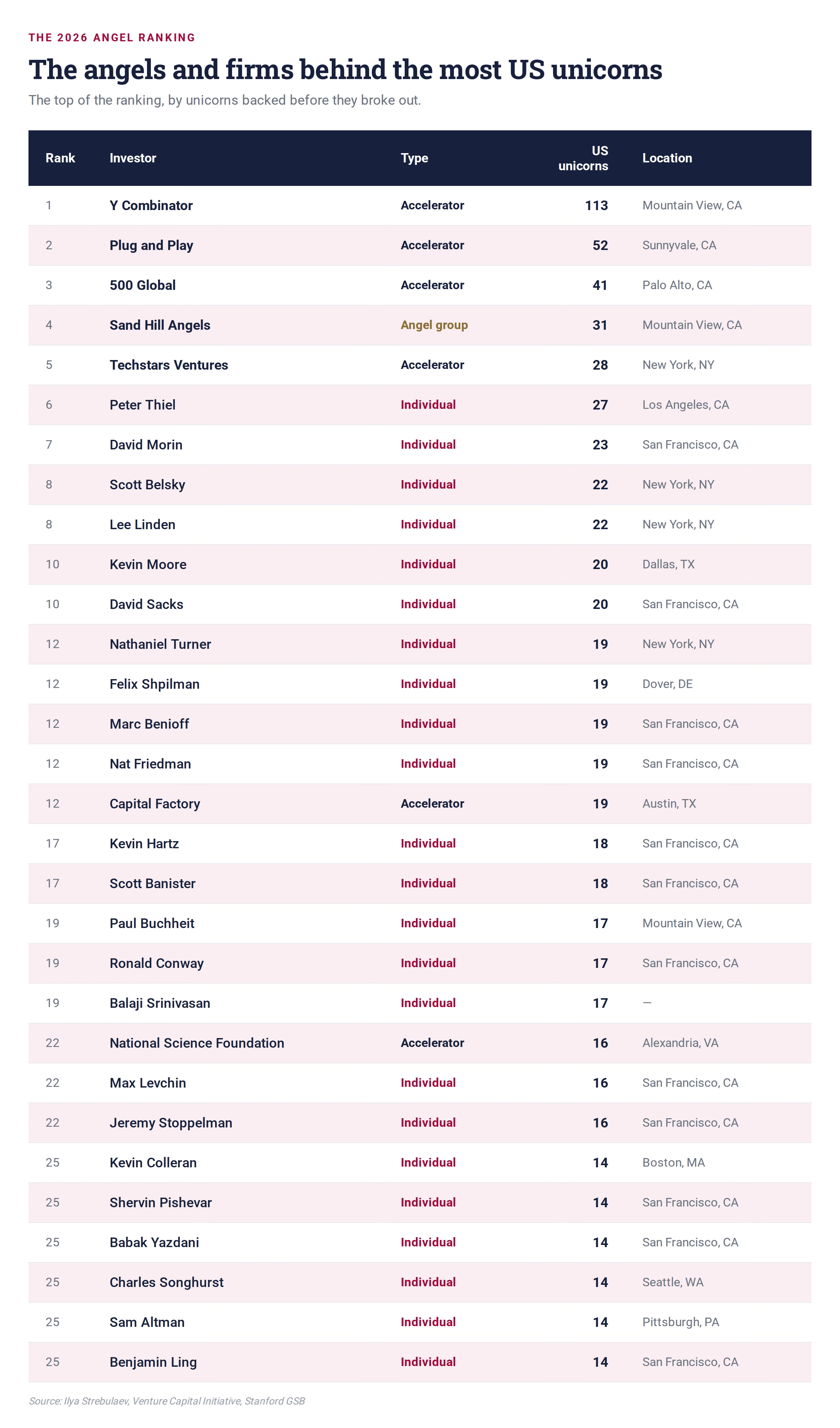
Ilya Strebulaev ranks angels, angel groups, accelerators, and incubators by lifetime U.S. unicorn investments, counting checks written before a company reached unicorn status. The top of the combined list is dominated by organizations: Y Combinator leads with 113 unicorn investments, followed by Plug and Play at 52 and 500 Global at 41. Sand Hill Angels is the highest-ranked angel group at 31.
The killer detail is how quickly the list changes below the biggest accelerators. Strebulaev says 271 of the 304 investors in the Top 200 are individuals, or 89%. In the top 100, individuals are 91%. That makes the market underneath the large accelerator counts look much more personal: mostly operators and individual angels writing early checks from their own networks.
The pull is the ranking’s own caveat. Strebulaev writes that every lifetime leaderboard has a blind spot because many of the unicorns behind those totals were founded a decade or more ago, and some angels have since moved into formal funds, slowed down, or stopped investing. His post therefore separates lifetime performance from recent cohorts, including companies founded in 2015 or later and 2020 or later. For founders or allocators making current decisions, that distinction matters: a career record and a current record are not the same measure.
Read more: Ilya Strebulaev
Are Prediction Markets Doomed to Fail?
Author: Contrary Published: July 16, 2026

Contrary argues that prediction markets’ current boom depends on whether platforms can prove they are more than regulated gambling with exchange-style branding. Kalshi and Polymarket have reached mass cultural, investor, and regulatory attention, but the article says the underlying idea is old: academic markets, corporate forecasting tools, Intrade, PredictIt, and other predecessors all struggled with the same linked problems of liquidity, legality, and user appeal.
The killer detail is the comparison with sportsbooks. Prediction markets present themselves as peer-to-peer, transparent, and non-house-based, but sports contracts reportedly account for more than 90 percent of Kalshi trading, and the article says the platforms keep a much thinner slice of volume than sportsbooks. A market can therefore show sports-betting-scale handle while generating far less revenue.
The pull is that the product’s hardest problem may be distribution of wins. If a small group of sharp traders captures most profits while casual users lose interest, prediction markets may become valuable data feeds and professional tools before they become durable consumer networks.
Read more: Source
Regulation
Exclusive: The Next Frontier of the Deportation Wars: College Campuses
Author: Adrian Carrasquillo Published: July 11, 2026

Adrian Carrasquillo reports that college campuses are becoming a new front in the fight over immigration enforcement because automatic license plate readers can turn ordinary campus security infrastructure into searchable location data. His thesis is that Flock Safety’s camera network, even without direct ICE or DHS contracts, can feed deportation enforcement through local police partnerships and data-sharing practices.
The killer detail is the campaign target. The Emergency Campaign to Support Higher Education, working with Schools Drop ICE, is focusing on 75 colleges and universities publicly identified as having Flock contracts. Flock says it has no ICE or DHS contracts, but activists argue the risk comes through local agencies that coordinate with federal authorities and run searches on their behalf.
The pull is broader than immigration. Carrasquillo notes that license plate readers have already been abused by officers for stalking, and that Flock’s AI search features can identify more than plates, including bumper stickers. A campus safety tool can become a political surveillance system when the data layer is searchable.
Read more: The Bulwark
The Supreme Court Broke Independent Agencies. Here’s a Way to Slow the Damage.
Author: Todd Phillips Published: July 12, 2026

Todd Phillips argues that the Supreme Court’s decision in Trump v. Slaughter damaged independent agencies by ending for-cause removal protections, but did not leave Congress powerless. The ruling weakens the old model in which commissioners at bodies such as the FTC, NLRB, CPSC, SEC, and CFTC could be insulated from dismissal over policy disagreements. Phillips says the next fight is whether presidents can turn nominally bipartisan commissions into one-party instruments.
The killer detail is the procedural fix: quorum rules. Phillips proposes that Congress require bipartisan slates of commissioners to be seated before independent agencies can act. A president could still fire commissioners, as the Court now permits, but if those firings broke quorum, the agency would be unable to proceed until replacements were confirmed. The guardrail would operate through institutional design rather than a direct limit on removal.
The pull is his test case, the CLARITY Act, a crypto-market structure bill that would hand major rulemaking authority to the SEC and CFTC. Phillips says senators should not give those agencies sweeping authority over digital assets unless the bill preserves some bipartisan agency function after Slaughter.
Read more: Source
India’s crackdown on a new WhatsApp feature risks setting a global precedent
Author: Faisal Mahmud Published: July 13, 2026
Faisal Mahmud reports that India’s government is challenging WhatsApp’s new username feature before it is fully live, raising a product-design fight with global privacy consequences. WhatsApp began rolling out usernames on June 29 so users can chat without sharing phone numbers. India argues that pseudonymous accounts could aid impersonation, scams, and financial fraud, and has also asked Telegram and Signal to explain their username systems.
The article’s central concern is precedent. Access Now’s Namrata Maheshwari tells Rest of World that if WhatsApp modifies or scraps the feature in India, other governments may copy the demand once they see it is technically possible. Experts quoted in the piece say India has not shown evidence that usernames increase cybercrime, and Bruce Schneier argues that the misuse risk is true of all infrastructure, including email and phones. EFF’s Erica Portnoy says usernames can protect people who need to separate online identity from real-world identity, including users facing harassment or political retaliation.
WhatsApp says users will still need phone numbers to use the service and that it has built protections against impersonation, including reserving high-profile names, blocking lookalikes, requiring exact usernames for first contact, offering optional username keys, limiting new-contact outreach, and detecting abuse patterns. The article’s caveat is that India has previously pushed WhatsApp on forwarding limits, labels, law-enforcement requests, and traceability. But this case is different because it objects to a design feature before harm has occurred, which Internet Freedom Foundation’s Apar Gupta says no law authorizes.
Read more: Source
Let’s build a children’s public internet
Author: Adi Robertson Published: July 14, 2026

Adi Robertson argues that child-safety regulation is too focused on keeping minors off the internet and too little focused on building better places for them to go. The article begins with the current policy climate: countries are experimenting with age verification and bans, the U.S. House passed the Kids Internet and Digital Safety Act, and Pew found majority support for banning social media under 16. Robertson says the alternative is to tax major tech companies and fund a nonprofit “children’s public internet.”
The proposal is modeled less on a separate national network than on public media or Ben Tarnoff’s idea of a public lane on the information superhighway. Eligible services would primarily serve children and would not operate for profit. Robertson’s examples include a library-run Mastodon instance, an open-source non-monetized Roblox-like space, ad-free youth news and educational sites, privacy-preserving reverse age verification for kid-focused spaces, local family-activity portals, and volunteer moderation for children’s craft forums.
The article’s evidence against the ban-first approach is practical as much as philosophical. Robertson says commercial social networks are shaped by engagement, advertising, data collection, low-cost moderation, microtransactions, and AI spending, while age gates are both easy to evade and risky for privacy. Australia’s teen social-media ban is cited as a warning, with one study suggesting more than 80 percent of kids retained access. The caveat is that a public internet would still face moderation, security, grant-making, oversight, and culture-war fights. Robertson’s answer is that those failures would likely be less harmful than the commercial alternatives, and that open-source, nonprofit public services could also model a better internet for adults.
Read more: The Verge
Computer cops
Webb Wright | The Verge | July 16, 2026

Webb Wright reports from the International Association of Chiefs of Police Technology Conference on the growing market for AI in law enforcement. The article says the pitch is familiar from enterprise software, automate routine work so humans can focus on higher-value tasks, but that police “busywork” includes reports, case histories, dispatch summaries, and other steps that affect legal outcomes and people’s lives.
The report describes a stack that now includes facial-recognition cameras, automated license plate readers, body cameras, chatbots for non-emergency 911 calls, gunshot detection, drones, AI report writing, and real-time crime centers. Wright says companies are selling police departments automated “digital brains” that aggregate the data produced by other surveillance tools and recommend how departments should allocate attention and resources. Police captain Abrem Ayana tells The Verge that much of the market is “sales gimmicks” and that agencies often have to trust vendors because federal oversight, industry standards, and evaluation methods are thin.
The article’s main business point is platform control. Axon, Motorola Solutions, Flock Safety, and startups such as ForceMetrics are competing to own more of the police technology stack, from data collection to AI decision support. Axon’s AI Era Plan subscriptions reportedly grew 140 percent year over year, and Axon said AI product revenue grew 700 percent. Legal experts and public-safety advocates quoted in the piece warn that black-box systems could reduce transparency and accountability, while even vendor safeguards such as AI report-writing blanks do not eliminate hallucination risk. Wright cites one Draft One incident in which a report said an officer had morphed into a frog after body-camera audio picked up a Disney movie.
Read more: The Verge
Google is better at playing the AI regulations game
Robert Hart | The Verge | July 16, 2026

Robert Hart reports that the European Commission has ordered Google to give rival AI assistants comparable Android system and data access to what Gemini receives, while also giving Google until July 2027 to comply. The decision comes under the EU’s Digital Markets Act, which requires gatekeeper platforms to make certain systems and data available to competitors on similar terms.
The article’s comparison is Google versus Apple. Google opposes opening its systems and argues that interoperability could hurt privacy, safety, and security, but Gemini remains available in Europe while Google negotiates technical compliance. Apple, by contrast, said its new Siri AI would not launch in Europe because the DMA would require comparable access for third-party assistants. Apple asked for 18 months and a gradual rollout, but the Commission rejected that proposal.
Hart presents the timing as a strategic advantage for Google. Gemini is already deeply integrated into Android and widely distributed, and the grace period gives Google a year to keep expanding it while the compliance details are worked out. Apple has turned Siri AI’s absence into a public argument against the DMA, including WWDC messaging and a blog post blaming European rules. The article notes that both companies share similar objections to the DMA, but for now Google’s ship-first posture has left it with a product in market while Apple’s EU launch remains uncertain.
Read more: The Verge
Infrastructure
Who Captures Value in AI Infrastructure?
Author: Chris Zeoli Published: July 13, 2026
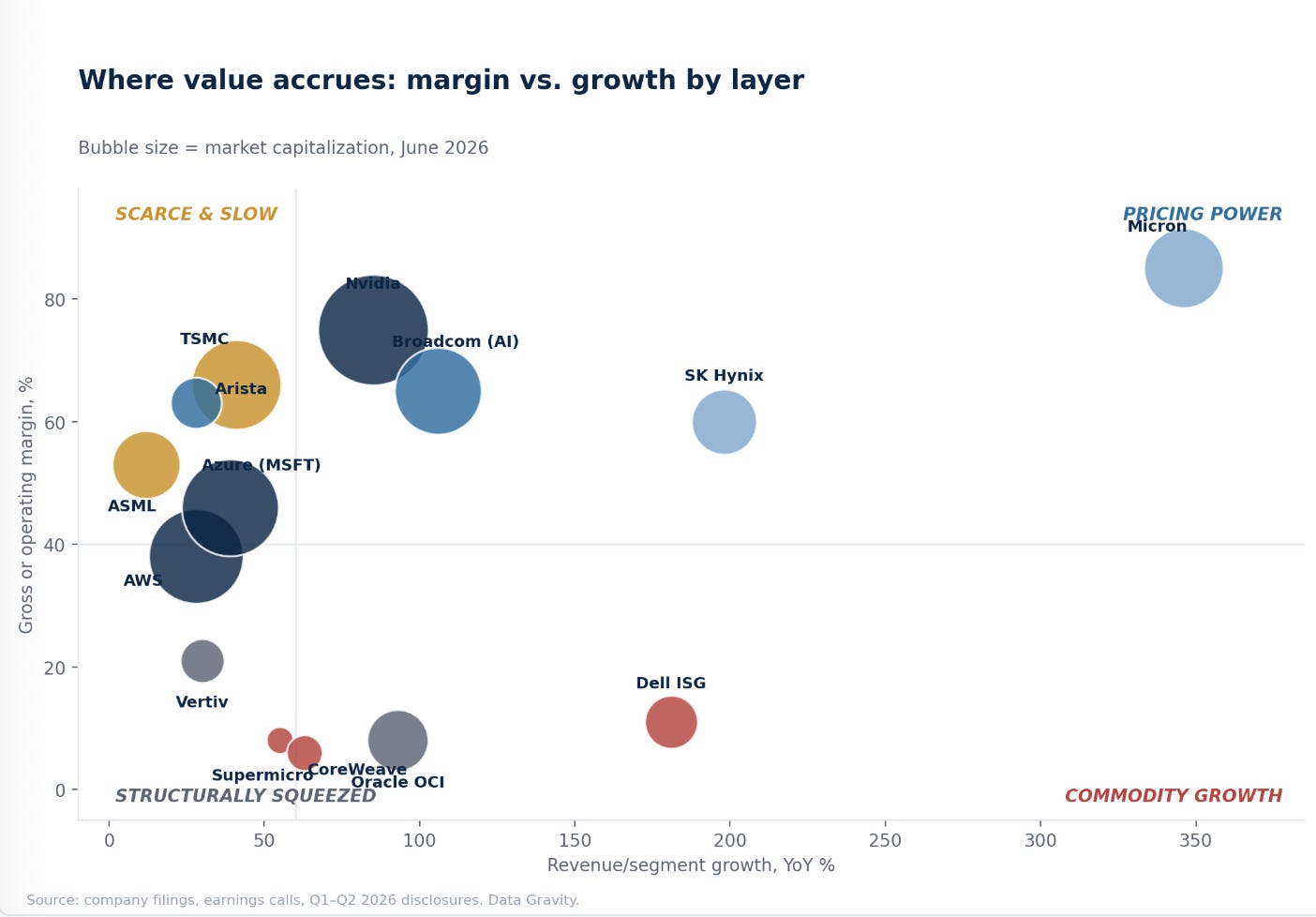
Chris Zeoli maps the AI infrastructure boom by asking which layers capture durable profit rather than just revenue. His starting example is a Blackwell GPU: he estimates Nvidia’s build cost at roughly $6,400, with HBM memory making up about 45 percent, while the chip sells for $30,000 to $40,000. That 5x to 6x spread, he says, shows how much value accrues at the design layer.
The post says six buyers, Microsoft, Amazon, Alphabet, Meta, Oracle, and CoreWeave, will deploy more than $760 billion of capex in 2026, up from $410 billion in 2025. But the profit pools concentrate in chokepoints: chip design, advanced foundry, EUV lithography, HBM memory, and networking. Nvidia, TSMC, ASML, SK Hynix, Micron, Arista, and Broadcom sit closer to scarcity and pricing power, while assembly and rental businesses such as Dell, Supermicro, and CoreWeave handle large capital flows with far thinner margins.
Zeoli’s historical analogy is the late-1990s fiber buildout. The internet thesis was correct, but the operators who financed excess capacity often failed, while some equipment suppliers captured durable value. His caveat is that AI demand has so far absorbed efficiency gains rather than being killed by them: inference cost per token has fallen roughly 99.7 percent since 2023, yet hyperscaler capex is still rising sharply. The conclusion is a framework, not a blanket AI-infrastructure endorsement: favor durable-moat layers, treat HBM as profitable but cyclical, and underwrite commodity assembly and neocloud businesses carefully.
Read more: Source
New York becomes the first state to enact a data center moratorium
Author: Lauren Feiner Published: July 14, 2026

Lauren Feiner reports that New York Governor Kathy Hochul has signed the first statewide moratorium on new hyperscale data centers, pausing environmental permits for projects above 50 megawatts for up to one year. The order is framed as time for the state to write standards for environmental and energy impacts, including water use, air quality, and pressure on utility bills. A broader bill passed by the legislature, with a 20-megawatt threshold, is still awaiting Hochul’s decision.
The report distinguishes the executive order from the pending bill. Hochul’s office says the higher 50-megawatt cutoff is meant to avoid disrupting smaller institutional data centers, such as those used by hospitals, but could not immediately identify how many proposals would be affected. The Department of Public Service is asked to assess operating and construction impacts, consider ways data centers could invest in state energy infrastructure, and help local communities negotiate benefits when developers come to town.
The broader context is the AI-driven infrastructure buildout. Feiner notes that Maine nearly passed a data center moratorium before its governor vetoed it in April, and that communities around the country are wrestling with energy prices, environmental effects, and public subsidies for data centers. Hochul also said she would push lawmakers to roll back sales-tax exemptions for large data centers that fail to meet clean-energy and community-benefit standards.
Read more: The Verge
Pollution from Musk’s unpermitted xAI power project hits hardest in Black communities
Author: Disha Raychaudhuri and Valerie Volcovici Published: July 14, 2026

Reuters reports that xAI’s Colossus 2 data center is a test case for how quickly AI infrastructure can outrun environmental oversight. The company has installed 59 natural-gas turbines for the Tennessee project without federal clean-air permits, according to regulator communications reviewed by Reuters, and the resulting pollution burden falls near predominantly Black communities with already elevated respiratory disease rates.
The killer detail is the emissions math. Reuters found that 30 of the turbines alone could emit nearly 2,500 short tons of nitrogen oxide, 4,000 short tons of carbon monoxide, and 22 short tons of formaldehyde annually if run continuously at 80 percent capacity. That would far exceed the Clean Air Act’s permitting threshold for facilities capable of emitting more than 100 short tons of pollutants such as nitrogen oxide each year. The 59 turbines are also about double the number xAI had publicly acknowledged.
The pull is legal and institutional. Civil-rights groups say the turbines are operating illegally; Mississippi regulators say temporary units do not need permits; the EPA has said temporary turbines above thresholds still require permits while considering flexibility. The case may help define whether AI’s energy buildout gets normal environmental review or a faster track with public-health costs handled after the fact.
Read more: Reuters
Interview of the Week
The End of the End of Geography
Andrew Keen with Mehran Gul | Keen On America | July 10, 2026


Andrew Keen interviews Geneva-based innovation geographer Mehran Gul about why the digital revolution did not end geography after all. Gul’s argument is that the promise that anyone could invent anything from anywhere has not survived contact with the evidence. He began expecting to find ten or twelve countries able to innovate competitively with the United States and China, but says he instead found a world of niche players, extensions of the U.S.-centric system, and two real innovation powers.
The interview’s central contrast is Europe versus the United States and China. Gul says Europe is increasingly a renter rather than an owner of American technology. Keen’s summary uses the PayPal and Skype exits as a concrete comparison: PayPal’s public offering minted about 160 millionaires who later helped build companies such as SpaceX, Tesla, LinkedIn, and Palantir, while Skype’s exit at a similar value minted 11. Gul also argues that AI has intensified the divergence, with about half of last year’s key research papers coming from China, 40 percent from America, and 4 percent from Europe.
Keen frames the conversation as the “end of the end of geography.” The old digital thesis said place mattered less; Gul says the new map of innovation shows place matters again, with China replacing Europe as America’s only serious competitor in radical invention.
Startup of the Week
Radical AI’s Joseph Krause: The Scientist Building The “Waymo” Lab For New Materials
Alex Konrad | Upstarts Media | July 10, 2026
YouTube:
Alex Konrad interviews Radical AI founder Joseph Krause about the company’s attempt to build an autonomous materials-science lab in Brooklyn’s Navy Yard. Krause describes materials science as a field that has not changed much in 150 years, even though aerospace, automotive, manufacturing, defense, climate, energy, semiconductors, and electronics all depend on materials R&D. His analogy is that many “autonomous labs” are closer to hands-free driving, while Radical AI is trying to build the Waymo version.
The company says it has already produced valuable, undisclosed alloys for customers since its 2024 founding, after raising a $55 million seed round from RTX Ventures, Nvidia, AlleyCorp, and others. Konrad contrasts that with rivals that have raised or sought far larger sums. Krause’s answer is that Radical AI’s edge is not simply robotic arms or automated tools, but the interdisciplinary team, lab workflow, experiment capture, and AI analysis systems that have to work together. He says that organizational and technical integration takes years to build and compounds as the company adds technology.
The origin story is that Krause, while in a PhD program and working at the U.S. Army Research Lab, cold-emailed 100 New York VCs and received an internship offer from AlleyCorp’s Kevin Ryan. Reviewing AI pitches pushed him and co-founder Jorge Colindres away from another software category and toward materials, where they believed AI could have a more fundamental effect. Krause’s long-term ambition is explicit: “When we put a civilization on Mars, the habitat that they’re living in will be made with Radical materials.”
Post of the Week
Marc Andreessen on AI Regulation
Author: Marc Andreessen Published: June 12, 2026

Marc Andreessen posts a long satirical riff on AI regulation, written as a parody of taking both sides of the argument at once. On one side, regulation is cast as the “devil’s firewall,” a red-tape machine that smothers coders, startups, GPUs, and invention. On the other, it is cast as safety theater, compliance industry, bureaucratic virtue, and a tax-and-fine apparatus that rewards incumbents and officials while slowing the people building the future.
The killer detail is the structure. Andreessen does not make a narrow policy case; he turns the whole debate into a farce in which both the monsters and the leashes are suspect. The result is useful less as regulation analysis than as a clear artifact of the Silicon Valley anti-regulatory temperament: the fear that AI oversight will become a tool for incumbency, moral preening, and bureaucratic capture before anyone really understands the technology.
The pull is how well it sits beside the open-letter debate. Where the economists ask policymakers to move faster and Andrew McAfee asks them to build response capacity before steering too hard, Andreessen gives the cultural version of the warning: if intelligence is being created at startup speed, regulation that arrives as process, permission, and compliance may decide who gets to build it.
Read more: X


